


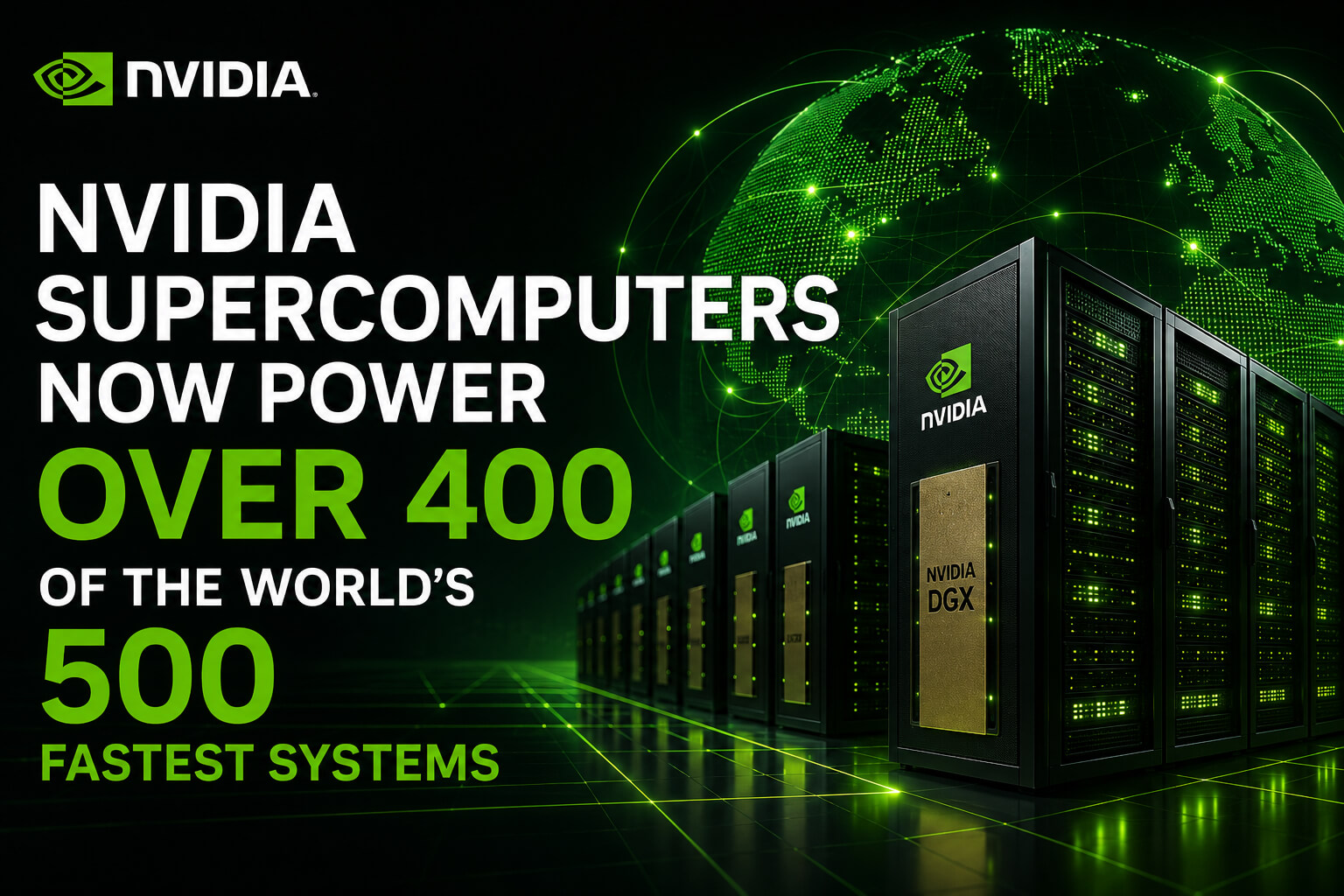
NVIDIA supercomputers now make up more than 400 of the world’s 500 fastest systems, marking another major milestone for accelerated computing, artificial intelligence and high-performance computing.
According to the latest TOP500 rankings released at ISC High Performance 2026 in Hamburg, Germany, NVIDIA technology now powers 81% of the TOP500 list. The company also said nearly 90% of the systems newly added to the ranking use NVIDIA technologies, showing how quickly AI-focused computing architectures are becoming the standard for scientific and industrial workloads.
The latest figures highlight NVIDIA’s growing role in global supercomputing. The company’s platforms are no longer limited to GPUs alone. NVIDIA’s footprint now covers processors, networking, AI infrastructure and energy-efficient system design.
NVIDIA Supercomputers Expand Across the TOP500 List
The TOP500 list ranks the world’s fastest supercomputers and is updated twice a year. The latest ranking shows that NVIDIA technologies are now used in more than 400 systems, up 17 systems from the previous list.
NVIDIA GPUs accelerate a record 238 systems on the TOP500. At the same time, NVIDIA networking connects 376 systems, with many relying on NVIDIA Quantum InfiniBand to support large-scale AI and high-performance computing workloads.
This matters because modern supercomputers are increasingly being built for more than traditional simulation. Research centers, universities, governments and enterprises now need machines that can handle AI training, AI inference, scientific modeling, climate research, physics, biology and engineering workloads at the same time.
NVIDIA said its systems across the TOP500 now deliver more than twice the AI training performance and nearly three times the AI inference throughput of every other platform combined.
Grace CPU Adoption Continues to Grow
NVIDIA’s Grace CPU is also gaining traction in the supercomputing market. The latest TOP500 list includes 26 systems using the NVIDIA Grace CPU, an increase of eight systems from the previous ranking.
Grace is part of NVIDIA’s broader strategy to deliver a full-stack computing platform for AI and scientific workloads. The company said it has now shipped nearly 2.5 million Grace CPUs.
Several leading systems use the NVIDIA Grace Hopper Superchip, which combines an NVIDIA GPU with the Grace CPU. This architecture allows the CPU and GPU to share memory more efficiently, helping support memory-intensive AI and scientific applications.
Grace-based systems also appear near the top of major rankings. JUPITER ranks No. 5 on the TOP500, while Alps ranks No. 10. Both systems use NVIDIA Grace Hopper technology.
NVIDIA Leads the Green500 Energy Efficiency Ranking
NVIDIA also posted strong results on the Green500, which ranks supercomputers by energy efficiency.
The top eight systems on the Green500 run on NVIDIA GPUs, while nine of the top 10 use NVIDIA technologies. The No. 1 system, KAIROS, is based at the University of Toulouse in France and uses a single NVIDIA Grace Hopper Superchip.
KAIROS delivers about 73.3 gigaflops per watt, making it the most energy-efficient supercomputer in the latest Green500 ranking.
Energy efficiency is becoming increasingly important as AI infrastructure expands worldwide. As organizations build larger AI factories and supercomputing centers, power consumption, cooling and sustainability have become critical design concerns.
NVIDIA’s Green500 performance shows that accelerated computing is not only about speed. It is also becoming central to building more efficient AI and scientific computing systems.
Europe Builds More NVIDIA AI Supercomputers
NVIDIA also highlighted growing supercomputing activity in Europe. A record 35 NVIDIA AI HPC supercomputers are now in development across the region.
These systems are expected to support more than 3 million researchers working across AI, science and industrial innovation. One of the most notable systems is JUPITER, located at the Jülich Supercomputing Centre in Germany.
JUPITER is Europe’s fastest supercomputer and its first system to reach exascale performance. The system is being used for major scientific workloads, including human brain mapping, climate simulation and research related to next-generation 6G networks.
Blackwell Systems Enter the Rankings
The latest TOP500 list also includes new systems based on NVIDIA Blackwell architecture. B200 and GB200 systems entered the rankings across Asia, Europe and the United States.
The first GB200 systems also debuted in Japan, signaling the start of a new generation of NVIDIA-powered AI supercomputing deployments.
Beyond Europe and Japan, NVIDIA pointed to a wider global buildout. New AI infrastructure projects are emerging in regions including South Africa, Saudi Arabia, Singapore and Vietnam.
Why This Matters for AI and Scientific Computing
The latest TOP500 and Green500 results show how supercomputing is changing. Traditional high-performance computing is now converging with AI infrastructure.
Research institutions need systems that can train models, run simulations, process large datasets and support real-time analysis. NVIDIA’s growing presence across the TOP500 suggests that accelerated computing has become a core part of that shift.
For AI, this means faster model development and stronger infrastructure for large-scale deployment. For science, it means researchers can process more complex simulations, analyze massive datasets and accelerate discovery in fields such as climate science, physics, medicine and engineering.
Conclusion
NVIDIA’s latest TOP500 and Green500 results strengthen its position at the center of global AI and supercomputing infrastructure.
With more than 400 of the world’s 500 fastest supercomputers using NVIDIA technologies, the company continues to shape the future of accelerated computing. Its growing presence in GPUs, networking, Grace CPUs and energy-efficient systems shows how AI and high-performance computing are becoming increasingly connected.
As more countries and research institutions invest in AI factories and next-generation supercomputers, NVIDIA’s role in powering global scientific discovery and industrial AI is likely to expand even further.
