


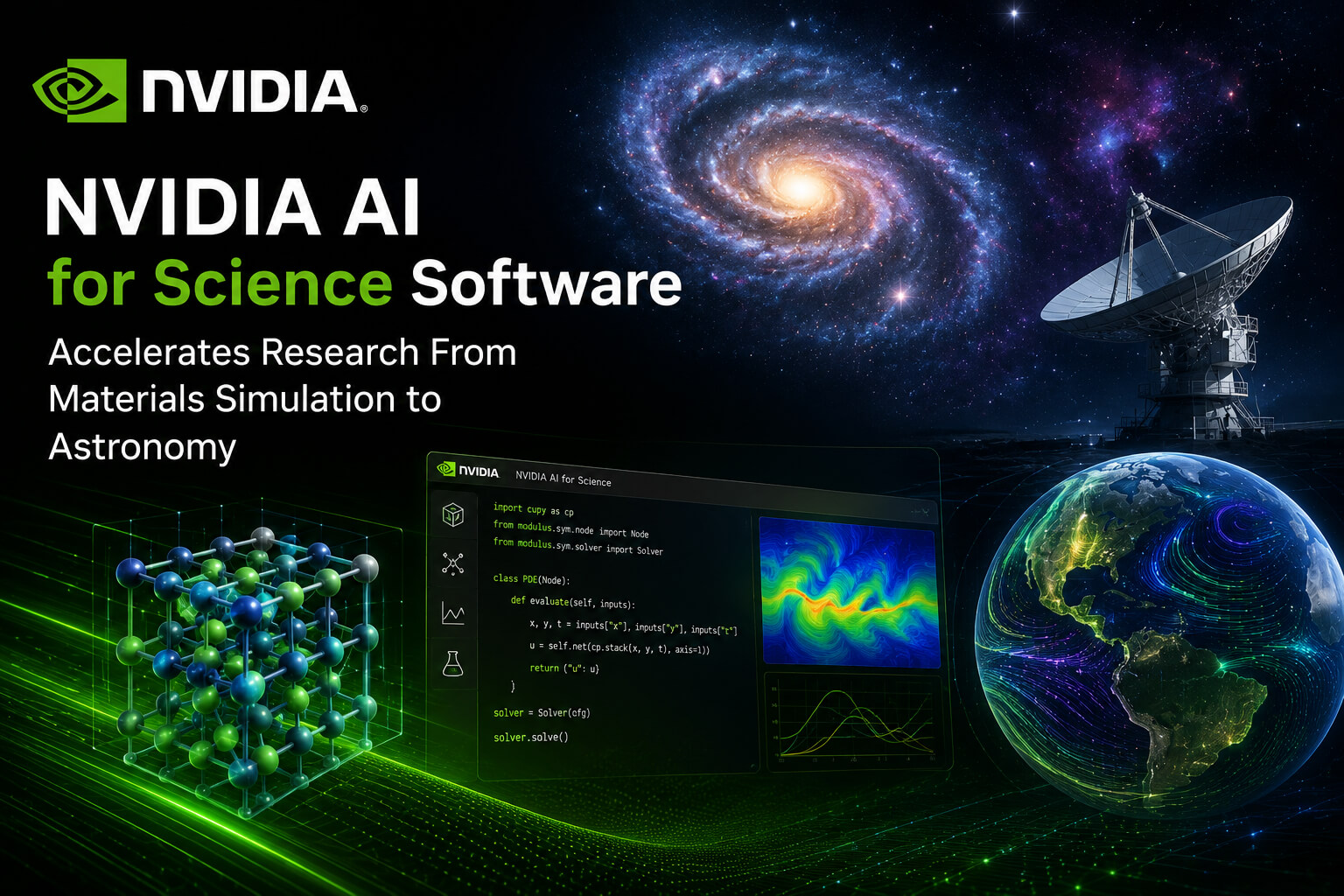
NVIDIA AI for science software is opening new possibilities for researchers working in chemistry, materials discovery, experimental physics and astronomy. The company introduced new CUDA-X libraries, microservices and reference code designed to turn complex scientific workloads into faster GPU-accelerated pipelines.
The announcement highlights NVIDIA DAQIRI, NVIDIA ALCHEMI NIM microservices and the upcoming NVIDIA cuPhoton reference code. Together, these tools aim to help scientists process massive data sets, run AI-powered simulations and analyze instrument data in real time.
NVIDIA AI for Science Software Expands CUDA-X Capabilities
The new NVIDIA AI for science software is part of CUDA-X, the company’s collection of GPU-accelerated libraries and tools for artificial intelligence, high-performance computing and scientific workloads.
NVIDIA said the new tools can support several areas of research, including dark matter studies, materials simulation, chemical discovery and telescope data analysis. As a result, researchers can move from slower CPU-based workflows to faster GPU-powered systems that process data more efficiently.
This matters because modern scientific instruments now generate huge volumes of information. Telescopes, particle detectors, X-ray systems and lab sensors can produce more data than traditional systems can quickly store or analyze. Therefore, faster AI software can help scientists capture more signals, reduce delays and uncover insights that may otherwise be missed.
cuPhoton Targets Astronomy and Large-Scale Scientific Data
One of the major tools in the announcement is NVIDIA cuPhoton, a reference code built to help scientists load, process, analyze and visualize multidimensional data. It is designed for fields such as astrophysics, astronomy, X-ray science and laser experiments.
NVIDIA said cuPhoton can support petabyte-scale workflows and work with other CUDA-X technologies to create end-to-end accelerated pipelines. In early access, cuPhoton accelerated the loading and reading of FITS images from the Rubin Observatory’s Legacy Survey of Space and Time by 14,900x.
In addition, NVIDIA reported up to 8,400x faster signal processing and analysis using 32 NVIDIA Grace Blackwell superchips. This could help researchers analyze telescope images more quickly, especially as observatories collect data from billions of galaxies and faint objects across the universe.
Princeton University collaborated with NVIDIA on cuPhoton, and researchers from Princeton and Harvard University are expected to use the software for observatory and dark energy survey data.
DAQIRI Brings Real-Time AI to Scientific Instruments
NVIDIA DAQIRI, short for Data Acquisition for Integrated Real-time Instruments, focuses on real-time data streaming. The high-performance networking library moves data from fast detectors and sensors into NVIDIA software systems.
This is important for experiments where instruments produce data faster than older hardware can store it. Instead of losing valuable information, DAQIRI helps process the stream as it arrives.
A research project called A-GHOST uses DAQIRI to run AI in real time on collision data from the ATLAS Experiment at CERN. The project was developed by scientists from CERN, the University of Chicago and University College London through CERN openlab.
According to NVIDIA, A-GHOST can analyze collision data that ATLAS would normally reject because of storage limits. Since researchers may discard more than 99% of the data, real-time AI analysis could help them detect useful signals before they lose them.
ALCHEMI NIM Microservices Support Materials and Chemical Discovery
NVIDIA ALCHEMI is another key part of the new AI for science software stack. It includes domain-specific microservices and a toolkit for chemical and materials discovery.
The platform supports applications such as battery materials, catalysts, OLED displays, beauty products and other advanced materials. NVIDIA previously released ALCHEMI NIM microservices for batched geometry relaxation and batched molecular dynamics.
These tools allow researchers to simulate millions of molecules and materials at once. Batched geometry relaxation helps identify stable structures, while batched molecular dynamics helps simulate how molecules and materials move over time.
NVIDIA also said ALCHEMI is expected to add a microservice for the Vienna Ab initio Simulation Package, widely known as VASP. The microservice is designed to improve GPU throughput for materials simulations and can deliver a 3x speedup for geometry optimization by running multiple VASP calculations on a single GPU.
Lila Sciences Uses ALCHEMI for Faster Materials Screening
Lila Sciences, a company building a scientific superintelligence platform and autonomous lab, collaborated with NVIDIA on a high-fidelity magnet simulation using ALCHEMI.
The company used the ALCHEMI NIM microservice for batched geometry relaxation to accelerate high-throughput materials screening by 50x. This helped identify stable material candidates with stronger chances of being synthesized.
Lila Sciences also used the early-access ALCHEMI VASP microservice to speed calculations of magnetic properties by 30% for shortlisted candidates. Meanwhile, ALCHEMI’s specialized kernels for TensorNet delivered a 6x speedup in training and inference while reducing memory usage by 3x.
These improvements show how AI and accelerated computing can help scientific teams test more possibilities in less time. Instead of running one experiment after another, researchers can evaluate multiple materials simultaneously and move promising candidates through the discovery pipeline faster.
Why NVIDIA AI for Science Software Matters
The latest NVIDIA AI for science software reflects a broader shift in research. Scientific discovery is becoming increasingly dependent on AI, accelerated computing and automated data pipelines.
In astronomy, faster data processing can help researchers study massive sky surveys more efficiently. Real-time AI can also help physics experiments capture important signals before they disappear. Meanwhile, GPU-accelerated simulation can shorten the path from idea to discovery in chemistry and materials science.
This approach could also support industries beyond academic research. Faster materials discovery may benefit clean energy, battery development, electronics, manufacturing, pharmaceuticals and advanced computing.
Availability of NVIDIA AI for Science Tools
NVIDIA said the ALCHEMI Toolkit and Toolkit-Ops are available through GitHub and PyPI. ALCHEMI NIM microservices are available through the NVIDIA NGC catalog.
NVIDIA has made DAQIRI available on GitHub. The company also plans to release cuPhoton this summer and the ALCHEMI NIM microservice for VASP later this summer.
Conclusion
NVIDIA AI for science software is designed to help researchers process data faster, run larger simulations and apply AI more directly to scientific discovery. With DAQIRI, ALCHEMI NIM microservices and the upcoming cuPhoton reference code, NVIDIA is expanding its CUDA-X ecosystem for the next generation of AI-powered research.
From dark matter searches to materials simulation and astronomy, these tools show how accelerated computing can help scientists move from raw data to discovery at much greater speed.
