


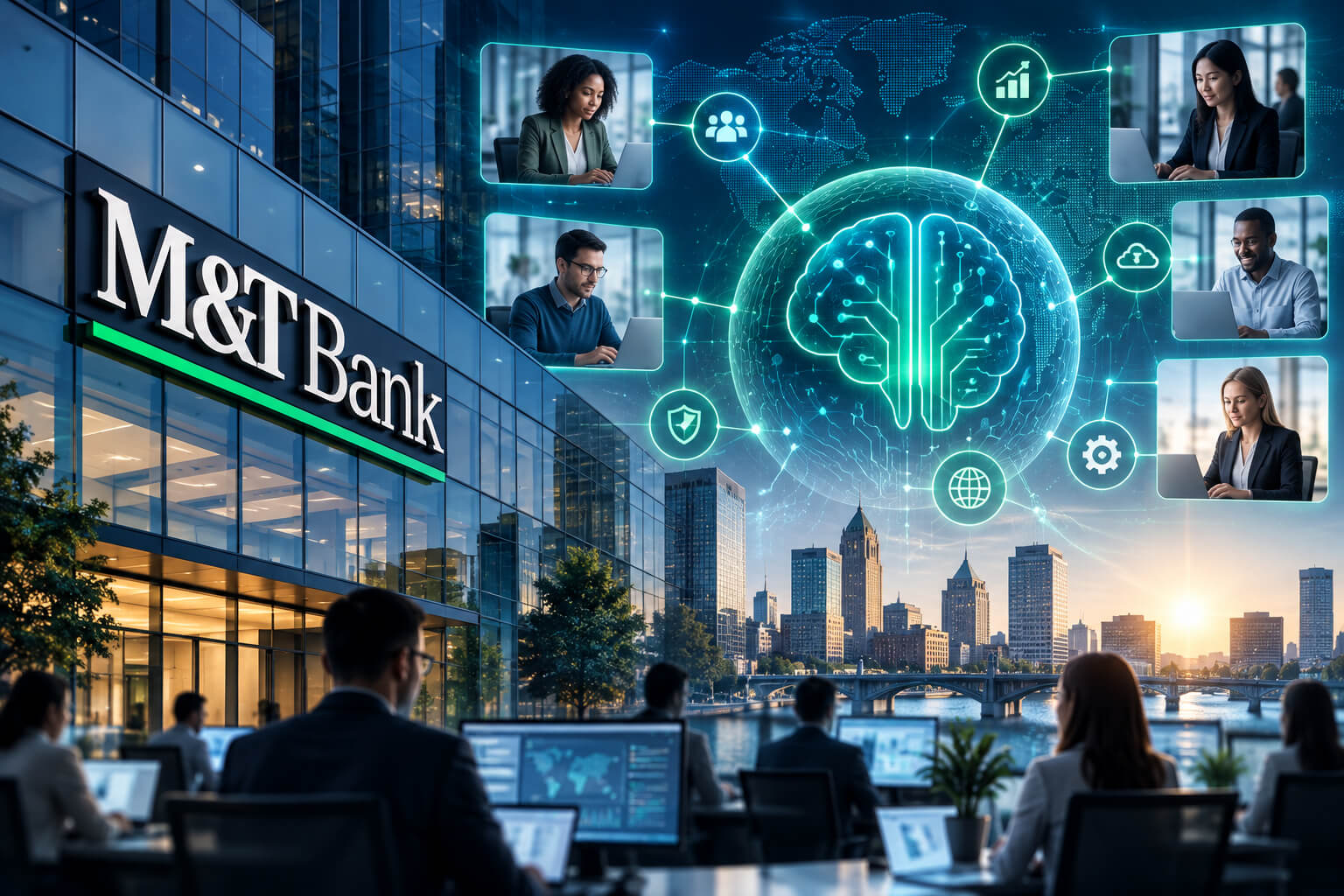
M&T Bank has spent years rebuilding its technology operation. Now that work is feeding directly into a much broader AI strategy.
The US regional bank has rolled out AI copilots to more than 15,000 employees. This brings generative AI into customer service, internal operations, software development and risk management. The move shows how quickly enterprise AI is shifting from isolated pilots into everyday banking workflows.
AI Copilots Are Becoming Part of Daily Work at M&T Bank
M&T Bank approached enterprise AI carefully at first. The bank restricted employees from using public generative AI tools because of concerns around confidential information, customer data and internal material being entered into systems outside its control. That caution eventually led M&T to evaluate enterprise-grade options with stronger governance. Microsoft Copilot became one of the main tools selected for internal use. The rollout started with a limited pilot before expanding across much of the organisation. Employees now use AI for tasks such as drafting emails, preparing reports, summarising meetings and reducing the amount of repetitive administrative work tied to everyday banking operations.
Generative AI Is Reducing Call-Centre Workload
One of the more practical uses of M&T Bank enterprise AI can be seen inside its call centres. Generative AI helps employees summarise customer conversations after calls, cutting down on the manual notes normally required before moving to the next customer. The bank has previously said this type of automation could save several minutes per interaction. That may not seem dramatic on a single call. However, across a large contact-centre operation, those small time savings quickly add up. The same principle applies elsewhere in the bank. AI is being used to support employees without completely replacing the processes they already know.
M&T Bank Keeps Humans Responsible for AI Output
M&T Bank has made it clear that AI-generated content still requires human review. Employees remain responsible for checking whether information produced by AI is accurate, suitable and compliant with internal policies. That is especially important in financial services, where a small mistake can create regulatory, reputational or customer risks. The bank also limits what workers can enter into unapproved AI systems. Confidential, proprietary, customer and employee information must stay within authorised platforms. This reinforces the idea that AI adoption in banking has to move alongside strong governance rather than ahead of it.
Years of Technology Investment Laid the Groundwork
M&T Bank’s enterprise AI expansion did not happen in isolation. The company has spent several years modernising its technology environment, reducing dependence on outside contractors and building more technical capability internally. That shift has given M&T greater control over its systems, data and application development. The bank has also increased technology investment significantly while improving platform reliability and accelerating the pace of software releases. Those changes created a much stronger foundation for introducing generative AI at scale. This was possible because the underlying systems were already becoming more modern, stable and easier to manage.
Better Data Governance Is Supporting the AI Rollout
Data quality is another major part of M&T’s AI strategy. The bank has worked on improving data lineage so teams can understand where information comes from, how it moves between systems and whether it can be trusted. This matters because enterprise AI is only as useful as the information it can access. M&T has invested in tools and internal programmes aimed at improving data governance. The bank has also been training employees to work more effectively with data. In addition, M&T has explored retrieval-augmented generation. This allows AI systems to pull information from approved internal sources rather than relying only on a general-purpose model.
M&T Bank Is Using Several Different Generative AI Approaches
M&T’s enterprise AI strategy is not centred on one product or one type of use case. The bank is using general-purpose productivity tools for employees while also exploring AI features built into software it already uses. At the same time, M&T is developing more specialised AI systems around its own data and internal processes. That includes work related to coding, back-office operations, fraud prevention and cybersecurity. This mixed approach gives the bank room to use commercially available AI where it makes sense. More sensitive or differentiated applications stay under tighter internal control.
Agentic AI Could Play a Bigger Role in Fraud and Cybersecurity
M&T Bank is also exploring how agentic AI could be used in areas such as fraud detection and cybersecurity. These applications go beyond simple content generation because they may involve analysing information across several systems, identifying unusual behaviour and recommending actions. The potential value is significant, but so is the level of risk if an AI system makes the wrong decision. That is why M&T appears to be moving carefully. Rather than rushing to automate sensitive processes, the bank is building governance, data quality and oversight into its AI strategy before handing more responsibility to autonomous systems.
Large Banks Are Moving AI Beyond Experimental Projects
M&T Bank is part of a wider trend across financial services. Major banks are increasingly rolling out generative AI tools to large sections of their workforce rather than keeping them inside innovation teams. JPMorganChase has expanded internal AI tools to a significant number of employees. Bank of America has also integrated generative AI into customer service operations. These deployments suggest that the conversation around AI in banking is changing. The question is no longer whether financial institutions will use generative AI, but where they will use it first. There are also questions about how much access systems should have and which decisions must stay under human control.
M&T Bank’s AI Strategy Shows Why Infrastructure Still Matters
The most important part of M&T Bank’s enterprise AI story may not be the number of employees using copilots. The bigger point is how much work happened before the rollout reached this stage. M&T modernised technology systems, strengthened internal technical teams, improved reliability, invested in data governance and trained employees before pushing AI deeper into daily operations. That groundwork makes it easier to use AI without creating unnecessary risk. It also underlines a simple reality that can get lost in the hype around generative AI: companies cannot solve weak data, poor governance or outdated infrastructure simply by adding a more powerful model on top.
Sources
Artificial Intelligence News:
https://www.artificialintelligence-news.com/news/mt-bank-enterprise-ai-15000-employees/
Fast Company:
https://www.fastcompany.com/91596458/michael-wisler-m-t-bank-pacesetters-2026
