


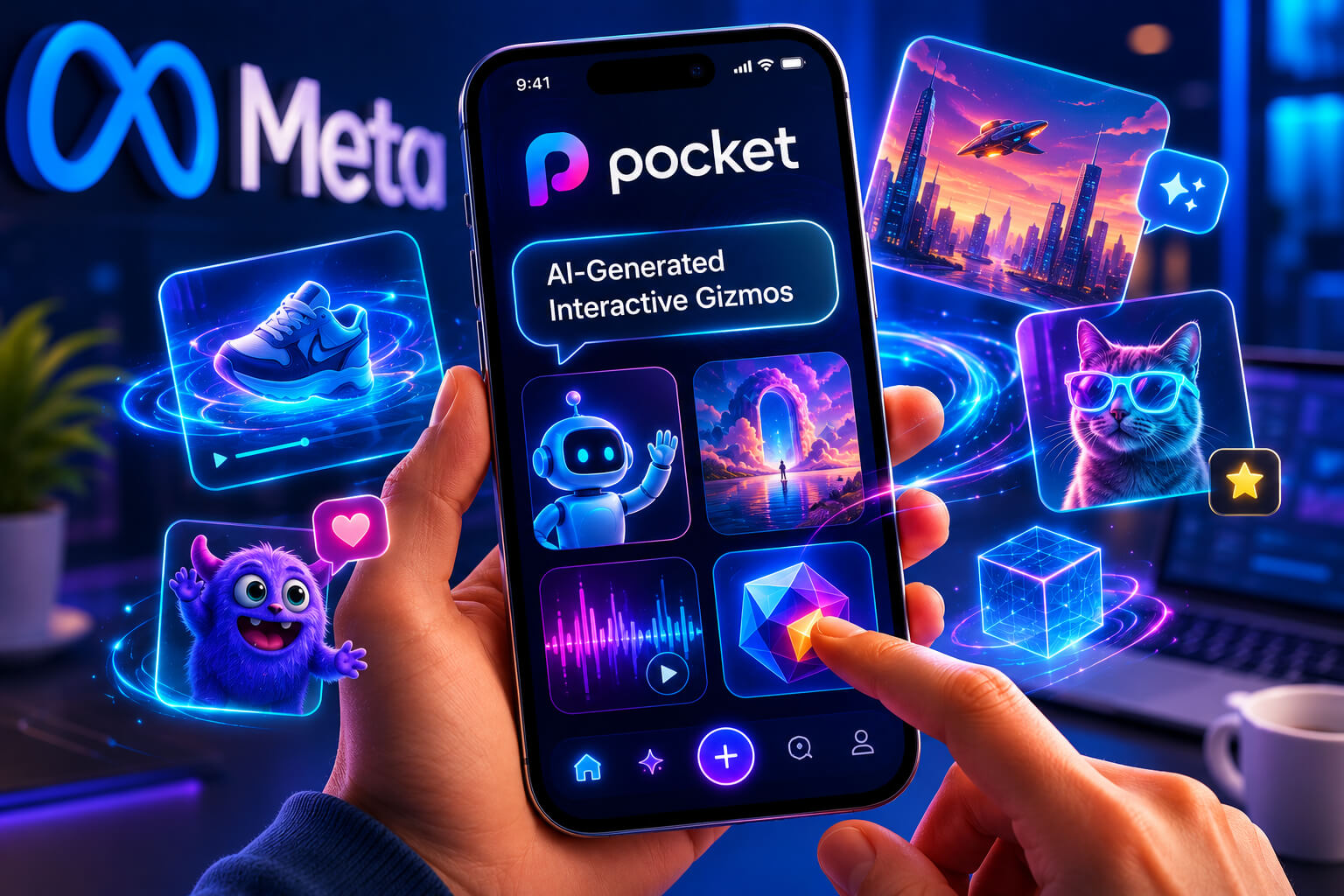
Meta appears to be testing a new AI-powered app called Pocket, and this one did not arrive with the usual big-stage announcement, polished launch video, or executive thread. It surfaced more quietly through Meta’s own Help Center documentation, which describes Pocket as an app for creating, sharing, and discovering “gizmos” with friends. A gizmo, according to Meta, is an interactive, playable AI-generated experience that users can either create themselves or interact with inside the app.
That quiet rollout is interesting on its own. Meta usually does not move silently when it wants attention. With Pocket, the company seems to be testing the waters first. The app is not available everywhere yet, and Meta says some features may still be unavailable depending on the user’s area.
What Is the Meta Pocket App?
The Meta Pocket app is built around a simple idea: type what you want, and AI turns it into something interactive. Not just a paragraph. Beyond a static image. More than another chatbot answer sitting on a screen.
Pocket is designed to create AI-generated experiences people can play with. These “gizmos” can live inside a feed, where other users can tap, swipe, drag, tilt their phone, use sound, or even use camera and microphone features when permissions are granted.
That makes Pocket feel closer to a social AI playground than a normal content creation tool. Meta has spent years building feeds around photos, videos, reels, comments, and recommendations. Pocket pushes that format toward something more active. The content does not just sit there. It responds.
How Pocket Works
Creating a gizmo in Pocket starts with a prompt. Meta says users can create their own gizmo by typing what they want to make, and Pocket uses AI to generate the interactive experience. The more specific the description, the better the result is expected to be.
The process is straightforward. A user opens the Pocket app, taps Create, describes the experience they want, taps Next, chooses whether to allow remixing, and then posts the gizmo. Once published, the creation can be shared inside Pocket or sent through a direct link. People who receive the link do not need to download Pocket just to view it.
That last part matters. Meta is not only testing creation. It is testing distribution. If Pocket experiences can move outside the app through links, the product has a better chance of spreading beyond the first group of testers.
The Remix Feature Could Be the Real Hook
Pocket also includes remixing, which may become one of its more important social features. When creators post a gizmo, they can choose whether to allow other people to remix it. If remixing is turned on, other users can build their own versions and share those remixes across Meta products and beyond.
That sounds small, but it changes the behavior of the app. Pocket is not only asking users to create from scratch. It also lets them react, modify, and extend what someone else already made. In plain terms, it gives AI-generated content a social loop.
There is one detail creators should notice. Meta says deleting the original post will not delete existing remixes. So once a gizmo starts spreading, parts of it may continue moving through the ecosystem even after the original creator removes the first version.
Why Meta May Be Moving Slowly
Meta has not made a major public launch around Pocket, and the limited availability suggests this is still an early rollout rather than a full release. The company may be watching how people use the app, what they create, how remixing behaves, and where moderation problems show up.
That is not surprising. AI-generated interactive content is more complicated than AI text or images. A gizmo may respond to touch, motion, camera input, microphone access, or user behavior. That creates a bigger testing surface. Fun, yes. Also messy.
Meta’s own support page notes that interactions with gizmos may be used to improve AI at Meta. It also says Pocket uses Meta account information to personalize the experience and keep users safe, including details such as login information, account ID, name, username, profile information, age, and account status related to policy violations.
Pocket Shows Where Social AI Is Going
Pocket is not just another AI app in the pile. It points to where Meta may want social AI to go next: from generated content to generated experiences.
A post used to be something you looked at. A reel was something you watched. A chatbot was something you talked to. Pocket is trying to sit somewhere else, where users can build tiny interactive objects from prompts and pass them around like social content.
That could become a new format for games, jokes, learning tools, fan content, mini apps, brand activations, and weird internet experiments that nobody planned but everyone starts sharing. Those are usually the things that make social platforms feel alive.
The Bigger Question for Meta
The bigger question is whether users actually want a feed of AI-generated interactive experiences. Meta clearly has the infrastructure, the accounts, the social graph, and the AI investment to test it. But new formats do not win just because they are technically possible.
Pocket will need creators to make gizmos worth opening. It will need users to remix without turning the feed into noise. It will need moderation systems that can handle interactive AI content before it becomes a problem. And it will need a reason to exist beside Instagram, Facebook, Threads, WhatsApp, and Meta AI.
Still, this is the kind of small product test worth watching. Not because Pocket is guaranteed to become huge. It may not. But because it shows Meta testing a future where AI does not just answer prompts. It makes things people can touch, play with, remix, and share.
