


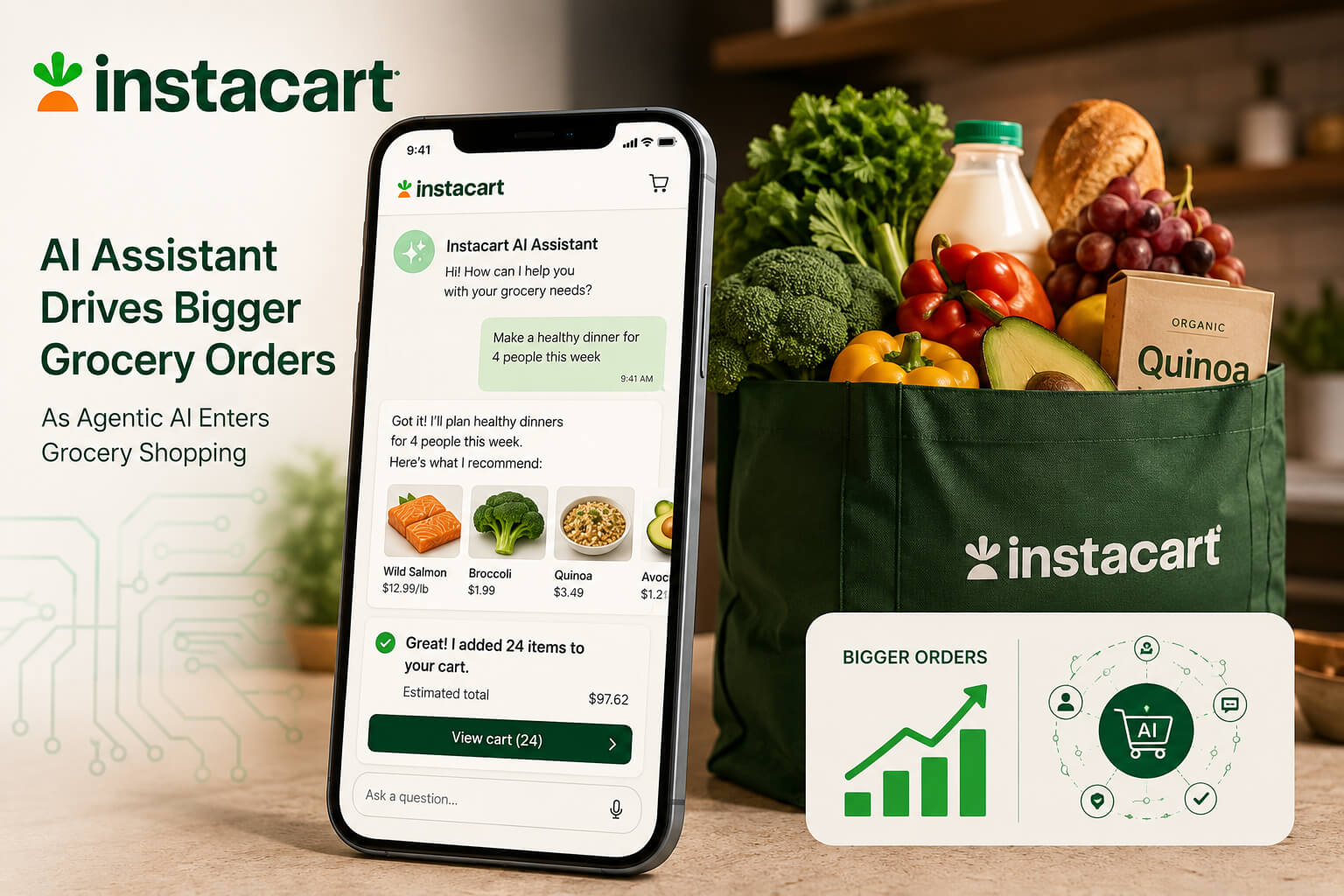
Instacart is bringing agentic AI deeper into the grocery shopping experience with a new AI assistant designed to help customers build complete, personalized carts in seconds.
The company has started rolling out the Instacart AI assistant to millions of U.S. customers through its app and website. A wider rollout across the United States and Canada is expected in the coming months.
Unlike a basic chatbot, the AI assistant is built directly into Instacart’s Marketplace. It can turn a shopper’s request into a ready-to-review grocery cart by using natural language prompts, suggested shopping ideas, uploaded grocery lists, live store inventory, past order history, and personalized brand preferences.
For example, a customer can ask for “easy weeknight dinners for four,” “deals on my usual items,” or “appetizers for a graduation party.” The assistant can then recommend products, build a cart, and tailor the results to what is actually available at the customer’s selected store.
How the Instacart AI Assistant Works
The Instacart AI assistant is designed around real grocery behavior. “It lets shoppers say in everyday language what they need, compared to having to search item-by-item.”
Customers can use the assistant for: Planning meals: Shoppers can ask for ideas for dinner, recipes, or full weekly meal plans. The assistant can suggest meals and add needed ingredients to the cart.
Grocery list uploads: Users can snap a picture of their handwritten or digital grocery list. The AI can convert that list to an entire cart without the hassle of manual searching.
Deals and savings: Shoppers can ask the assistant to search for discounts, cheaper options or special offers on the things they usually buy.
Event shopping: The tool can build carts for events such as parties, BBQs, game nights, or family get-togethers.
Personalized recommendations: The assistant analyzes order history and preferences to recommend known brands, commonly ordered staples and relevant substitutions.
A key part of the system is Instacart’s access to live inventory data from nearly 100,000 stores across North America. That means the assistant is not just suggesting generic grocery items. It is building carts based on what is currently in stock at the customer’s chosen retailer.
AI Shopping Could Increase Grocery Basket Size
One of the biggest signals from Instacart’s early testing is that customers using the AI assistant tend to place larger orders than typical shoppers.
That is important because grocery shopping is often complex. Customers may start with one need, such as dinner ideas, but end up adding ingredients, household staples, snacks, deals, and event-related items once an AI assistant helps organize the shopping journey.
For Instacart, larger basket sizes could make the AI assistant more than just a convenience feature. It may become a revenue-driving tool that increases order value while helping shoppers complete more of their weekly grocery needs in one session.
The company says early users are not only shopping faster but also using the assistant for more complex tasks such as recipe discovery and meal planning. This suggests that agentic AI may be especially useful in grocery, where shoppers often need help deciding what to buy, not just where to find it.
Why Agentic AI Matters for Online Grocery
Agentic AI refers to AI systems that can take a user’s goal and complete multiple steps toward achieving it. For grocery shopping, this may include knowing a meal idea, picking out ingredients, seeing what’s in stock, finding sales, offering alternatives and building a cart to check out.
This is not like traditional ecommerce search. A shopper does not need to type “chicken breast,” “lettuce,” “avocado,” and “tortillas” separately. Instead, they can request “healthy taco bowls for four” and the AI can create a grocery basket to meet that objective.
This could reduce decision fatigue for busy households. Grocery shopping often involves budget planning, dietary preferences, brand loyalty, store availability and forgotten items. An effective AI assistant can combine those signals into a more useful shopping experience.
Instacart’s AI Strategy Expands Beyond Its Marketplace
Instacart’s AI assistant is also part of a broader strategy. The company is positioning its grocery AI tech not just as a tool for consumers, but also for retailers, advertisers and AI platforms.
For retailers, Instacart’s technology could allow AI-powered shopping experiences on their own ecommerce platforms. For advertisers, enhanced personalization and shopping intent data could improve product discovery and campaign performance.
Instacart has also been deploying its grocery know-how on big AI platforms like ChatGPT, Claude and Gemini, indicating that grocery ordering could increasingly take place through AI assistants outside of the usual shopping apps.
The Bigger Picture for AI Commerce
The rollout of the Instacart AI assistant shows how quickly AI commerce is moving from experimentation to everyday use.
Grocery is one of the hardest areas of ecommerce because inventory changes quickly, shoppers have strong personal preferences, and small recommendation errors can affect trust. If Instacart’s AI assistant can reliably build useful carts from simple prompts, it could become a major example of how agentic AI changes digital shopping.
For consumers, the benefit is convenience: faster shopping, better meal planning, personalized deals, and fewer forgotten items.
For Instacart, the benefit may be even bigger: higher basket sizes, stronger customer engagement, and a larger role in the future of AI-powered retail.
As AI assistants improve, online grocery shopping could transition from search-based buying to goal-based buying. Rather than manually creating a cart, shoppers could simply describe what they need — and let AI take care of the planning.
