


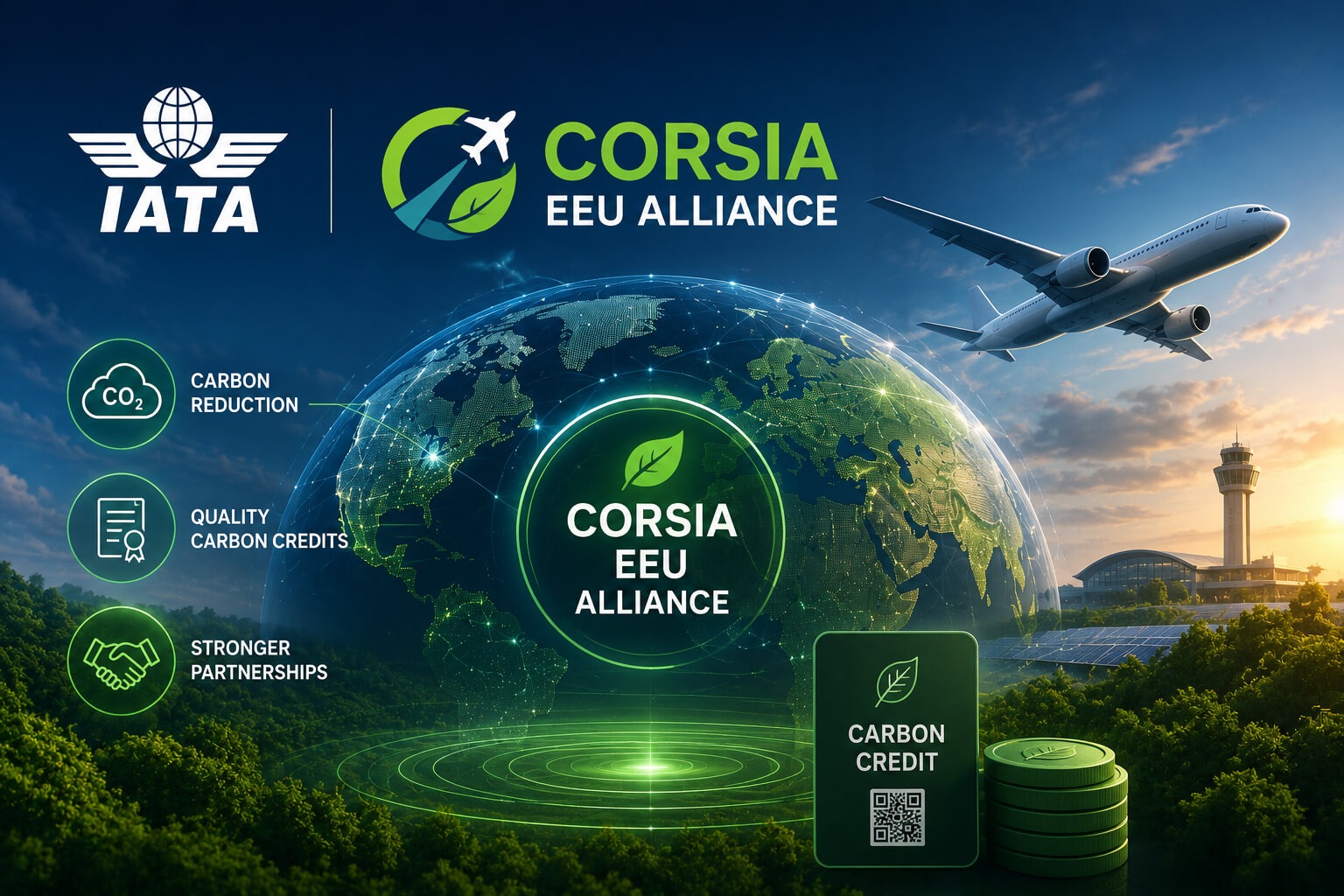
The International Air Transport Association (IATA) has launched a new industry initiative to increase the supply of carbon credits for international aviation. This is under CORSIA, the global emissions offsetting framework for airlines.
Announced in Rio de Janeiro on June 6, 2026, the Supporting Alliance for CORSIA EEU Supply brings together airlines, governments, carbon market stakeholders, and technical experts. They aim to help expand the availability of CORSIA Eligible Emissions Units, also known as EEUs.
The alliance is targeting the availability of 225 million to 250 million CORSIA Eligible Emissions Units by spring 2027. This comes as the aviation industry prepares for its first major CORSIA compliance deadline in December 2027.
What Is the IATA CORSIA EEU Alliance?
The IATA CORSIA EEU Alliance is designed to address practical bottlenecks that limit the supply of eligible aviation carbon credits.
CORSIA, short for the Carbon Offsetting and Reduction Scheme for International Aviation, is the global market-based mechanism created by the International Civil Aviation Organization to manage emissions from international flights. Meanwhile, airlines covered by the scheme must offset a portion of their emissions by cancelling eligible emissions units.
However, bringing carbon credits into the CORSIA market requires coordination between different international climate frameworks. This includes the Paris Agreement and national climate commitments. IATA says this process has created challenges, particularly around avoiding double-counting of emissions reductions.
The new alliance aims to provide hands-on support to countries and organizations. As a result, more eligible credits can become available for airline compliance.
Why CORSIA EEU Supply Matters
CORSIA relies on a steady supply of approved emissions units. Without enough eligible credits, airlines may face higher costs, tighter supply conditions, and more complexity when meeting their offsetting obligations.
IATA says the alliance will help participating organizations pool resources and provide practical implementation assistance. In addition, it will support countries in managing the link between their national climate commitments and the requirements for making carbon credits available under CORSIA.
The initiative is also expected to support wider access to carbon markets. This is particularly helpful for countries that want to authorize the use of domestic emissions units for international aviation.
Support Ahead of the 2027 Compliance Deadline
A major focus of the alliance will be host country implementation assistance.
This support will be offered to countries that request help in authorizing domestic emissions units for use under CORSIA. The assistance will involve recognized Article 6 and CORSIA experts and will be provided on a pro bono basis.
The goal is to help countries prepare before the first CORSIA compliance deadline in December 2027. Besides that, it will also support ongoing reporting and review processes.
Airlines Joining the Alliance
The initial membership of the alliance includes more than 32 entities. Airline participants named by IATA include:
AirAsia, Air France-KLM, All Nippon Airways, Austrian Airlines, China Airlines, Corsair, Egyptair, IAG, Japan Airlines, KM Malta Airlines, Lufthansa Group, Pegasus Airlines, Qatar Airways, Scoot, Singapore Airlines, and SWISS.
The alliance is open to organizations and national governments willing to contribute expertise, practical resources, and implementation support.
Potential Climate Finance Impact
According to IATA, CORSIA could generate $4 billion to $5 billion in climate finance during its first phase. There is also potential to reach $100 billion by 2035, depending on market prices.
The funding may support climate action, economic development and remote communities. Moreover, it could provide the aviation sector with a global mechanism to manage growth in emissions.
What CORSIA Means for International Aviation
CORSIA was agreed by governments through ICAO in 2016 to avoid overlapping emissions schemes for international aviation. Offsetting requirements began in 2021.
CORSIA applies only to flights between countries that volunteer to participate in the scheme from 2021 to 2026. However, under the scheme, offsetting requirements will be expanded to all international flights from 2027, with exemptions for certain countries. These include Least Developed Countries, Small Island Developing States and Landlocked Developing Countries, unless they decide to participate voluntarily.
The Bigger Picture
The launch of the IATA CORSIA EEU Alliance underlines the increasing importance of carbon market infrastructure in aviation’s climate strategy.
New aircraft technology, operational efficiency and sustainable aviation fuel will remain key drivers of long term decarbonisation. Still, CORSIA is an important tool to manage emissions from international flights in the meantime.
IATA’s new alliance is targeting carbon credit supply, country-level implementation and Article 6 coordination. These efforts aim to build the reliability of the CORSIA system ahead of the next key compliance phase for the aviation industry.
The alliance could offer a key platform for scaling up aviation-ready carbon credits for airlines, governments and carbon market players. All of these actions come ahead of the 2027 deadline.
