


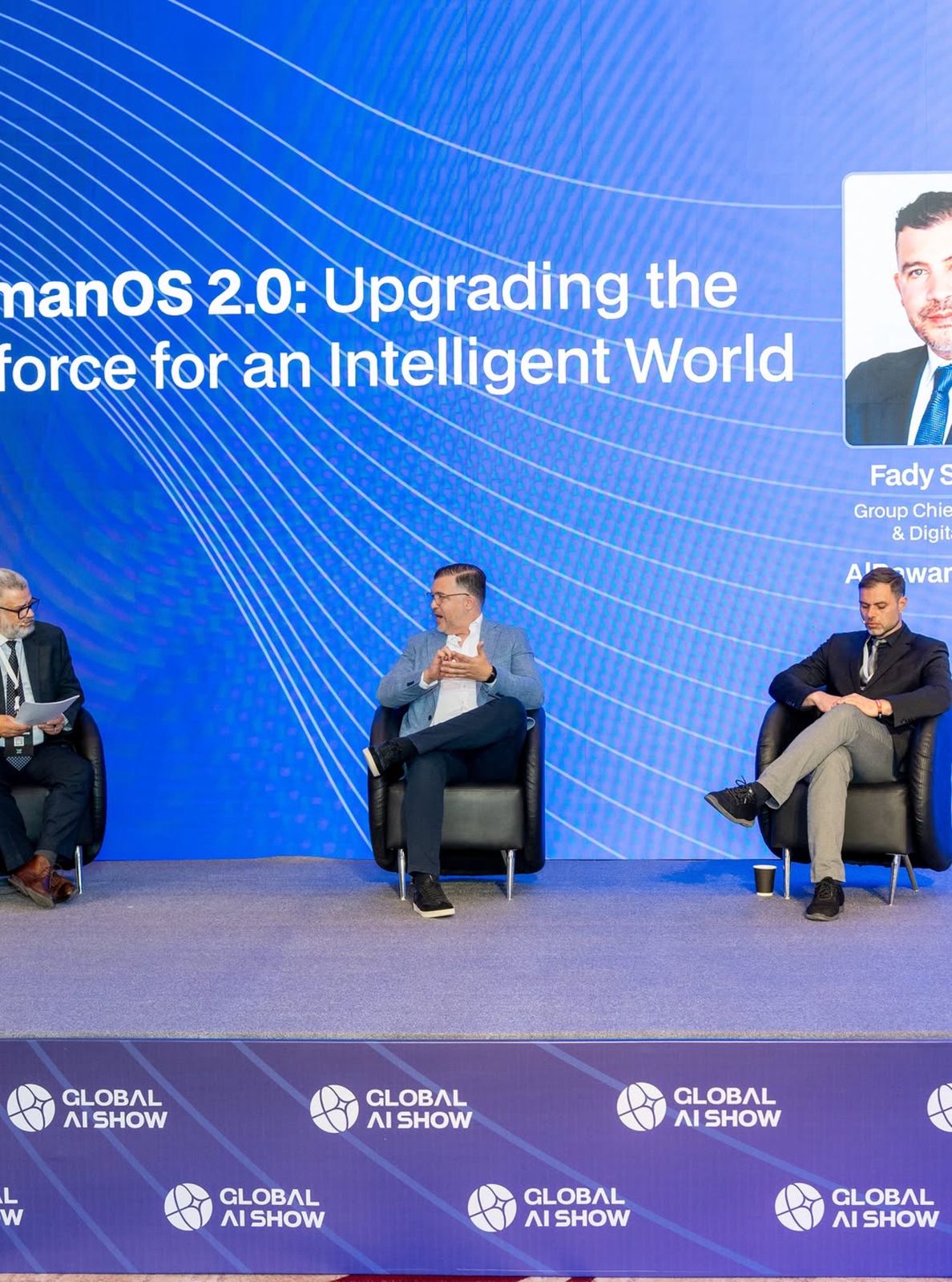
At Global AI Show Riyadh 2026, “HumanOS 2.0: Upgrading the Workforce for an Intelligent World” looked at one of the more uncomfortable questions inside companies right now: what happens to human work when AI agents stop being tools and start acting more like coworkers?
The session was moderated by Youssef El Jabri, Digital Transformation Advisor at Saudi Food & Drug Authority, with insights from Fady Sleiman, Group Chief Information & Digital Officer at AlBawani Holding, and Daniel Hill, Chairman & CEO at AQUIVIO. The discussion was not about replacing people in the usual dramatic way. It was more practical than that. If AI is already entering the workflow, then the real challenge is knowing what humans should stop doing, what they should learn faster, and how enterprises can keep their people relevant when job roles keep shifting under their feet.
When AI Agents Become Coworkers
For years, companies treated AI as software. Something you buy, deploy, test, and maybe integrate into a few business processes. That picture is already changing. AI agents are starting to sit inside daily work, handling tasks, making recommendations, drafting outputs, analyzing information, and sometimes moving faster than the people managing them.
That creates a strange new workplace dynamic. AI is no longer just a dashboard or automation layer. It can behave like a teammate that does not need sleep, onboarding, or a normal learning curve. Useful, yes. Also disruptive.
The panel raised a sharp question: if AI agents become coworkers, which human skills should be retired and which must be accelerated? Some skills may no longer deserve the same attention because AI can handle them faster and more consistently. Repetitive reporting, basic information retrieval, routine drafting, and manual coordination may slowly lose value. But other human skills become more important, not less. Judgment. Context. Creativity. Emotional intelligence. Ethical reasoning. Leadership. The ability to ask better questions. The ability to know when not to trust the machine.
Not Every Skill Needs to Survive
There is a tendency in corporate training to protect every existing role and skill set as if the future will simply add AI on top of the old workplace. That may be wishful thinking. Some skills will fade. Some workflows will disappear. Some job descriptions will age badly.
HumanOS 2.0 is a useful way to frame it because the workforce does not only need more training. It needs an upgrade. And upgrades usually remove outdated features too.
That does not mean people become less valuable. It means the value moves. The worker who only follows instructions may struggle. The worker who can supervise AI, challenge outputs, connect ideas, understand business context, and make responsible decisions becomes far more important.
Can Human Potential Be Measured Like AI Performance?
One of the more sensitive questions from the discussion was whether human potential can be quantified like AI performance without crossing ethical boundaries.
Companies already measure people constantly. Productivity, attendance, output quality, sales numbers, learning progress, engagement scores. AI adds the possibility of measuring much more: decision speed, adaptability, collaboration patterns, learning ability, even how well someone works with AI systems.
That sounds efficient. It also sounds risky.
The danger is turning people into performance dashboards. Human potential is not the same as model accuracy. A person’s value cannot be fully captured through a score, a ranking, or a productivity graph. Enterprises may need better workforce intelligence, but they also need limits. Measurement should support growth, not become surveillance dressed up as innovation.
Reskilling Cannot Move at Old Speed
Traditional reskilling is too slow for the AI era. A company identifies a skills gap, creates a training program, schedules workshops, tracks completion, and hopes the business has not already changed by the time people finish the course.
That model feels outdated now.
AI evolves faster than job roles. New tools appear, workflows change, and entire departments suddenly need new capabilities. The panel’s question around a plug-and-play reskilling stack speaks directly to this problem. Reskilling can no longer be a once-a-year program or a learning portal nobody opens unless HR sends a reminder.
It has to move into the workflow.
What a Plug-and-Play Reskilling Stack Could Look Like
A modern reskilling stack would not feel like traditional training. It would be closer to a live support layer inside work. Employees would receive guidance while doing the task, not three months before or after it. AI could identify where a person is struggling, suggest micro-lessons, recommend better prompts, explain new tools, and help workers build skills without pulling them out of their daily responsibilities.
This is where human-AI collaboration becomes more realistic. The goal is not only to train people to use AI. It is to let AI help train people continuously.
A plug-and-play reskilling stack might include workflow-based learning, AI coaches, role-specific skill maps, real-time feedback, internal knowledge assistants, and personalized development paths. Less classroom. More live upgrade.
From Software Licensing to Skill-as-a-Service
The panel also raised an interesting shift: should enterprises move from software licensing to skill-as-a-service?
It sounds unusual at first, but it makes sense. Companies have spent years buying software licenses and then trying to train people afterward. In an AI-driven workplace, the bigger value may not be access to software. It may be access to capability.
Skill-as-a-service would mean delivering real-time upskilling inside the tools employees already use. Instead of giving workers a platform and expecting them to figure it out, companies could provide AI-driven guidance that helps them perform better immediately. The skill becomes part of the workflow, not a separate training event.
That could change how enterprises think about talent development. Learning would become continuous, personalized, and tied directly to business performance.
Human-AI Collaboration Needs Better Design
A lot of companies talk about human-AI collaboration as if it will happen naturally. It will not. People need clarity. What should the AI do? What should the human decide? Who is accountable when the system makes a mistake? When should workers override the AI? How much autonomy should agents have inside business processes?
Without clear design, AI agents can create confusion instead of productivity. Employees may either over-trust them or avoid them completely. Managers may expect instant efficiency without giving people time to adapt. Leaders may measure AI adoption without understanding whether it is actually improving work.
HumanOS 2.0 is not just about adding AI into the workplace. It is about redesigning the relationship between people, machines, skills, and decisions.
The Real Upgrade Is Human Judgment
The strongest idea from the discussion is that the intelligent workplace will not be won by companies that simply deploy the most AI tools. It will be won by organizations that know how to upgrade their people at the same time.
AI can automate tasks. It can accelerate workflows. It can act as a coworker, coach, analyst, and assistant. But humans still carry the responsibility for context, ethics, trust, leadership, and direction.
That is the real workforce upgrade. Not just more digital skills. Not just another training platform. A sharper understanding of what humans are still uniquely needed for in an intelligent world.
At Global AI Show Riyadh 2026, the HumanOS 2.0 panel made that point clearly. The future of work is not only about AI entering the workflow. It is about whether people are given the right skills, systems, and support to evolve with it.
