


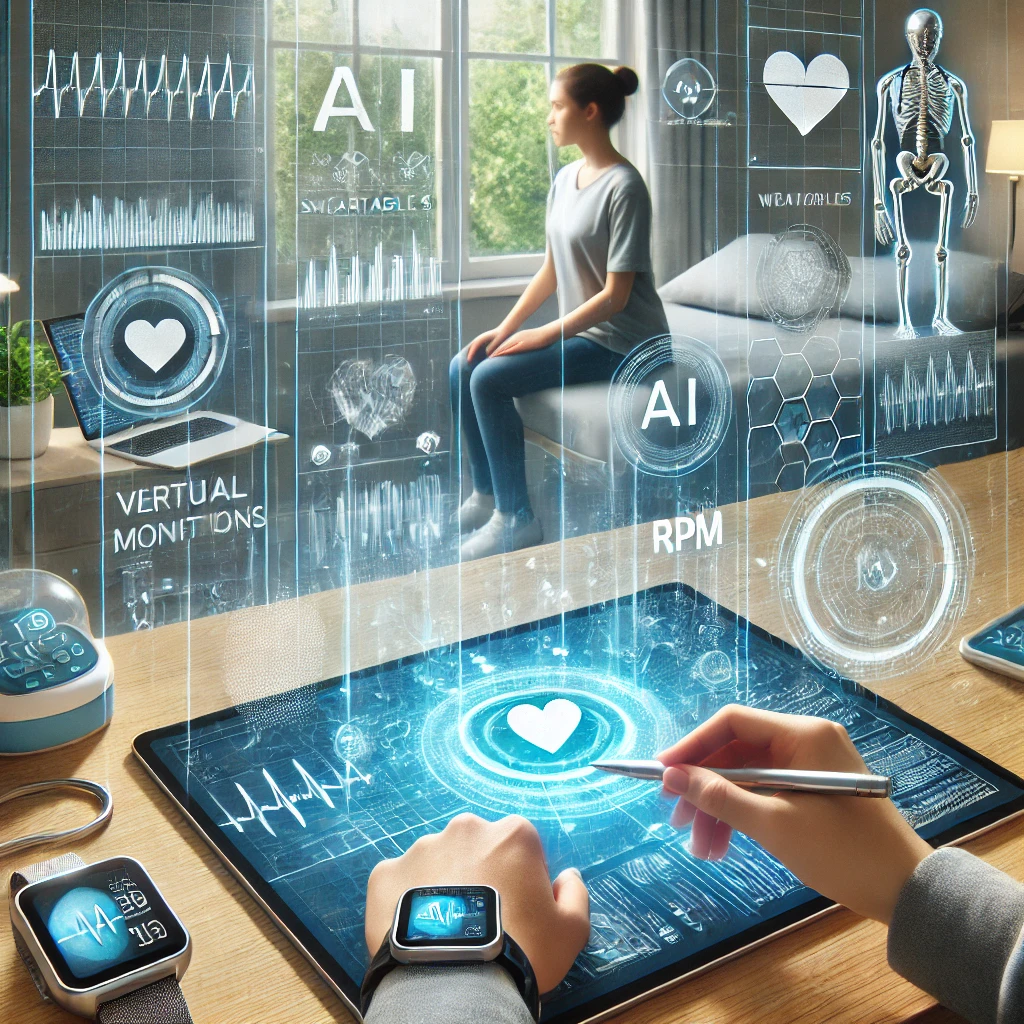
As healthcare technology continues to evolve, the combination of Remote Patient Monitoring (RPM) and artificial intelligence (AI) is creating new opportunities for improving patient care. RPM allows healthcare providers to monitor patients’ health data remotely, enabling timely interventions without the need for in-person visits. When paired with AI, RPM becomes even more powerful, offering advanced analytics, predictive insights, and automation that can transform the way healthcare is delivered.
In this article, we explore how AI is enhancing RPM, with real-world examples of tools currently being developed and deployed to improve patient access and expand virtual care.
The Role of AI in RPM
At its core, RPM relies on connected devices—such as wearable sensors, blood pressure monitors, and glucose meters—to collect health data from patients. These devices transmit real-time information to healthcare providers, allowing them to track vital signs, detect anomalies, and manage chronic conditions from afar. However, the sheer volume of data generated by RPM devices can be overwhelming for healthcare providers to process and analyze manually.
This is where AI comes in. By integrating AI algorithms with RPM systems, healthcare organizations can automate data analysis, identify patterns, and even predict potential health issues before they become critical. AI-driven RPM systems can flag concerning trends in patient data, triggering alerts for providers and suggesting tailored interventions. These capabilities help reduce the burden on healthcare staff while ensuring patients receive timely, personalized care.
Examples of AI-Enhanced RPM in Action
Several healthcare companies and startups are already using AI-powered RPM solutions to improve patient outcomes. Here are a few examples of how AI is making a difference in remote care:
1. Diabetes Management with AI
RPM technology is being used to help patients manage chronic conditions like diabetes. Devices such as continuous glucose monitors (CGMs) track blood sugar levels in real-time. AI algorithms analyze this data to detect trends, predict glucose fluctuations, and recommend adjustments to treatment plans. For example, AI can notify a patient when their blood sugar levels are trending dangerously high or low, enabling them to take action before a health crisis occurs.
2. Cardiac Care with AI-Powered Wearables
AI-enhanced RPM tools are also making waves in cardiac care. Smartwatches and wearable ECG devices can monitor heart rate and detect irregularities, such as atrial fibrillation. AI algorithms analyze heart rhythm data, automatically alerting healthcare providers when abnormalities are detected. This early warning system can prevent strokes or other serious cardiac events by enabling faster medical intervention.
3. AI for Hospital-at-Home Programs
Hospital-at-home programs are designed to provide hospital-level care in the comfort of a patient’s home. AI-enhanced RPM tools play a key role in these programs by continuously monitoring patients’ vital signs, such as oxygen levels, blood pressure, and respiratory rates. AI helps analyze this data to identify early signs of deterioration, allowing healthcare providers to intervene before patients require hospitalization. This not only improves patient outcomes but also reduces the strain on hospital resources.
Improving Access and Expanding Virtual Care
AI-powered RPM has the potential to greatly expand access to healthcare, particularly for underserved or remote populations. By leveraging AI and RPM, healthcare providers can offer virtual care services to patients who may not have easy access to healthcare facilities. This can be especially beneficial for elderly or disabled patients who struggle with transportation or for those living in rural areas with limited healthcare infrastructure.
Moreover, AI helps to personalize virtual care. By continuously analyzing data, AI algorithms can tailor treatment plans to individual patients, recommending lifestyle changes, medication adjustments, or preventive measures based on their specific health profile. This level of personalized care can improve patient engagement and encourage adherence to treatment, ultimately leading to better health outcomes.
Challenges and Considerations
While AI-powered RPM holds great promise, it also faces certain challenges. Data privacy and security remain top concerns, as the transmission of sensitive health data over digital platforms requires robust safeguards to prevent breaches. Additionally, there is the challenge of ensuring that AI algorithms are trained on diverse datasets to avoid bias in predictions and recommendations.
Healthcare providers must also consider the regulatory landscape. As AI tools become more integrated into RPM, ensuring that they meet regulatory standards for medical devices and software is critical to ensuring their safety and efficacy.
The Future of AI and RPM
Looking ahead, AI’s role in RPM is expected to expand further. AI advancements in natural language processing (NLP) could enable voice-activated RPM systems, allowing patients to communicate symptoms or concerns directly to virtual assistants. Additionally, AI may play a role in automating administrative tasks, such as scheduling follow-ups or adjusting medication doses, freeing up healthcare providers to focus on more complex aspects of care.
As AI and RPM technology continue to evolve, the potential for improved patient outcomes, increased access to care, and cost savings for healthcare systems will only grow. By leveraging AI, healthcare providers can offer more proactive, personalized, and accessible care, transforming the future of remote patient monitoring.
Conclusion
The integration of AI with remote patient monitoring represents a significant advancement in healthcare. AI’s ability to analyze vast amounts of patient data, predict health issues, and enable timely interventions has the potential to revolutionize how care is delivered remotely. As AI-powered RPM tools become more sophisticated and widely adopted, they will play a critical role in expanding access to healthcare, improving patient outcomes, and shaping the future of virtual care.
