


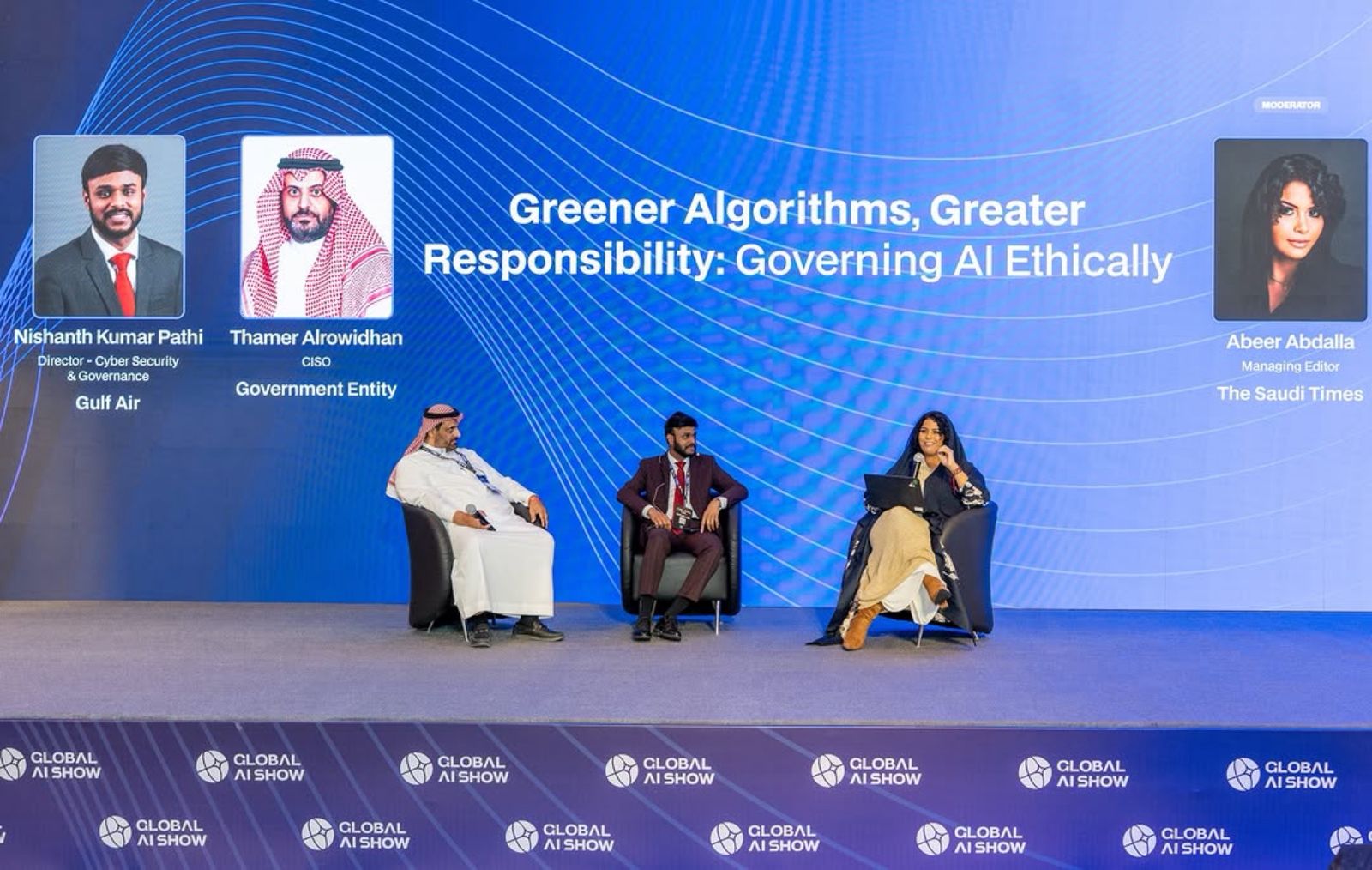
Artificial intelligence has become faster, bigger, and more deeply embedded in business and government operations. That progress comes with a cost, and the industry is now being forced to look at it more directly. At Global AI Show Riyadh 2026, the fireside chat “Greener Algorithms, Greater Responsibility: Governing AI Ethically” brought this issue into focus.
The session was moderated by Abeer Abdalla, Managing Editor at The Saudi Times, and featured Nishanth Kumar Pathi, Director – Cyber Security & Governance at Gulf Air, Ayman Alhabib, CRO at D360 Bank, and Thamer Alrowidhan, CISO at a Government Entity. The discussion looked at a question many companies still prefer to avoid: can AI keep scaling without making sustainability and ethics part of the core design?
Carbon-Aware AI Enters the Governance Conversation
For a long time, AI performance was judged mainly through accuracy, speed, and cost. That old scoreboard is starting to feel incomplete. As models become more compute-heavy, the carbon footprint behind every training run, deployment, and enterprise query is becoming harder to ignore.
During the fireside chat, speakers raised a key question: should regulators mandate carbon-per-query transparency for enterprise AI models? It sounds technical at first, but the idea is simple. If companies can measure latency and uptime, they may also need to measure the environmental cost of using AI at scale.
That kind of transparency could change how enterprises choose models. A system that is slightly more accurate but far more energy-intensive may not always be the responsible choice. This becomes especially important when organizations use AI thousands, or even millions, of times across financial services, aviation, government platforms, and customer-facing systems.
Accuracy Alone Is Not Enough Anymore
The discussion pushed toward a larger shift: AI teams may need to treat carbon cost as a first-class metric in model training, placing it beside accuracy and latency instead of leaving it as a footnote.
That would change the way AI systems are built. Developers would not only ask, “How well does the model perform?” They would also ask, “How much energy did it take to get there?” and “Is this level of compute justified by the value it creates?”
It is not the neatest conversation for the AI industry. Bigger models still attract attention. Faster systems still impress the market. But the next stage of responsible AI may reward something less flashy: efficient intelligence.
Green GPU Clusters Could Redefine AI Infrastructure
Another major theme was the role of green GPU clusters. As demand for AI compute grows, governments, regulators, sponsors, and infrastructure providers may need to think beyond simply building more capacity. The harder question is how that capacity is powered, governed, and allocated.
The fireside chat explored whether regulators and sponsors can co-develop green GPU clusters that allocate compute based on social impact. It is an ambitious idea, but it points to where the AI infrastructure debate is heading. Not every workload has the same social value. Some models do not deserve unlimited compute. In addition, not every AI deployment should be treated as equally urgent.
A greener compute stack could prioritize use cases that support healthcare, public safety, education, financial inclusion, cybersecurity, climate resilience, or national development. That would move sustainable AI infrastructure from a branding exercise into a real governance mechanism.
Ethical AI Governance Needs Practical Controls
Ethical AI governance can easily become vague if it stays at the level of principles. The panel discussion made it clear that responsibility needs to show up in actual systems, policies, procurement rules, security frameworks, and executive decisions.
For sectors such as banking, aviation, and government, AI ethics is not only about bias or explainability. It also includes resilience, cybersecurity, data governance, regulatory accountability, and environmental responsibility. These issues are connected. A model that is powerful but opaque, wasteful, insecure, or poorly governed creates risk across more than one layer.
That is why boards now treat ethical AI governance as a strategic issue, not just a compliance topic. Organizations need clear leaders to approve AI systems, monitor their impact, measure their energy use, respond when something goes wrong, and decide whether to scale, pause, or replace a model.
Sponsors Need to Productize Green AI Capabilities
The fireside chat also raised a practical business question: which ethical or green AI capabilities should sponsors productize today to remain indispensable tomorrow?
This matters because sustainability cannot stay as a slide in a pitch deck. Sponsors and technology providers need to turn green AI into usable capabilities. That could include carbon-aware dashboards, energy-efficient model selection, low-carbon deployment options, green GPU access, audit trails for AI sustainability, and governance tools that help enterprises compare performance against environmental impact.
The companies that productize these capabilities early may have an advantage. Not because “green AI” sounds good, but because enterprise buyers are likely to face more pressure from regulators, customers, boards, and investors. When that pressure arrives, vendors that already offer measurable sustainability controls will be harder to replace.
Responsible AI Means Measuring What Was Previously Hidden
One of the most important ideas from the session was that responsibility starts with visibility. Organizations cannot govern what they refuse to measure. If the carbon cost of AI remains invisible, then it will stay outside procurement, compliance, and leadership decisions.
Carbon-per-query reporting, sustainable infrastructure metrics, and green compute allocation may sound like future-facing ideas today. But they could become normal parts of enterprise AI governance sooner than expected. The same way cybersecurity moved from a technical department issue to an executive priority, sustainable AI may follow the same path.
The Future of AI Will Be Judged Differently
The fireside chat at Global AI Show Riyadh 2026 showed that the next phase of AI will require more than intelligence. Leaders, companies, and governments will also need to judge AI by its level of responsibility.
Companies and governments will still want powerful models. They will still care about speed, accuracy, and scale. But the conversation is changing. The question is no longer just whether AI works. It is whether AI can be trusted, governed, secured, and powered responsibly.
Greener algorithms are not a soft ambition anymore. They are becoming part of the infrastructure, policy, and business conversation around AI. And for organizations that want to stay relevant, ethical AI governance may soon become as important as innovation itself.
