


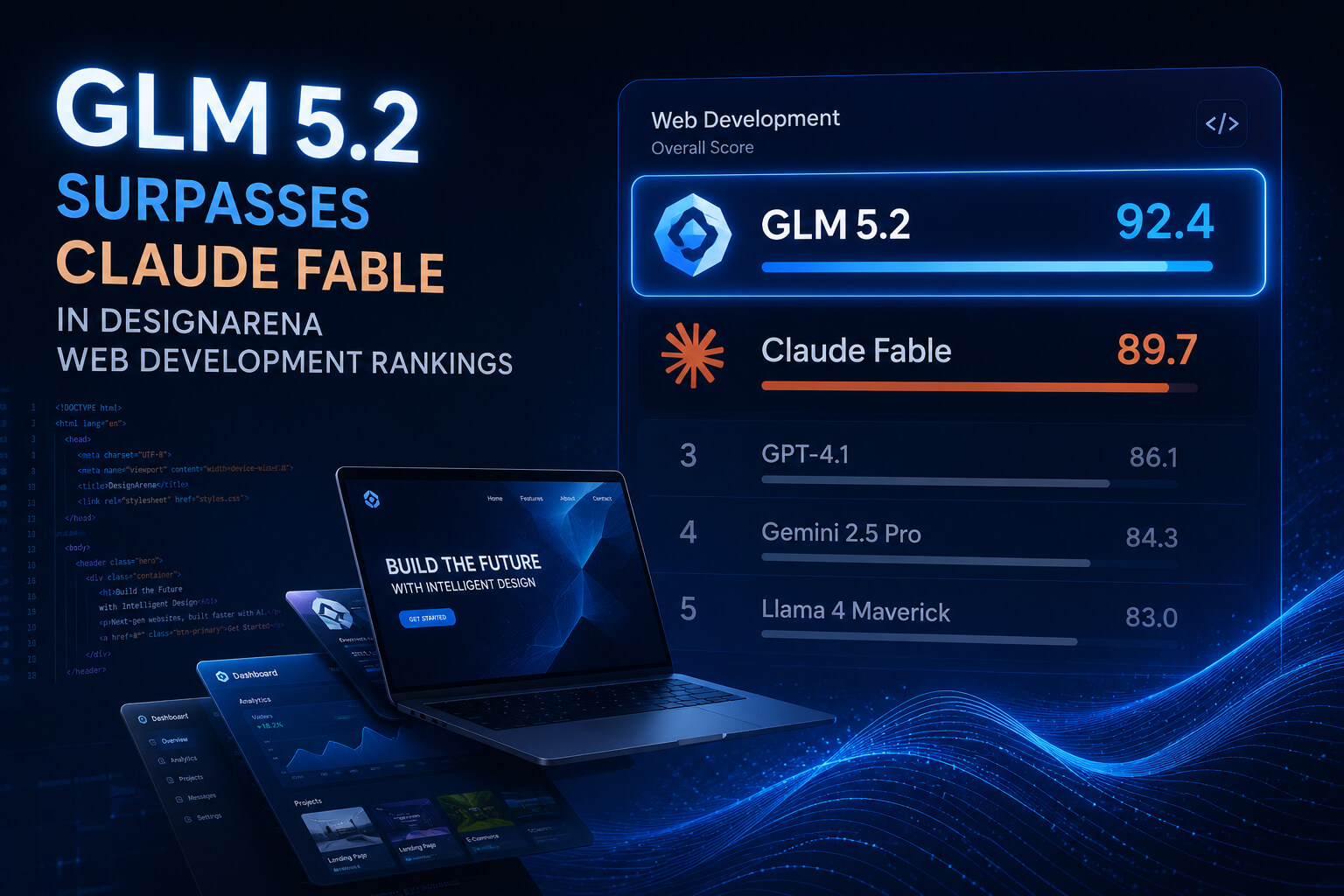
Z.ai’s latest open-weight AI model, GLM 5.2, is creating a buzz after besting Claude Fable on DesignArena’s non-agentic web development leaderboard. The result is yet another major milestone for open-weight AI models, especially as developers are looking for systems that can tackle complex coding tasks without relying on agentic workflows.
According to the DesignArena ranking, GLM 5.2 is the top non-agentic web development model, beating out Claude Fable on Elo ratings. This category is unlike the agentic benchmarks that evaluate autonomous planning and tool use, in this task the user-to-model task is direct, and the model has to generate robust outputs from a single prompt or controlled interaction.
How is GLM 5.2 different?
GLM 5.2 is built for long-context engineering work, so it performs well on tasks that involve understanding large codebases, detailed project instructions, and long development requirements. This ability appears to be a major factor in its strong performance in DesignArena.
The leaderboard assesses models on real-world web development problems like pitch websites, UI components, data visualization, games, and 3D outputs, and these are not purely theoretical challenges. They reflect how well AI models perform in user-facing development scenarios where quality, structure, and execution matter.
By ranking ahead of Claude Fable, GLM 5.2 shows that open-weight models are becoming more competitive against leading closed-source AI systems.
Why the DesignArena Ranking Matters
DesignArena’s non-agentic category is important because it measures direct performance. In other words, the model does not depend on complicated agent loops, external tools, or multi-step autonomous planning to achieve strong results.
This makes the ranking useful for developers who want fast, reliable AI support for coding and design tasks. The strong non-agentic score indicates that GLM 5.2 can produce good outputs even when users are using it in a more direct and simple way.
For web developers, this could mean better single-prompt generation, stronger context retention, and more consistent execution across longer instructions.
Open-Weight AI Models Are Closing the Gap
The rise of GLM 5.2 adds to a broader trend in artificial intelligence: open-weight models are becoming serious competitors to proprietary frontier models. While closed models from major AI labs still dominate many benchmark discussions, open-weight alternatives are increasingly showing strength in practical development workflows.
GLM 5.2’s performance suggests that open models can compete not only in research settings but also in real-world coding and design tasks. This is especially important for developers, startups, and organizations who want more control over how they deploy, customize, and integrate AI models into their existing systems.
Long-Context AI Is Becoming More Important
One of GLM 5.2’s biggest advantages is its long-context capability. In software engineering, context is everything. A model that can process more instructions, files, and dependencies has a better chance of maintaining consistency throughout a project.
This is important for web development because even if the output is a single page, there is design logic, component structure, styling, interactivity and user experience decisions involved. If a model loses track of earlier instructions, the final result can feel incomplete or inconsistent.
GLM 5.2’s strong showing suggests that long-context design is becoming a major factor in AI coding performance, even outside fully agentic environments.
What This Means for Developers
The success of GLM 5.2 could offer developers another strong option for AI-assisted coding. Its strong performance on non-agentic web development tasks makes it particularly relevant to users looking for direct help with UI generation, application prototypes, and coding workflows without the need for complex automation systems.
It also shows a change in the AI model race. The best model isn’t always the one with the biggest brand name. Increasingly, developers are comparing models on specific use cases such as coding accuracy, context handling, cost, openness and ease of integration.
The Bigger Picture
GLM 5.2 surpassing Claude Fable in DesignArena’s non-agentic rankings is more than a benchmark update. It reflects the growing strength of open-weight AI and the increasing importance of long-context performance in software development.
As AI coding tools continue to evolve, developers may have more competitive options beyond the most popular closed-source models. GLM 5.2’s result shows that open-weight systems are no longer just experimental alternatives. They are becoming practical contenders for real development work.
The ranking is a sign that the AI industry is becoming more competitive, with open and closed models continuing to push each other.
