


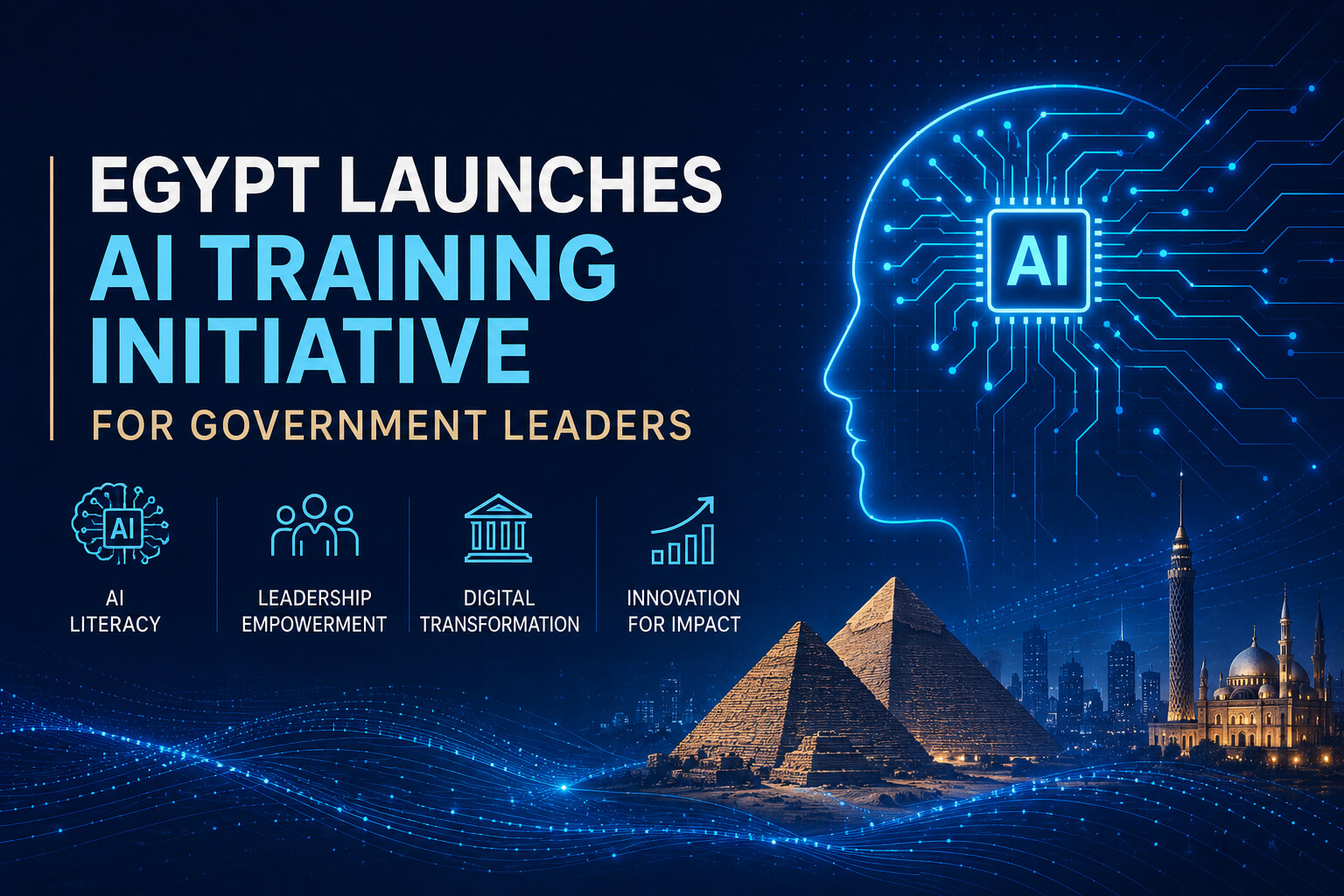
Egypt has launched a new national artificial intelligence training initiative. It is designed to prepare senior government leaders for the next phase of digital transformation.
In a joint effort between Egypt’s Ministry of Communications and Information Technology and the National Training Academy, the Artificial Intelligence for Government Organization Leaders National Initiative was introduced. This program is designed to provide decision-makers in the public sector with hands-on experience of AI and digital leadership skills. In addition, it aims to offer a deeper understanding of responsible AI implementation in government institutions.
The move comes as Egypt continues to bolster its national AI agenda as part of the National AI Strategy 2025-2030. This strategy focuses on governance and data, infrastructure, technology, talent development and ecosystem growth.
What Is Egypt’s New AI Training Initiative?
The Egypt AI training initiative is designed for leaders across government organizations. Its primary aim is to support public sector leaders. They will learn how to safely, ethically and effectively deploy artificial intelligence in institutional operations and public services.
The training program addresses several key technology areas:
- Strategic leadership in the AI era
- Generative AI
- Agentic AI
- Digital twins
- Cybersecurity
- Data protection
- Data governance
- Legal and ethical AI frameworks
- Responsible use of smart digital systems
This is not an introductory awareness program, but rather a blend of theory and practical applications. It includes pre- and post-assessments, hands-on training, and graduation projects. This suggests participants will be expected to apply what they learn to real institutional challenges.
Why Egypt is training government leaders in AI
Artificial intelligence is playing an increasingly central role in how governments deliver services, manage data, and improve institutional performance. For Egypt, training senior leaders is a critical step to ensure AI is adopted responsibly and not just adopted.
Government leaders are often the ones to approve new digital systems, oversee public service transformation and set institutional priorities. Without a strong understanding of AI, decision-makers may struggle to evaluate opportunities, risks and governance requirements.
This effort aims to fill that gap by providing leaders with the knowledge to lead AI projects, protect sensitive data, and ensure AI-driven systems meet national and international standards.
Supporting Egypt’s National AI Strategy 2025–2030
The new training program supports Egypt’s broader National AI Strategy 2025–2030. The strategy aims to bolster Egypt’s position as a regional AI leader. Additionally, it will leverage artificial intelligence to support social and economic development.
Egypt’s AI strategy highlights the development of national capabilities including technical talent, digital infrastructure, data governance, innovation and the development of a responsible AI ecosystem.
Egypt is focusing on leadership readiness, not just technical AI development, by training government leaders. This is important because the large-scale adoption of AI in the public sector depends on more than software and infrastructure. It also requires leaders who understand governance, ethics, cybersecurity, and institutional change.
Focus on Generative AI, Agentic AI and Digital Twins
One of the more interesting aspects of the initiative is its focus on emerging AI technologies. These technologies are already changing the operations of both the public and private sectors.
Generative AI can assist government agencies to boost productivity, automate content creation, support citizen services and analyze large volumes of information.
Agentic AI is AI systems that can act, do things, and operate at a higher level of autonomy. For government institutions this opens up new opportunities, but also raises important questions around control, accountability and oversight.
Digital twins help organizations create virtual copies of physical systems, infrastructure or processes. For government, digital twins can enable planning, simulation, resource management and service optimization.
The inclusion of these topics suggests that Egypt’s training initiative is preparing public sector leaders for advanced AI use cases. Rather than limiting the program to basic digital literacy, it aims for higher expertise.
Responsible AI and Data Governance are Key Themes
The initiative also focuses on responsible AI. Attendees will be taught about legal and ethical frameworks, cybersecurity, data protection and data governance in the age of AI.
These areas are growing in importance as governments increasingly use AI tools that could handle sensitive information. They may affect public services, or help with decisions related to administration.
Responsible AI governance provides for transparent, secure, fair, and human-centered AI systems that are consistent with human oversight. This is of particular importance for public institutions. Government AI systems need to be trusted by the public while increasing efficiency.
Building on the Digital Egypt Leaders Initiative
The new AI program builds on the existing partnership between MCIT and the National Training Academy. The two organizations previously worked together on the Digital Egypt Leaders National Initiative. That initiative focused on developing qualified national talent to support institutional digitalization.
The AI program is the next step in that partnership. Previous digital leadership programs focused on the broader digital transformation. However, this new program zeroes in on artificial intelligence and the skills needed to govern and apply AI across public institutions.
What This Means for Egypt’s Digital Future
Egypt’s launch of a national AI training program for government leaders is part of a broader global trend. Countries are increasingly aware that AI readiness is not just about building tools or attracting investment. It is also about preparing institutions and leaders to responsibly manage the technology.
The initiative could assist Egypt in enhancing the efficiency of its government, increasing innovation in the public sector, and facilitating the development of AI-powered services. It could also aid public institutions in adhering to international best practices in digital governance and responsible AI.
As AI comes to the fore in government operations, leadership training will be critical to making sure the technology delivers genuine public value. Egypt’s new initiative is a signal that the country is investing not only in AI systems, but in the people who will steer their use.
