


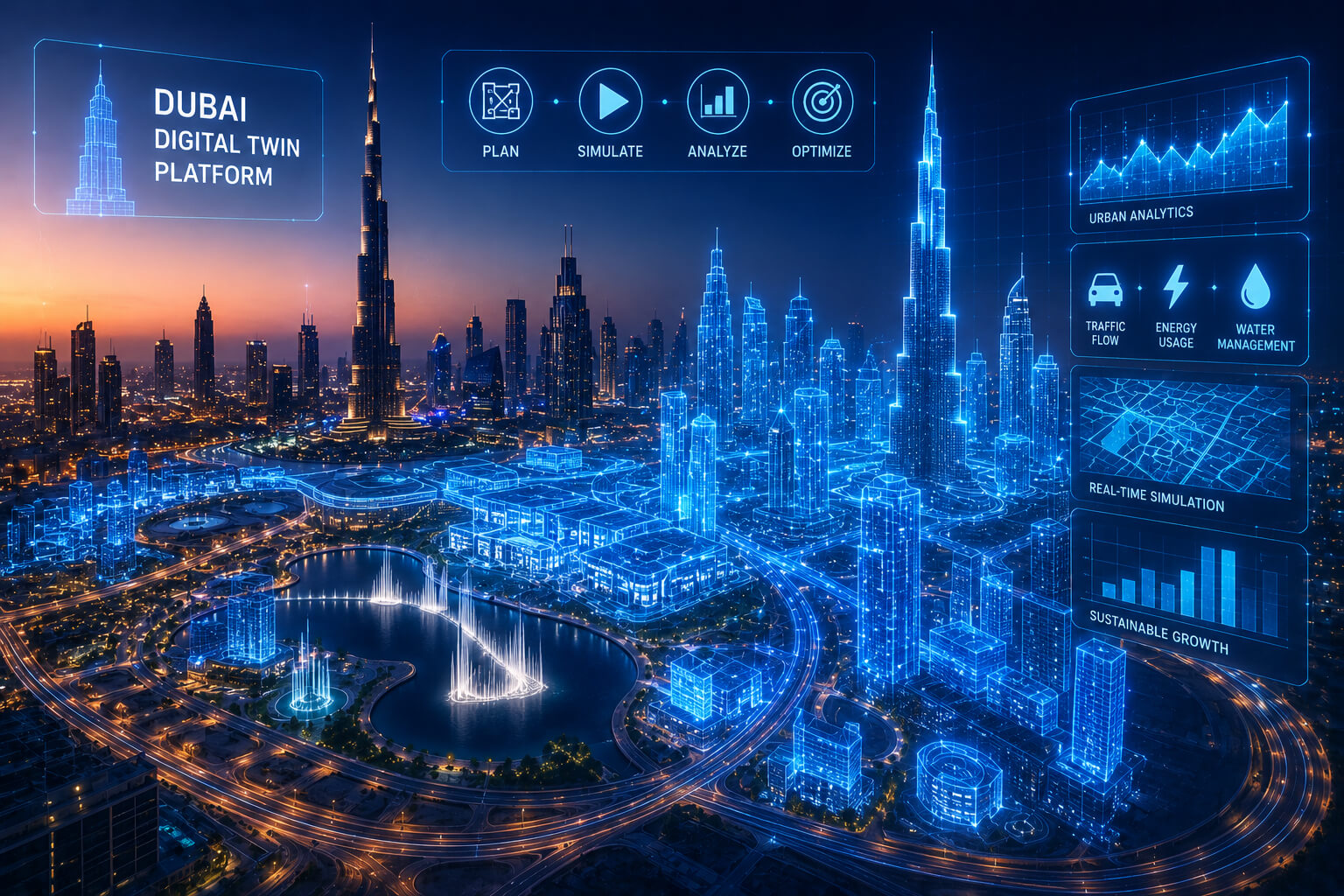
Dubai has launched the Dubai Digital Twin Platform, a city-scale virtual replica of the emirate designed to help government teams, planners, and infrastructure leaders see the city in a more connected way. Not as flat maps. Not as scattered files sitting across departments. A living 3D environment that brings buildings, assets, public facilities, infrastructure, and planning data into one digital layer.
The launch marks phase three of the project and took place on Thursday, July 2, 2026, with Dubai Crown Prince H.H. Sheikh Hamdan bin Mohammed bin Rashid Al Maktoum and Sheikh Ahmed bin Mohammed bin Rashid Al Maktoum, Second Deputy Ruler of Dubai, attending the event. Dubai Municipality announced the platform as part of the emirate’s wider push toward smarter, more sustainable city management.
What the Dubai Digital Twin Platform Includes
The scale is the part that stands out first. The platform includes more than 1,500 geospatial data layers, along with 3D renderings of around 280,000 infrastructure assets and 195,000 buildings across the emirate. It also supports over 100 two-dimensional and three-dimensional applications covering buildings, infrastructure, public facilities, and master plans.
That sounds technical, but the point is simple. Dubai now has a digital environment where city systems can be studied, tested, compared, and managed before decisions hit the ground. For a fast-moving city, that matters. A lot.
Why This Is More Than a 3D Map
A digital twin is easy to misunderstand. It is not just a pretty 3D version of Dubai. It is not a visual showcase built for presentations. The real value is in the data behind it.
The Dubai Digital Twin Platform can support urban planning simulations, infrastructure and asset management, rainfall modelling, scenario planning, and other digital tools that help officials make decisions with a clearer view of the city. That means future developments, road networks, public facilities, buildings, and service systems can be reviewed in a connected environment instead of being treated as separate pieces.
This is where the project becomes interesting. Dubai is not only digitizing what already exists. It is building a system that can help test what might happen next.
City Planning Gets a New Operating System
Urban planning usually moves through reports, maps, engineering files, surveys, site visits, and long coordination chains. The digital twin does not remove all of that, but it changes the rhythm. It gives planners and decision-makers a shared model of the city, updated with layers of information that can support faster and better-informed choices.
For Dubai, this could help with construction planning, infrastructure upgrades, emergency readiness, public service delivery, and long-term development. It also gives different government entities and partners a common digital reference point, which is often where big city projects either move quickly or get stuck.
The platform connects buildings, infrastructure, landmarks, residential units, public facilities, and master plans into one environment for analysis and decision support. That is not a small shift. It turns the city into something that can be read, simulated, and adjusted with far more precision.
Rainfall Simulation Shows the Practical Side
One of the most practical use cases highlighted in the platform is rainfall simulation. That may not sound as futuristic as AI robots or autonomous transport, but it is exactly the kind of function cities need as climate pressure grows and urban systems become more complex.
Rainfall modelling can help planners understand how water may move through roads, drainage systems, communities, and infrastructure zones. In a city that continues to expand, these simulations can support better preparedness and smarter infrastructure design.
This is the side of smart city technology that often matters most. Not the buzzword. The ability to see a problem before it becomes expensive, disruptive, or dangerous.
Dubai Expands the Digital Twin Ecosystem
Dubai Municipality also signed memorandums of understanding with Al-Futtaim Group and Huawei to expand the Digital Twin ecosystem. The next phase is expected to focus on research, future foresight, and wider sector integration.
That signals the platform is not being treated as a one-time government technology launch. Dubai appears to be building an ecosystem around it, with private-sector partners, technical capabilities, and broader use cases expected to grow over time.
The timing fits Dubai’s bigger economic and technology ambitions. The platform aligns with the Dubai Economic Agenda D33, which aims to double the size of Dubai’s economy over the next decade and strengthen the city’s role as a global benchmark for smart city development.
A Bigger Step in Dubai’s AI and Smart City Strategy
The Dubai Digital Twin Platform did not appear from nowhere. Dubai Municipality has been building digital city capabilities for years, layering geospatial data, AI, analytics, and IoT-connected systems into urban operations.
At GITEX Global in October 2025, Dubai Municipality introduced Dubai Live, a real-time city operations platform that brings infrastructure data, construction activity, planning updates, and mobility systems across land, air, and maritime transport into one hub. It also has Dubai Here, a web and mobile application that gives professionals access to 2D and 3D maps of assets, buildings, service networks, and landmarks across the emirate.
The new Digital Twin platform takes that direction further. It gives Dubai a more complete model of its built environment, with large-scale 3D modelling and geospatial intelligence sitting at the center of planning and operations.
Why It Matters for AI-Driven Cities
Cities are becoming too complex to manage with old planning tools alone. Traffic, buildings, utilities, climate risk, population growth, mobility systems, energy use, and public services all interact with each other. A change in one area can affect another. A digital twin helps make those relationships easier to understand.
For Dubai, this platform could become a core part of how the city plans, tests, and manages future development. It gives the emirate a digital foundation for smarter decisions, stronger infrastructure readiness, and more coordinated public services.
The bigger message is clear enough. Dubai is not waiting for the future city to arrive. It is trying to model it, stress-test it, and build it with data already in hand.
