


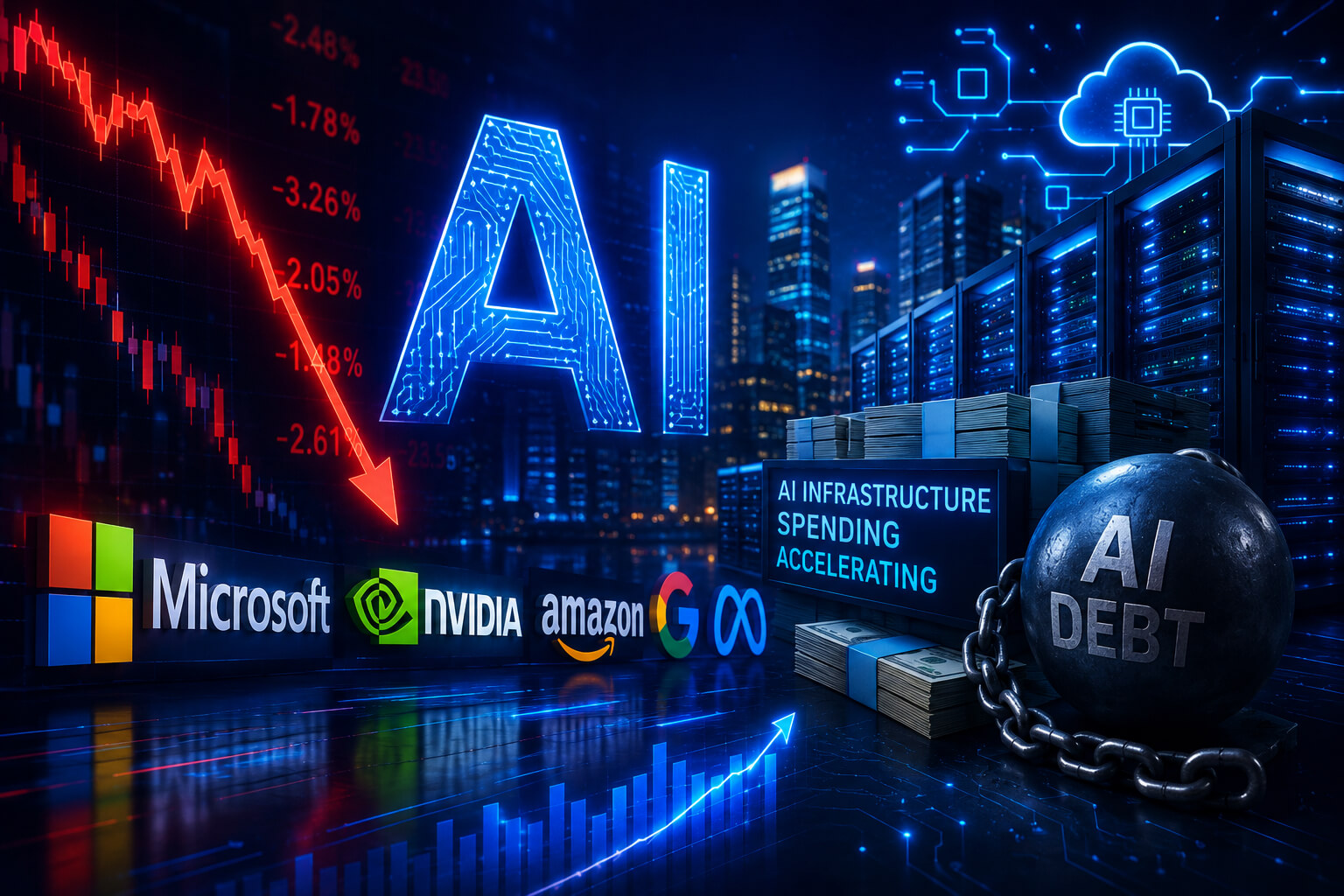
Technology companies are turning to equity sales, bond offerings and bank loans to fund the next phase of artificial intelligence expansion, raising fresh concerns among investors about the growing cost of the AI boom.
The latest wave of capital raising highlights a major shift in how the world’s biggest technology companies are financing AI infrastructure. For years, many large tech firms relied heavily on strong cash reserves and operating cash flow to support cloud growth, research and product development. Now, the scale of AI investment has become so large that companies are increasingly looking to financial markets for additional support.
The result is a growing debate on Wall Street: can AI deliver returns fast enough to justify the massive spending on data centers, advanced chips, energy capacity and cloud infrastructure?
AI Spending Enters a More Expensive Phase
The AI race has moved beyond software models and chatbots. Companies now need large-scale computing power to train, deploy and support advanced AI systems. That requires billions of dollars in capital expenditure for servers, semiconductors, networking equipment, power supply and real estate.
This infrastructure buildout has created a new financial challenge. Even highly profitable technology companies are facing pressure to balance innovation with capital discipline. Equity sales and debt issuance may help fund growth, but they also raise questions about dilution, leverage and long-term profitability.
Investors are no longer focused only on who is leading in AI. They are also asking how much it costs to stay in the race.
Why Tech Equity Sales Are Raising Concern
Equity sales can give companies fresh funding without immediately increasing debt. However, they may also signal that AI spending needs are becoming too large to fund through existing cash alone.
For credit investors, equity issuance may be viewed as a way to protect balance sheets. For stock investors, however, it can create concerns about dilution and future returns. The issue becomes more serious when companies combine equity sales with large bond offerings, private credit arrangements or bank loans.
This mix of financing has renewed worries about an AI debt binge, especially as companies commit to long-term infrastructure projects before the full commercial returns from AI are clear.
The AI Debt Binge Becomes a Market Concern
The growing use of debt to fund AI infrastructure has become one of the most closely watched trends in technology finance. Major cloud providers, semiconductor customers and AI infrastructure companies are spending heavily to secure computing capacity.
Debt can help companies move quickly, but it also adds risk. If AI revenue growth slows or margins fail to meet expectations, companies with large borrowing needs could face pressure from higher interest costs, weaker cash flow or credit-rating concerns.
This does not mean the AI boom is collapsing. Many leading tech companies still have strong earnings, powerful cloud businesses and dominant market positions. However, investors are becoming more selective. They want clearer evidence that AI investments can generate sustainable revenue, not just higher spending.
Data Centers and Chips Drive the Financing Boom
Much of the funding demand comes from data centers and AI chips. Advanced AI models require huge computing clusters, and demand for graphics processing units and other accelerators remains high.
Companies are also investing in energy infrastructure, cooling systems and specialized cloud environments designed for AI workloads. These projects are expensive and often require long planning cycles.
As AI adoption grows across industries, demand for computing capacity may remain strong. But the key question is whether companies can monetize that capacity fast enough to support the amount of capital being deployed.
Investors Shift From AI Hype to AI Returns
The market conversation around AI is changing. In the early phase of the boom, investors rewarded companies that announced major AI initiatives. Now, they are paying closer attention to revenue growth, margins, capital spending and balance sheet strength.
This shift marks a more mature phase for the AI industry. Companies can no longer rely only on excitement around artificial intelligence. They must show that AI products, cloud services and enterprise tools can produce measurable financial results.
The pressure is especially high for companies making aggressive infrastructure commitments. If they succeed, they could control the backbone of the AI economy. If returns disappoint, the same investments could become a financial burden.
What This Means for the AI Industry
The renewed concerns around tech equity sales and AI-related borrowing show that artificial intelligence is becoming a capital-intensive industry. The next stage of AI growth may depend not only on model performance, but also on financing strategy.
Companies with strong balance sheets may have an advantage because they can fund infrastructure while absorbing market volatility. Smaller or more leveraged players may face greater pressure as borrowing costs, investor expectations and competition increase.
The AI sector is still expanding rapidly, but the financial risks are becoming harder to ignore. As more companies raise capital to fund AI projects, investors will be watching whether the spending turns into real earnings growth.
Conclusion
Tech equity sales are renewing worries about the AI debt binge as companies race to finance massive infrastructure needs. Data centers, chips and cloud systems remain essential to the future of artificial intelligence, but the cost of building that future continues to rise.
The next test for the AI market will be profitability. Investors want to see whether the billions flowing into AI infrastructure can produce sustainable returns. Until then, the AI boom will remain both one of the most powerful growth stories in technology and one of the most closely watched risks in global finance.
