


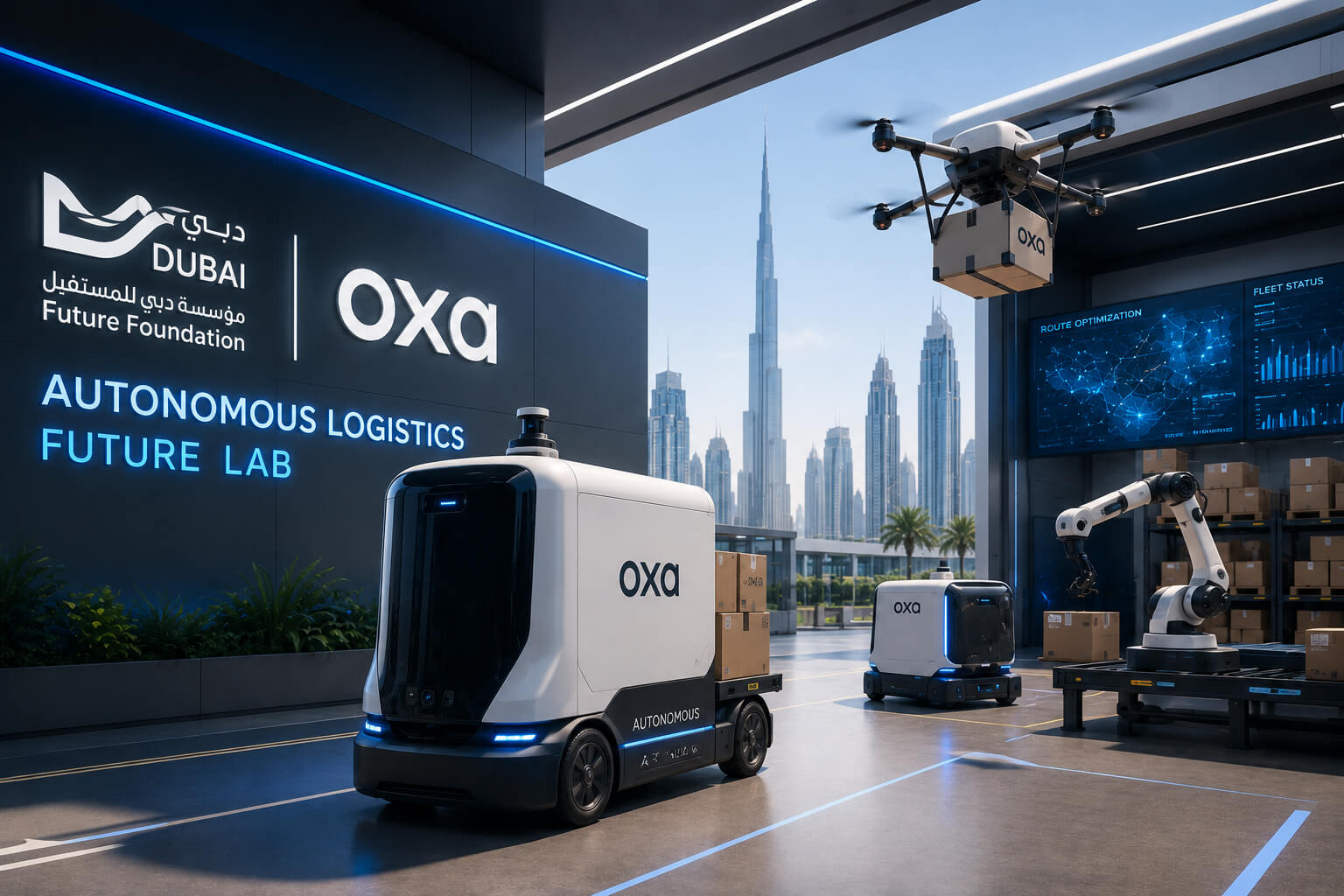
Dubai is moving its autonomous vehicle ambitions away from public roads and into the places where goods actually move.
Dubai Future Foundation and UK autonomous vehicle technology company Oxa have launched the Autonomous Logistics Future Lab, a new initiative focused on developing self-driving systems for ports, airports and other industrial environments.
The two organisations formed a joint venture called SHIFFT to run the programme. Rather than stopping at demonstrations, the venture plans to test autonomous logistics technology, validate it in working environments and turn it into commercial systems that operators can deploy at scale.
SHIFFT Will Build Autonomous Systems for Industrial Sites
The Autonomous Logistics Future Lab sits under the Dubai Research, Development and Innovation Ecosystem. SHIFFT will bring together autonomous driving software, fleet management tools, specialised hardware and operational data. The goal is to create an integrated platform capable of handling vehicle movements across complex industrial sites.
That matters because autonomous logistics involves more than teaching a vehicle to drive from one point to another. Ports and airports operate around tightly controlled routes, loading schedules, restricted zones, heavy equipment and constant changes in traffic.
A useful autonomous system needs to understand that entire environment. It must also share information with fleet managers and existing site systems instead of operating as a standalone vehicle.
SHIFFT plans to combine autonomous operations with worksite data collection, analysis and operational intelligence. That could give logistics operators a clearer picture of vehicle activity while helping them manage fleets, reduce delays and respond faster when conditions change.
Ports and Airports Will Come First
The first phase will focus on autonomous vehicle deployments at ports and airports. Those sites offer a practical starting point. Vehicles often follow repeatable routes, carry predictable loads and work inside controlled areas. Operators can also introduce autonomous systems gradually without immediately placing them in unpredictable public-road traffic.
Dubai Future Foundation and Oxa aim to secure the first commercial deployment in Dubai before the end of 2027. The announcement did not identify a specific port, airport or fleet operator for that initial rollout.
The timeline gives the partners less than two years to move from laboratory development into a revenue-generating deployment. That is a much tougher target than running a short pilot with a handful of vehicles.
Oxa Brings Configurable Self-Driving Technology
Oxa will provide technology designed for industrial vehicle fleets rather than a single vehicle model.
Its autonomous vehicle platform includes configurable self-driving software, cloud-based fleet management and modular autonomy hardware that can connect with existing industrial vehicles and equipment. This approach could allow operators to automate parts of their current fleets instead of replacing every vehicle at once.
The company describes its wider strategy as Industrial Mobility Automation. Its technology targets environments such as ports, factories, distribution centres and other private industrial sites where vehicles perform repetitive but essential jobs.
Oxa has already worked on autonomous logistics projects involving industrial vehicles and yard tractors in the United Kingdom. Those projects give SHIFFT a starting point, although Dubai’s climate, infrastructure and operating requirements will still demand local testing and adaptation.
The Lab Is Built Around Commercial Deployment
Dubai has no shortage of innovation programmes. SHIFFT stands out because its stated target is commercial use. The lab will test whether autonomous systems can deliver measurable improvements in productivity, fleet reliability, safety and operational resilience. If the technology works only in carefully managed demonstrations, it will not solve much for a busy cargo terminal.
Khalifa Al Qama, Chief of Dubai’s RDI Ecosystem, said the lab will help turn advanced technologies into practical logistics solutions that create economic and operational value. Oxa founder and CEO Paul Newman said the venture would speed up the commercial deployment of industrial mobile autonomy and help fleet operators improve efficiency, reliability and safety.
Autonomous Logistics Supports Dubai’s D33 Agenda
The project also feeds into the Dubai Economic Agenda, known as D33. Dubai wants to double its foreign trade by 2033. Reaching that target will place more pressure on ports, airports, warehouses and freight networks to process larger volumes without allowing delays and operating costs to climb at the same pace.
Autonomous vehicles will not solve every bottleneck. Cargo movement also depends on customs systems, warehouse capacity, labour, road connections and global demand.
Still, automating repetitive vehicle movements inside controlled sites could help logistics operators use their fleets more consistently. Vehicles can be assigned around the clock, fleet activity can be tracked centrally and data from each movement can feed back into site planning. The SHIFFT platform is being designed around that broader operational picture rather than autonomy alone.
Dubai Expands Its Work in Robotics and Physical AI
The Autonomous Logistics Future Lab fits into Dubai Future Foundation’s existing work in robotics, artificial intelligence and autonomous systems. Dubai Future Labs has already explored warehouse robots, last-mile delivery machines, unmanned aerial vehicles and electric connected autonomous vehicles for logistics. Its role includes developing technology while also helping organisations deal with testing facilities, technical requirements and regulatory barriers.
SHIFFT pushes that work further into industrial mobility. The immediate target is not a robot delivering coffee across a residential community. It is larger vehicles moving cargo and equipment around high-value infrastructure where a stalled fleet can disrupt entire supply chains.
Commercial deployment by the end of 2027 will be the real test. Until then, the interesting part is not that Dubai has opened another future lab. It is that this one already has a deadline for leaving the lab behind.
