


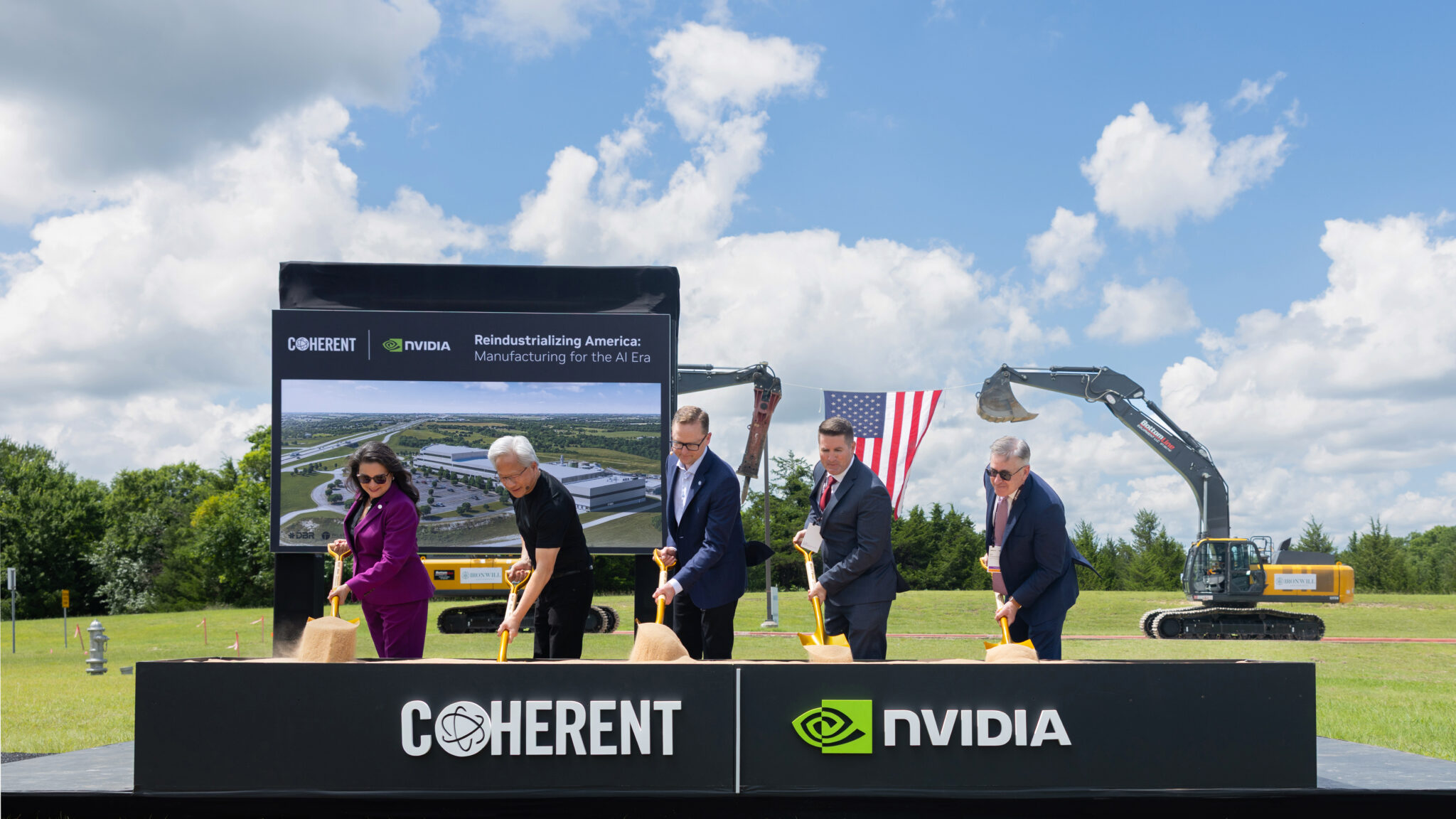
Coherent Breaks Ground on Expanded Sherman, Texas Manufacturing Facility. This is a major step forward for optical technology driving modern AI data centers. The new development establishes the Coherent Texas AI optical facility as a major hub for the future of artificial intelligence hardware.
The expansion is intended to increase production of indium phosphide, or InP, wafers, which are used in lasers, transceivers and optical networking components. These technologies move data between chips, servers and data centers at very high speeds. They are crucial for the growth of advanced AI systems.
At the groundbreaking, in attendance were NVIDIA founder and CEO Jensen Huang, Coherent CEO Jim Anderson, Sherman Mayor Shawn Temann and Texas economic development officials. This highlights how AI infrastructure today depends not only on GPUs and software but high-performance optical connectivity. Consequently, this demonstrates the strategic role the Coherent Texas AI optical facility will play in the industry.
Why Coherent’s Texas Expansion Matters for AI
As AI models and data centers grow larger, the need for faster and more efficient data movement is rising sharply. Traditional copper connections become less practical over longer distances inside massive AI systems, especially as data transfer speeds increase.
Optical networking helps solve that problem by using light to move information across racks and data centers. This is especially important for large-scale AI systems. In such systems, hundreds or thousands of processors must work together as one connected computing platform.
Coherent’s Sherman facility is expected to play a key role in producing the optical components needed for this AI buildout. The company operates what it describes as the world’s first volume-production 6-inch indium phosphide fab. This offers a major advantage in scaling production for AI networking demand.
CHIPS Act Funding Supports U.S. AI Manufacturing
The expansion is also being supported by a $50 million CHIPS Act grant. This funding builds on earlier support from the Texas CHIPS program and the Sherman Economic Development Corporation.
The investment reflects a broader push to strengthen semiconductor and advanced manufacturing supply chains in the United States. While much of the AI hardware conversation focuses on GPUs, optical components are becoming just as important. This is because AI factories and data centers become larger and more complex. Moreover, the growth of the Coherent Texas AI optical facility marks a significant advance toward domestic technological leadership.
AI systems need to communicate effectively, and high-speed optical components based on indium phosphide and other compound semiconductors can help. Such an optical backbone could avoid major bottlenecks in speed, power efficiency and scalability in AI infrastructure.
NVIDIA, Coherent Double Down on AI Infrastructure Partnership
NVIDIA and Coherent have been partners for some 20 years, but the partnership’s become even more relevant as AI infrastructure expands. Earlier this year, NVIDIA announced a $2 billion investment in Coherent to support research and development. The investment also supports future capacity and U.S.-based manufacturing.
The companies are also tied through a multibillion-dollar purchase commitment for advanced laser and optical networking products. These components are expected to support NVIDIA’s growing AI networking stack. This includes technologies that connect GPUs and servers across large-scale AI data centers.
For NVIDIA, optical networking is becoming essential as its AI systems scale beyond individual racks. In large AI platforms, copper connections can become less efficient and consume more power. However, optical links offer a more practical way to move data over longer distances. This further enhances the profile of the Coherent Texas AI optical facility within the global supply chain.
6-Inch Indium Phosphide Wafers Could Help Scale AI Optics
One of the most important parts of Coherent’s expansion is its focus on 6-inch indium phosphide wafer production.
Most indium phosphide production has historically relied on smaller 3-inch and 4-inch wafers. Moving to 6-inch wafers allows manufacturers to produce more parts per run. As a result, this boosts output and helps drive down costs as demand grows.
That’s important because AI data centers require vast numbers of optical modules, lasers and transceivers. As more companies build AI factories and high-performance computing clusters, the supply of optical components could be a major constraint. This will affect how quickly AI infrastructure can scale.
Jobs and Economic Impact in Sherman, Texas
Coherent expects the expanded Sherman site will support more than 550 direct jobs at full build out. This will occur along with thousands of direct and indirect jobs associated with the project.
The facility also highlights Sherman as an emerging center in the AI manufacturing boom. While cities like Silicon Valley often get associated with AI software, places such as Sherman are becoming increasingly critical. They are now vital to the physical infrastructure behind artificial intelligence.
The expansion shows that the AI economy is spreading beyond cloud platforms and chip design. It is now moving into manufacturing, construction, logistics, energy and skilled technical labor.
AI Infrastructure Depends on Connectivity
The key message from the groundbreaking is clear: AI does not scale on compute alone.
GPUs are essential, but massive AI systems also need fast, efficient, and reliable ways to move data. Optical networking is becoming one of the most important technologies enabling that shift.
Coherent’s Texas expansion is therefore more than a factory project. It is part of the larger race to build the physical backbone of the AI era.
As AI systems become more powerful, demand for advanced optical components will likely continue to grow. Supported by the CHIPS Act and a larger manufacturing footprint in Texas with backing from NVIDIA, Coherent is positioning itself to be a key supplier for the next generation of AI infrastructure. In summary, the Coherent Texas AI optical facility is poised to shape the direction of AI hardware and data center technology for years to come.
Key Takeaway
Coherent’s strengthened Sherman, Texas facility could become a big part of the U.S. AI infrastructure supply chain. By increasing production of indium phosphide wafers and optical networking components, the company is helping to address one of the biggest challenges in AI. The biggest challenge is moving data fast enough to keep up with more powerful systems.
