


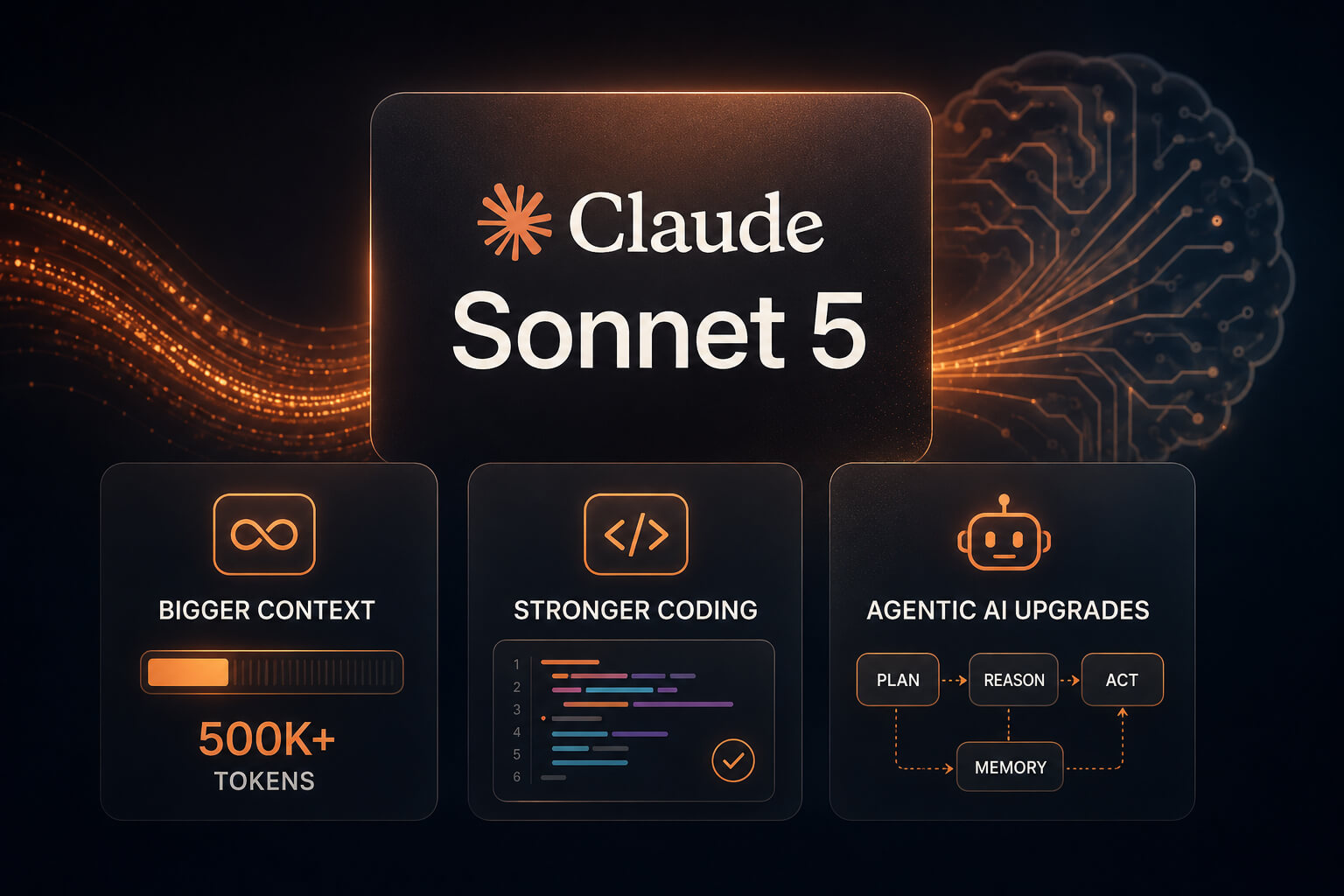
New Claude Sonnet 5 leaks are fueling speculation that Anthropic may be preparing a major upgrade to its popular Sonnet model family. While Anthropic has not officially announced Claude Sonnet 5, recent online discussions point to a next-generation model that could focus heavily on coding, long-context reasoning, faster responses, and more advanced agentic AI workflows.
According to circulating reports, the rumored model has been associated with an internal codename, “Fennec,” and may be designed to deliver a stronger balance between performance and cost. For developers, researchers, and enterprise users, the most discussed claim is a possible 1 million token context window, which would represent a major leap for handling large documents, codebases, research files, and multi-step projects.
However, the details remain unconfirmed. Until Anthropic shares official specifications, all claims around Claude Sonnet 5 should be treated as speculation.
What the Claude Sonnet 5 Leaks Claim
The latest Claude Sonnet 5 leaks suggest that Anthropic may be working on a model built for more demanding AI workflows. The most widely discussed rumored upgrades include:
- A possible 1 million token context window
- Stronger coding and software engineering performance
- Faster response times and lower latency
- Better handling of large repositories and technical documents
- More autonomous agentic behavior
- Improved price-to-performance compared with higher-end models
- Stronger support for enterprise automation and research tasks
The rumored improvements appear to follow a broader trend in the AI industry: models are becoming less like basic chatbots and more like full productivity systems. Instead of simply answering prompts, next-generation AI tools are increasingly expected to manage longer tasks, reason across massive context windows, and operate with greater independence.
Why a 1 Million Token Context Window Would Matter
One of the biggest rumored features in the Claude Sonnet 5 leaks is a 1 million token context window. In practical terms, this could allow users to work with far more information in a single session.
For developers, that could mean analyzing large codebases without constantly splitting files across multiple chats. For researchers, it could make it easier to compare long reports, academic papers, transcripts, and datasets. For businesses, it could improve document review, internal knowledge search, policy analysis, and workflow automation.
A larger context window does not automatically guarantee better reasoning, but it can reduce one of the biggest limits in current AI workflows: losing important information because the model cannot keep enough material in view at once.
If Claude Sonnet 5 truly moves toward a 1 million token window, it could become especially useful for enterprise teams that need AI to process long, complex, and interconnected information.
Claude Sonnet 5 Could Focus Heavily on Coding
Another major part of the Claude Sonnet 5 leaks is coding performance. Anthropic’s Sonnet models have already built a strong reputation among developers, especially for software engineering, debugging, code explanation, and app-building workflows.
The rumored Claude Sonnet 5 upgrade could push that further by improving its ability to understand full projects, detect bugs, refactor code, and carry out multi-step development tasks. This would make the model more useful for developers working on larger applications, not just isolated scripts or small code snippets.
If the leaks are accurate, Claude Sonnet 5 may also improve autonomous coding workflows. That means the model could potentially plan, edit, test, and revise code with less step-by-step human instruction.
For software teams, this could make Claude Sonnet 5 a stronger assistant for code review, technical documentation, bug fixing, migration projects, and internal developer tools.
Agentic AI May Be a Major Upgrade
The term “agentic AI” refers to systems that can take actions across multiple steps to complete a goal. Instead of waiting for a new instruction after every response, an agentic model can plan a workflow, use tools, make decisions, and continue working toward an objective.
The Claude Sonnet 5 leaks suggest that agentic behavior may be one of the model’s biggest focus areas. This would fit with the direction of the AI market, where companies are competing to build models that can function as AI coworkers, coding agents, research assistants, and automation tools.
For businesses, stronger agentic capabilities could support tasks such as:
- Processing internal documents
- Drafting reports
- Managing research workflows
- Automating repetitive operations
- Assisting with customer support
- Reviewing contracts and policies
- Building and testing software features
Still, agentic AI also raises questions about reliability, oversight, and safety. More autonomous models need strong guardrails, especially when used in business-critical environments.
How Claude Sonnet 5 Could Compare With Earlier Sonnet Models
The Sonnet line has generally been positioned as a balance between intelligence, speed, and cost efficiency. Earlier versions of Claude Sonnet focused on general reasoning, writing, coding, and workplace productivity. More recent models have leaned further into software engineering, tool use, and complex reasoning.
If the rumored Claude Sonnet 5 features are accurate, the model could represent a bigger shift from conversational assistance to long-running productivity work. The main difference would not just be better answers, but the ability to manage larger, more complex tasks with fewer interruptions.
A simplified rumored comparison would look like this:
| Feature | Earlier Sonnet Models | Rumored Claude Sonnet 5 |
|---|---|---|
| Main focus | General reasoning, coding, productivity | Coding, agents, long-context workflows |
| Context handling | Large, but limited compared with rumored 1M window | Rumored 1M-token context |
| Coding | Strong | Potentially stronger for full projects |
| Agentic workflows | Improving | Expected to be a major focus |
| Enterprise use | Useful for documents and automation | Potentially stronger for large-scale workflows |
| Status | Officially released models | Unconfirmed leak-based speculation |
Why This Matters for AI Users
Claude Sonnet 5 could become important because many users want powerful AI models that are both capable and practical. Ultra-premium models may offer top-tier performance, but they are not always cost-effective for everyday work. Sonnet models are often attractive because they aim to combine strong performance with speed and usability.
If Claude Sonnet 5 delivers near-frontier performance at a lower operating cost, it could become a popular choice for developers, startups, researchers, and enterprise teams. A model with stronger coding, larger context, and better agentic abilities could also compete more directly with other advanced AI systems used for software development and business automation.
Anthropic Has Not Confirmed Claude Sonnet 5 Yet
Despite the growing discussion, Anthropic has not officially confirmed Claude Sonnet 5 at the time of writing. That means details such as the release date, pricing, benchmarks, context window, and feature set remain uncertain.
The leaks may point to where Anthropic is heading, but users should wait for an official announcement before making decisions based on the rumored specifications.
For now, Claude Sonnet 5 appears to be one of the most closely watched potential AI model releases. If even some of the leaked features are accurate, Anthropic’s next Sonnet model could be a major upgrade for coding, research, enterprise automation, and agentic AI workflows.
Key Takeaway
The Claude Sonnet 5 leaks suggest that Anthropic may be preparing a powerful new AI model focused on long-context reasoning, advanced coding, faster performance, and more autonomous workflows. The rumored 1 million token context window is especially notable, but none of these claims have been officially verified.
Until Anthropic confirms the model, Claude Sonnet 5 should be viewed as an exciting but unconfirmed development in the AI model race.
