


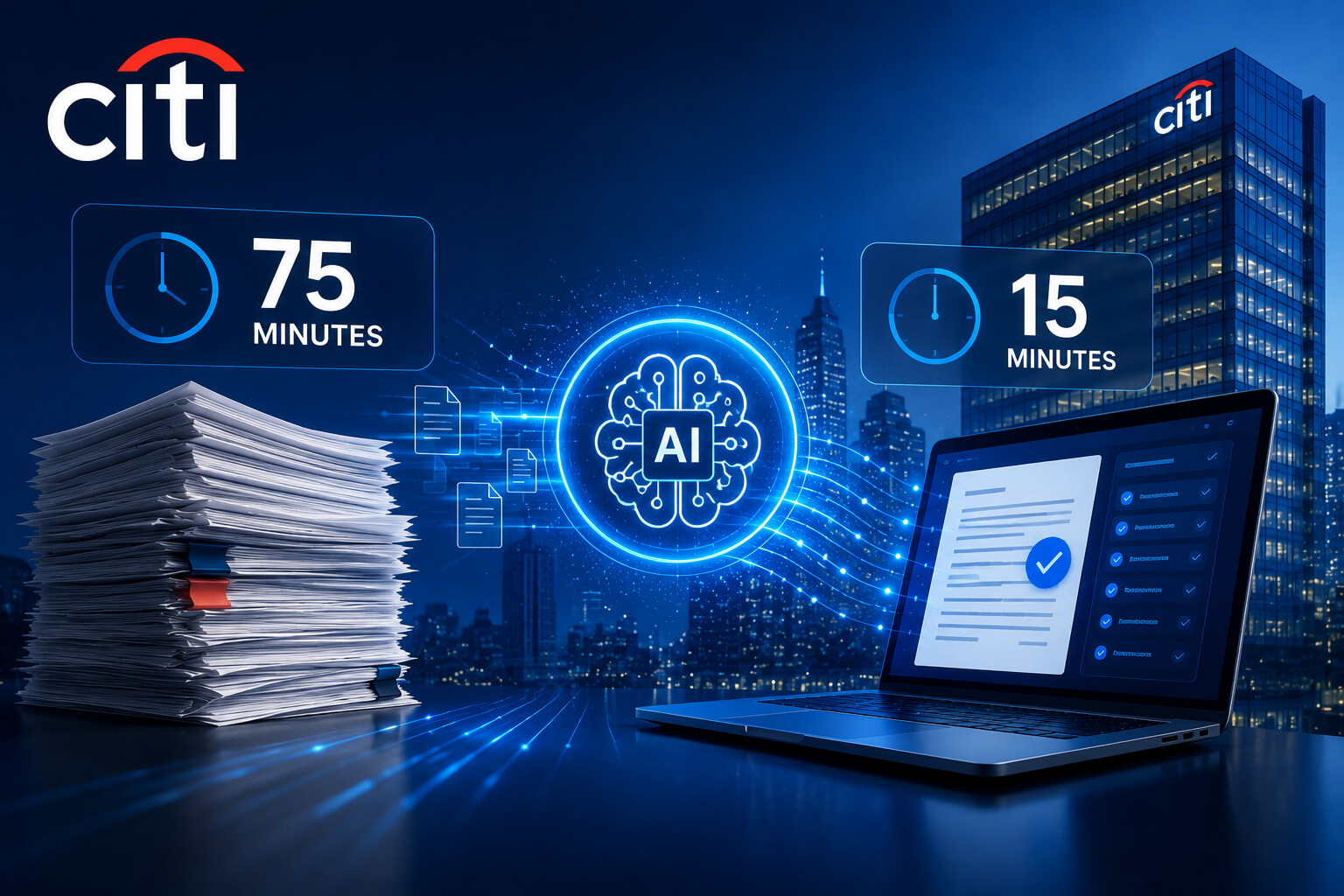
Citi is accelerating its use of artificial intelligence across banking operations, with one AI-powered workflow reducing document review time from 1 hour and 15 minutes to just 15 minutes.
The improvement was reported as part of Citi’s broader push to automate internal processes, modernize legacy systems, and improve productivity across the bank. According to the report, Citi has identified an initial 50 processes that it plans to automate using AI.
The bank’s early focus includes client onboarding, employee onboarding, know your customer processes, document review, coding automation, and data migration from older systems.
AI Speeds Up Account Opening at Citi
One of Citi’s clearest AI productivity gains is in account opening.
Banking teams often have to review documents, verify information and perform internal checks before an account can be opened, which can take time, especially in highly regulated financial services environments.
Citi is now using AI to streamline part of that process. In one U.S. In the services division workflow, the AI had reduced the time to review documents before opening an account from 75 minutes to just 15 minutes.
That represents a major reduction in manual review time and shows how AI can deliver measurable efficiency gains in banking operations.
Citi Targets 50 Processes for AI Automation
Citi has identified 50 initial processes for automation as part of its wider technology transformation.
The bank is not only using AI for document review. It’s also deploying the technology to automate coding, assist with data migration from legacy systems and improve operational workflows across the organization.
This suggests that Citi’s AI strategy is moving from experimentation to real enterprise deployment. Rather than employing AI in isolated pilot projects, Citi is applying the technology to practical banking tasks that affect productivity, compliance and client service.
Citi’s AI rollout keeps expanding across its workforce
By the end of 2025, more than 182,000 Citi staff in 84 countries were using the bank’s AI tools. The company has also introduced prompt training, with employees generating over 6.5 million prompts.
This approach to adoption demonstrates that Citi is treating AI as a productivity tool for the entire workforce, not a back-office tech project.
For large banks, teaching staff how to use AI tools could be just as crucial as the tools themselves. Successful adoption will depend on whether teams can utilize AI safely, accurately and effectively in regulated environments.
AI and the Future of Banking Operations
Citi’s adoption of AI reflects a larger trend in the financial services industry.
Banks are under pressure to speed up, cut costs, replace old technology and beef up compliance. AI is being used more and more to help process documents, spot fraud, analyze risk, customer service, develop software and make internal decisions.
In workflows like onboarding and KYC that rely heavily on documents, AI can help teams review information more quickly, catch problems sooner and cut down on repetitive manual tasks.
But banks also have to manage risks around data privacy, model accuracy, regulatory compliance and human oversight. In financial services, AI cannot just replace controls. It needs to be woven into systems where transparency, auditability and security still matter.
Citi’s Technology Workforce Is Changing
As Citi expands its AI and technology capabilities, the bank is also reshaping its workforce.
The report said Citi increased its technology workforce to around 50,000 people while reducing the share of contractors in its technology workforce from 50% a year ago to 20%.
This shift suggests Citi is building more internal technology capacity as it develops and deploys AI tools. For large financial institutions, owning more of the technology talent base may help improve speed, governance, and long-term innovation.
AI Is Moving From Pilot Projects to Production
Citi’s document review example is important because it shows AI producing a clear operational result.
Reducing a 75-minute process to 15 minutes is not just a small productivity improvement. It shows how AI can compress repetitive, rules-based, document-heavy tasks into shorter workflows that help banks move faster.
As more financial institutions deploy AI across their daily operations, the biggest impact may come from many small workflow improvements across thousands of employees and millions of customer interactions.
Why It Matters
Citi’s AI use is an example of how artificial intelligence is becoming a core part of the infrastructure of modern banking.
Customers could benefit from faster document reviews, which may lead to quicker onboarding and smoother account opening. At the same time, AI can reduce repetitive administrative work for employees and free up time for higher-value tasks. Meanwhile, banks can use automation to improve efficiency, lower costs, and modernize legacy operations.
The bigger story is that AI is no longer being tested only in innovation labs. Major financial institutions are now using it inside real workflows, at global scale, with measurable results.
Citi’s 15-minute document review process may be one example, but it points to a much larger trend: AI is beginning to reshape how banks operate from the inside out.
For more Breaking AI news, visit: https://breakingai.news
