


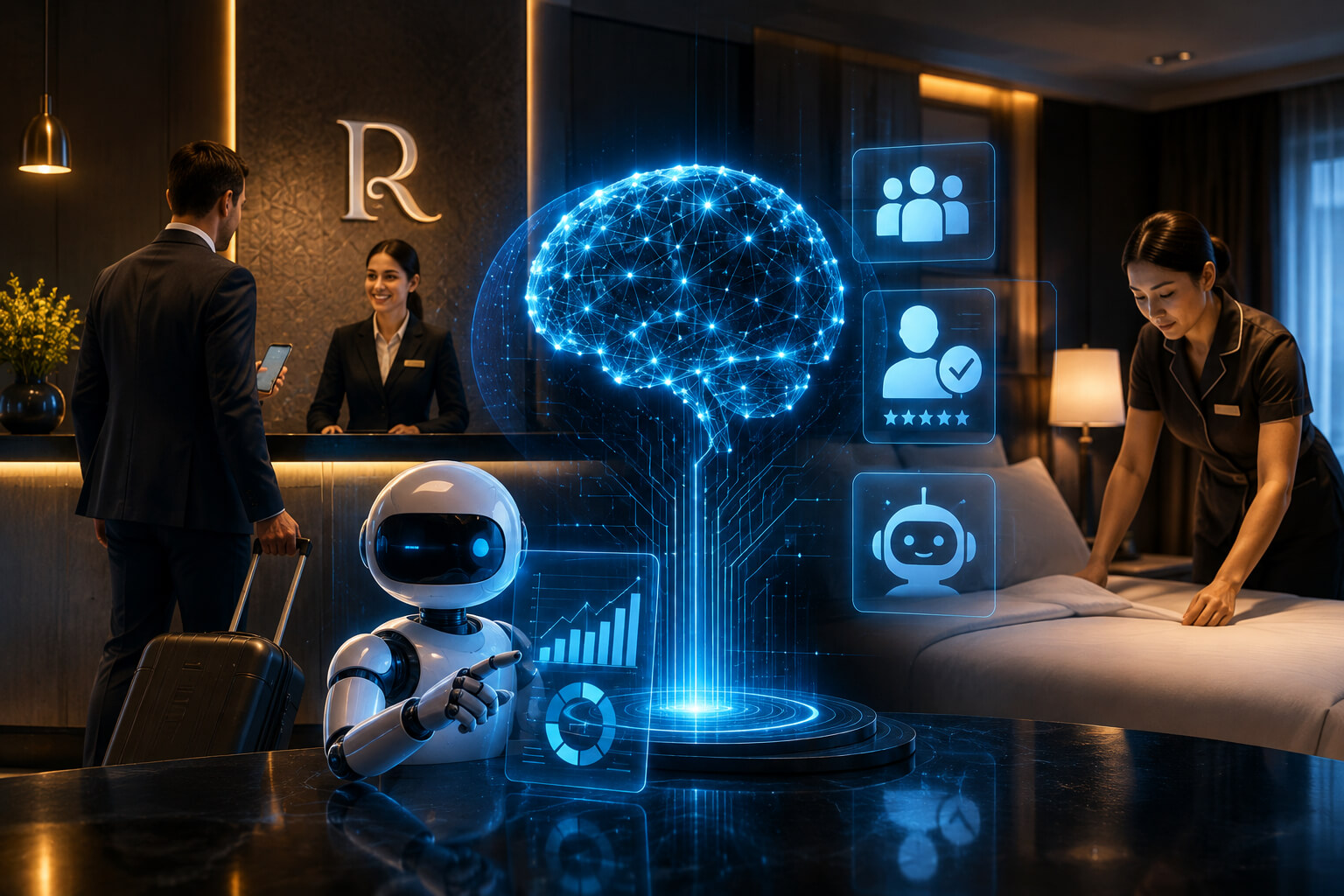
Artificial intelligence in travel is quickly moving beyond chatbots that answer questions about check-in times.
At Radisson Hotel Group, AI is starting to influence pricing, advertising, recruitment and even the way the hotel company thinks travelers may book rooms in the future.
Velit Dundar, vice president of global e-commerce at Radisson Hotel Group, recently detailed the company’s approach in an interview with PhocusWire. One number stands out immediately: Radisson says an AI-supported price matching feature has produced a 19% uplift in direct-channel conversion since its launch.
That is not an experimental chatbot sitting quietly in the corner of a website. It is AI being attached directly to revenue.
Radisson Is Using AI to Fix an Old Hotel Booking Problem
Hotel companies have spent years trying to convince travelers to book directly rather than through online travel agencies.
Price has always complicated that pitch.
A guest could find a cheaper rate elsewhere, but using a traditional best-rate guarantee often meant finding the competing offer, taking screenshots, filling out a claim and waiting for somebody to approve it.
Radisson launched a new Price Match feature in July that approaches the problem differently. The system can identify a lower rate for a Radisson property on an online travel agency, verify the price and match it on Radisson’s own website.
The customer does less work.
Radisson potentially keeps more bookings inside its own channel.
That combination helps explain why the company is interested in AI far beyond simple cost cutting.
Dundar described the broader shift as moving away from manual intervention and toward proactive intelligence operating at scale. For Radisson, the Price Match system gives guests more confidence while also giving commercial teams more information about pricing behavior and points where customers abandon the direct booking process.
The Marketing Numbers Are Hard to Ignore
Radisson has also been using generative AI behind the advertising that brings travelers to those booking pages.
Working with Google Cloud and Accenture, the hotel group applied generative AI to advertising creation, localization and translation. Radisson says this allowed personalized marketing content to be produced across more than 30 languages in hours instead of weeks.
The reported results were significant.
The case study cited by Dundar showed a 22% increase in ad-driven revenue, a 35% improvement in return on ad spend and a 50% productivity improvement for global media teams.
That last number matters.
Generative AI discussions often get trapped in arguments about whether AI-generated copy is good enough. Large companies have another calculation to make: how quickly can one campaign be adapted for dozens of markets, languages and customer groups?
For a global hotel brand, shaving weeks off that process changes the economics of personalization.
AI Agents Could Change Who Actually Chooses the Hotel
The more interesting part of Radisson’s AI strategy may have little to do with what is happening today.
It is what happens when travelers stop manually comparing hotels.
Agentic AI could allow an assistant to search properties, evaluate prices, check availability, account for personal preferences and eventually complete parts of a booking on a traveler’s behalf.
That creates a strange new customer for hotel companies.
The traveler still matters, obviously. But the hotel may also have to convince an AI system that its property is the right answer.
Dundar believes this could become one of the biggest changes to online hotel distribution. In that environment, simply appearing prominently in conventional search results will not be enough. Hotel information needs to be structured, accurate and understandable to AI systems, including rates, availability, policies, loyalty benefits and booking connectivity.
That shift is already visible elsewhere in travel, where companies such as Eurostar are moving search and trip discovery directly into conversational AI interfaces.
Suddenly, the competition is not only about getting a human to click.
It is about becoming a hotel an AI agent can confidently recommend.
SEO Is Starting to Look Different Too
Radisson is already thinking about that shift through what is increasingly called generative engine optimization, or GEO.
Traditional SEO is designed largely around appearing prominently in search engine results. GEO introduces another objective: making information easy for AI-powered search engines and assistants to interpret, trust and recommend.
Radisson says it is working on structured content, accurate information, transparent pricing and the technical foundations needed for this new discovery environment.
It is still early. Nobody has completely solved optimization for AI recommendations.
But travel could be one of the industries where the change becomes particularly visible. Planning a trip involves hundreds of small decisions, and that is exactly the sort of messy task AI assistants are being built to handle.
Hotels that are difficult for machines to understand may eventually have a visibility problem even if their traditional websites look fine.
AI Is Also Showing Up in Radisson’s Hiring Process
Not every AI deployment at Radisson faces the customer.
The company says AI has helped make recruitment faster and has nearly halved its time to hire.
Radisson is not describing that as handing hiring decisions to an algorithm.
Dundar said the technology is being used to reduce friction in routine parts of recruitment while human judgment remains important for evaluating people, potential, culture and values.
That distinction is worth watching.
Businesses are rapidly discovering that some of the most useful AI applications are not dramatic autonomous systems. Sometimes the payoff comes from removing repetitive administrative work that quietly absorbs thousands of employee hours.
Radisson Doesn’t Want “AI Native” to Mean AI Everywhere
There is an interesting restraint running through Radisson’s approach.
Dundar’s definition of an “AI native” company is not simply a business that piles AI features onto existing software. He argues that companies need to rethink customer journeys, commercial systems and internal workflows with automation, intelligence and data built into them from the beginning.
But hospitality creates an obvious limit.
People still expect hospitality to feel human.
A hotel can automate the comparison of room rates. It can generate advertising. It can make recruitment workflows faster. An AI agent might eventually arrange an entire stay.
The moment somebody walks through the hotel doors is different.
Radisson’s position is that AI should remove friction around the human experience rather than attempt to replace it.
That may end up being the more durable AI strategy for hospitality. Automate the invisible work. Make discovery easier. Make booking less annoying. Give employees fewer repetitive tasks.
Then leave some things stubbornly human.
AI Could Become Part of the Travel Industry’s Operating Layer
Travel companies spent the first phase of the generative AI boom experimenting.
Write this advertisement. Summarize this review. Answer this customer question.
The next phase is starting to look less like a collection of AI tools and more like infrastructure.
Dundar expects intelligence to spread across the entire travel journey: inspiration, search, booking, the stay itself, loyalty programs and post-trip engagement. Radisson is consequently strengthening its data infrastructure, experimenting with AI-powered marketing and content, improving personalization and preparing its properties for AI-driven search and booking experiences.
That direction also mirrors Tourism Fiji’s attempt to connect AI-assisted discovery, itinerary planning and booking into a single travel funnel.
The interesting question is no longer whether hotels will use AI.
They already are.
The question is how much of the journey happens through AI before the traveler ever reaches the hotel.
And that part is moving surprisingly fast.
Source: PhocusWire — “AI transformation in travel: Velit Dundar of Radisson,” published August 20, 2026
