


Dubai’s Agentic AI ambitions are starting to move beyond government announcements and into something more practical: companies, partnerships and actual market expansion.
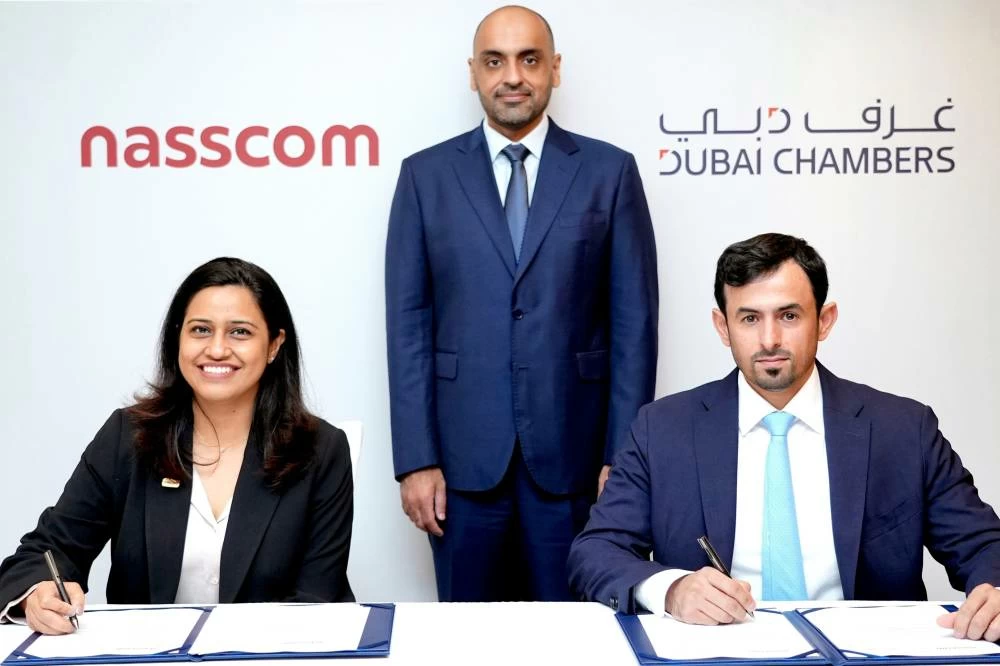
Dubai Chambers and India’s National Association of Software and Service Companies (NASSCOM) are strengthening cooperation around artificial intelligence, with the relationship aimed at accelerating Agentic AI adoption and creating a clearer route for Indian technology companies looking at Dubai as a base for regional and international growth.
It fits neatly into something Dubai has been building for a while. The emirate doesn’t simply want businesses experimenting with AI tools. Its current strategy is much more aggressive — get autonomous AI systems into day-to-day business operations and do it quickly.
Dubai Is Making Agentic AI a Private-Sector Priority
The timing isn’t accidental.
In May 2026, Dubai launched a two-year programme designed to move its private sector toward Agentic AI, described by the Dubai government as AI capable of self-executing and self-leading tasks. The programme includes specialised training for business councils, Agentic AI incubators and dedicated funding mechanisms.
A month later, Dubai Chambers formed an Executive Committee for Agentic AI to oversee parts of that transformation. Its responsibilities include approving training programmes, developing incubators for Agentic AI companies, supporting specialist AI businesses and establishing funds for selected companies making the transition.
So the Dubai Chambers-NASSCOM cooperation lands in the middle of a much bigger push.
And India is an obvious place to look for companies that can help supply the technology, engineering talent and enterprise AI experience needed to make it happen.
Why NASSCOM Matters to Dubai
NASSCOM sits at the centre of India’s enormous technology services and startup ecosystem.
For Dubai, closer links with the organisation create a direct bridge to Indian software firms, AI startups, enterprise technology providers and founders already looking beyond the domestic Indian market.
This isn’t a completely new relationship either.
NASSCOM previously signed an agreement with Dubai Internet City aimed at helping Indian technology SMEs establish operations in Dubai and use the city as a gateway into the wider Middle East and North Africa market. NASSCOM has described the partnership as a way to help member companies navigate the process of establishing a presence in Dubai.
What has changed is the technology conversation.
Earlier expansion efforts were broadly about software, IT services and digital businesses. Now Agentic AI is moving closer to the centre of Dubai’s economic strategy.
That changes the type of companies Dubai is likely to want.
Not just another SaaS startup. Companies building autonomous agents, enterprise orchestration systems, AI infrastructure, industry-specific copilots, automation platforms and tools that can hand increasingly complicated business workflows over to software.
Indian Tech Companies Already Have a Strong Dubai Connection
There is another reason this partnership makes sense: Indian businesses are hardly newcomers to Dubai.
More than 9,000 Indian companies reportedly joined the Dubai Chamber of Commerce during the first half of 2025, while Dubai has increasingly marketed itself to Indian startups as a launch point for expansion into the Gulf, Africa and other international markets.
Dubai Chamber of Digital Economy has also been expanding its work with international technology companies.
The chamber said it supported the establishment and expansion of 1,690 digital startups during 2025, up 39.7% from the previous year. Roughly 15% of those companies specialised in artificial intelligence, while three-quarters were international companies.
Those numbers make the attraction strategy easier to understand.
Dubai needs technology companies if it wants an AI-heavy private sector. India has a deep pool of them. NASSCOM offers a ready-made connection between the two ecosystems.
Agentic AI Is the Bigger Story Here
The phrase “Agentic AI” is appearing everywhere in the technology industry right now, sometimes a little too freely.
The basic shift, though, is important.
Generative AI typically waits for someone to ask it for something. An AI agent can be designed to pursue a goal, make decisions between steps, interact with software and complete a series of actions with less human intervention.
For businesses, that could mean an AI system that doesn’t merely draft a customer email. It could identify the customer problem, retrieve account information, decide what action is required, update internal systems and initiate the response.
That’s considerably more consequential than putting a chatbot on a website.
Dubai appears to be betting that this next stage of AI will become infrastructure rather than an optional productivity feature.
The emirate’s two-year private-sector programme is intended to improve productivity, reduce costs and encourage businesses to redesign operations around autonomous systems.
That shift mirrors the wider move from pilots toward operational deployment seen across the region, including enterprise and government Agentic AI initiatives across the Gulf.
Dubai Wants AI Companies Too, Not Just AI Users
One detail shouldn’t get lost here.
Dubai’s strategy isn’t only about convincing existing businesses to buy AI software.
It is also trying to create and attract companies that build it.
Dubai Chamber of Digital Economy describes part of its mission as attracting international companies and talent while strengthening Dubai as a global centre for advanced technology.
Agentic AI incubators and dedicated funding add another layer. A company entering Dubai isn’t necessarily being offered only a place to sell. It could potentially become part of the ecosystem developing the systems Dubai wants its own private sector to adopt.
That makes Indian AI firms particularly interesting.
India has enormous enterprise IT capability, a growing AI startup market and thousands of companies accustomed to building technology for global customers. Dubai, meanwhile, offers those firms geographic proximity, capital, multinational customers and access to markets stretching well beyond the UAE.
It’s a fairly natural trade.
The Competition for AI Companies Is Getting More Serious
Dubai isn’t operating in an empty field.
Countries, cities and economic zones are increasingly competing for AI companies, engineers and investment. Tax policy helps. So does capital. But the more interesting contest may be around who can give AI businesses customers, regulatory clarity and actual opportunities to deploy their technology.
Dubai’s approach is becoming unusually specific.
There are targets, incubators, training programmes and public-private initiatives built around Agentic AI instead of AI being treated as a vague innovation category.
Dubai Chamber of Digital Economy has already been courting technology companies internationally, including presenting Dubai’s digital ecosystem to hundreds of European startups and scaleups at GITEX AI Europe in July 2026.
The NASSCOM relationship extends that search deeper into one of the world’s biggest pools of technology talent.
What Happens Next Matters More Than the Announcement
Partnership agreements are easy to announce. The interesting part comes afterward.
For the Dubai Chambers-NASSCOM initiative, that means watching how many Indian AI companies actually establish operations in Dubai, whether meaningful Agentic AI projects emerge from the partnership, and whether Dubai’s private-sector programme moves from pilots into everyday business use.
There is also the question of scale.
Dubai has publicly committed to transforming private-sector adoption over a two-year period. That is a short runway for technology that many companies globally are still trying to understand.
But that may be exactly the point.
Dubai has repeatedly used speed as part of its technology strategy. Rather than waiting for Agentic AI standards and business models to settle, it is trying to build the ecosystem while the category itself is still being defined.
The Dubai Chambers-NASSCOM partnership gives that strategy another supply line — straight into India’s technology sector.
And if Agentic AI really does become the next major enterprise computing layer, attracting the companies building it could end up mattering just as much as adopting the technology itself.
Sources
- Emirates 24/7 — Dubai Chambers, NASSCOM join forces to accelerate Agentic AI adoption and attract Indian tech firms
- Dubai Media Office — Dubai launches two-year private-sector Agentic AI initiative
- Dubai Chambers — Executive Committee for Agentic AI
- Dubai Chamber of Digital Economy — 1,690 digital startups supported in 2025
- NASSCOM — Earlier Dubai Internet City partnership with NASSCOM
