


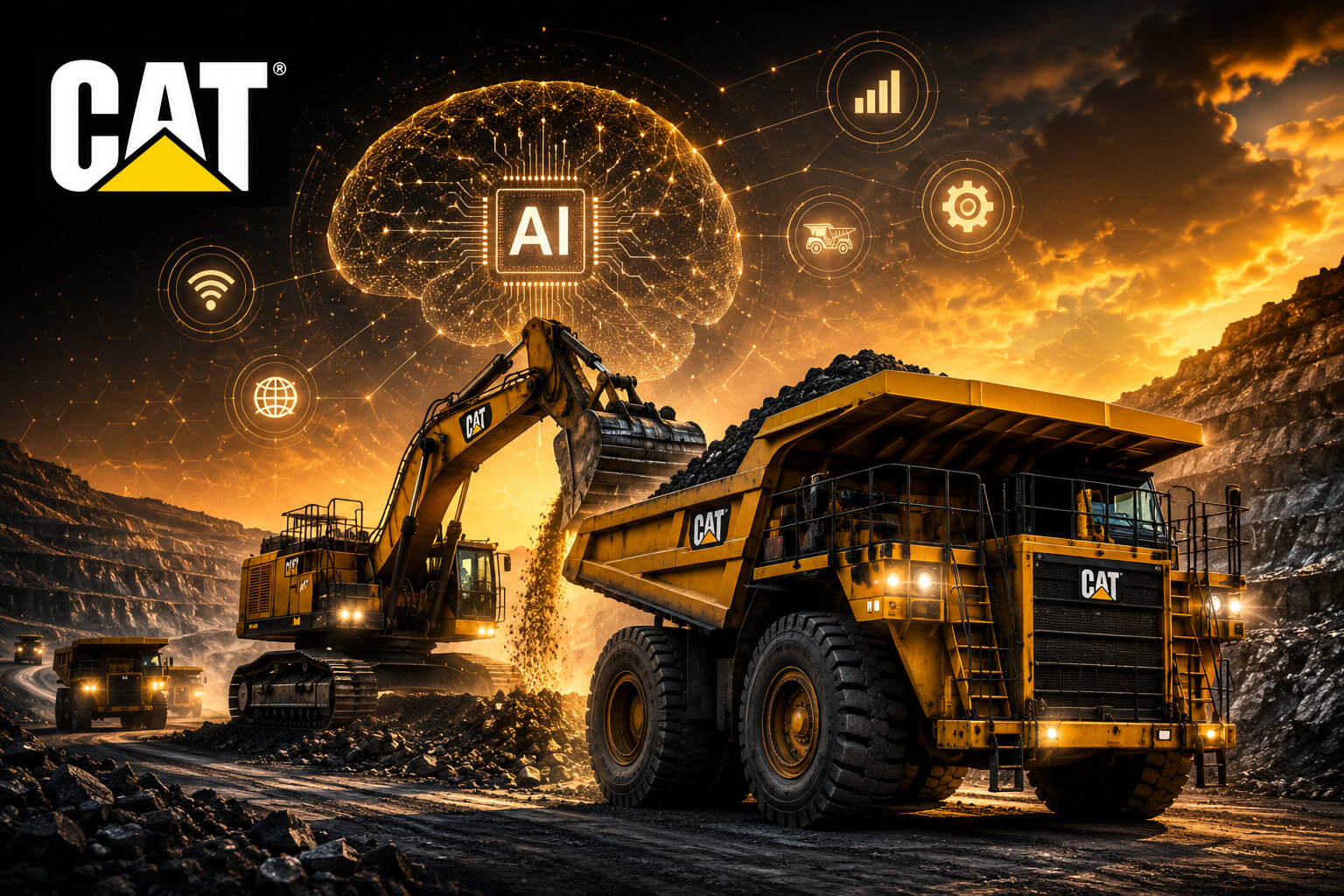
Caterpillar has spent years teaching enormous machines to work with less human intervention. Now, those lessons are shaping its wider artificial intelligence strategy, especially as Caterpillar AI deployment becomes increasingly important across the industry.
The company first pushed hard into autonomy in mining. That made sense. Mines can be dangerous, remote, repetitive, and short on skilled workers.
Today, Caterpillar sells autonomous haul trucks, drills, loaders, dozers, and remote-controlled equipment. It also provides fleet management software and command-center technology. Now the company wants to take that experience somewhere messier.
Construction sites, quarries, factories, maintenance operations, and internal software teams are all becoming part of Caterpillar’s AI expansion. The technology changes. The difficult part doesn’t. AI has to fit into the way people actually work.
Mining Gave Caterpillar an Early Lesson in Real-World AI
Caterpillar’s experience with autonomous technology stretches back decades. Mining became one of its most important testing grounds. The environment offered a clear reason to automate dangerous and repetitive work. Caterpillar introduced autonomous haulage in large open-pit mines in 2013. Its autonomous mining fleet has since grown to nearly 700 trucks. Those machines have hauled more than 11 billion tonnes of material, according to the company. That history gave Caterpillar something many AI adopters lack: years of experience putting automation into real operations.
Caterpillar Wants to Take Mining Automation Into More Dynamic Sites
A mine can be highly controlled. A construction site is another story. Workers move around, conditions change, and equipment may perform different tasks throughout the day. Caterpillar CTO Jaime Mineart told TechCrunch that the company wants to bring its mining lessons into these environments. Quarries and construction sites are major targets. Caterpillar has already deployed autonomous haulage at a quarry in Virginia. Four Cat 777 trucks operate at Luck Stone’s Bull Run plant. The project passed one million autonomously hauled tons within months of deployment.
Cat AI Assistant Brings AI Directly to Technicians
Caterpillar’s AI strategy isn’t limited to machines driving themselves. The company is also putting AI into everyday maintenance work. Cat AI Assistant gives technicians access to repair information through voice commands. A technician can request procedures while standing beside a machine. The assistant can also help troubleshoot faults and identify required parts. That saves workers from repeatedly stopping a job to search manuals or other systems.
Caterpillar Has 1.6 Million Connected Assets Feeding Its AI Strategy
Caterpillar has an advantage that newer AI companies can’t easily recreate: machine data. The company has around 1.6 million connected assets worldwide. Its Helios data platform manages more than 16 petabytes of data. That information comes from Caterpillar’s enormous installed base and digital ecosystem. Cat AI Assistant can use proprietary manuals, equipment information, parts data, and machine history. For industrial AI, that specialized data matters. A general chatbot may know machinery. Caterpillar’s systems can know the specific Cat machine sitting in front of a technician.
AI Is Also Building Digital Twins Inside Caterpillar
Some of Caterpillar’s AI work stays behind the scenes. The company uses AI-powered software to scan sites and create digital twins. Those virtual environments can help teams examine manufacturing operations. Caterpillar is also bringing AI into regular enterprise workflows. Software development is one example. Mineart said AI agents help modernize legacy code and test new software. They can also identify defects earlier in development. It’s less flashy than an autonomous truck. It may be just as useful.
The Hard Part Isn’t Building the AI
This is where Caterpillar’s mining experience becomes particularly relevant. Installing autonomous technology doesn’t automatically transform an operation. Workflows also have to change. Employees need to understand what the system does and where humans still fit. Mineart identified integration into customer jobsites as a major challenge for physical AI. Caterpillar learned a similar lesson while expanding autonomy into quarry operations. At Luck Stone, its teams studied workers and existing processes before deploying autonomous trucks. The company adapted the system around the actual site instead of simply copying its mining setup.
Experienced Workers Are Helping Train Caterpillar’s AI
Automation doesn’t necessarily make decades of worker knowledge irrelevant. Caterpillar is trying to capture it. Experienced operators help the company train AI systems using knowledge developed on actual jobsites. Their roles could change as autonomy improves. An operator who once controlled one machine may eventually supervise several autonomous machines remotely. That creates a different kind of industrial job. It also creates a training problem. Employees need new skills to work effectively alongside increasingly autonomous equipment.
Caterpillar Plans $100 Million for AI and Robotics Training
Caterpillar employs around 118,000 people, so retraining won’t be a small project. The company plans to spend $100 million over five years on workforce development. Training will cover AI, autonomy, and robotics. That investment says something important about Caterpillar’s approach. Deploying AI isn’t being treated purely as an IT upgrade. Workers and operating processes are part of the deployment itself. For companies struggling to move AI beyond pilot programs, that may be the more useful lesson from Caterpillar’s experience.
AI Infrastructure Is Creating Another Business for Caterpillar
There’s a second AI story happening inside Caterpillar. The company isn’t only using artificial intelligence. It’s also benefiting from the infrastructure needed to run it. Caterpillar reported record quarterly revenue of $20.5 billion in the second quarter. Demand for power-generation equipment helped drive that result. Sales in its power-generation business jumped 72% to $3.10 billion. Data centers need enormous amounts of reliable electricity. The generative AI boom is making that requirement even bigger. Caterpillar happens to sell equipment that helps provide it.
Caterpillar Is Betting on Physical AI Beyond Mining
Generative AI has made chatbots the most visible face of artificial intelligence. Caterpillar is working on something much more physical. Its AI has to operate beside heavy machinery, dust, workers, unpredictable terrain, and expensive equipment. Some systems also need to work where cloud connectivity isn’t dependable. Caterpillar is partnering with NVIDIA to bring edge AI into its machines. NVIDIA’s Jetson Thor platform supports real-time inference for equipment and in-cab applications. That allows some AI processing to happen directly on the machine.
Caterpillar’s Bigger AI Lesson Is About Deployment
There is plenty of attention around which company has the smartest AI model. Caterpillar’s experience points toward another question. Can the technology survive contact with an actual workplace?
Mining taught the company that automation involves more than software and machines. Workers need training. Processes need redesigning. Customers need evidence that the technology is safe and useful.
Construction will make that challenge harder. Those environments are less predictable than large mines.
Still, Caterpillar isn’t starting from zero. It already spent years learning what happens after autonomous technology leaves the demonstration stage.
That experience could become surprisingly valuable as more companies discover that building AI is only half the job. Getting people to use it successfully is the other half.
Sources
TechCrunch — Caterpillar is bringing to AI deployment what it learned from automating mining
https://techcrunch.com/2026/08/30/caterpillar-is-bringing-to-ai-deployment-what-it-learned-from-automating-mining/
Caterpillar — Coming Soon: The Cat AI Assistant
https://www.caterpillar.com/en/news/caterpillarNews/2026/cat-ai-assistant.html
