


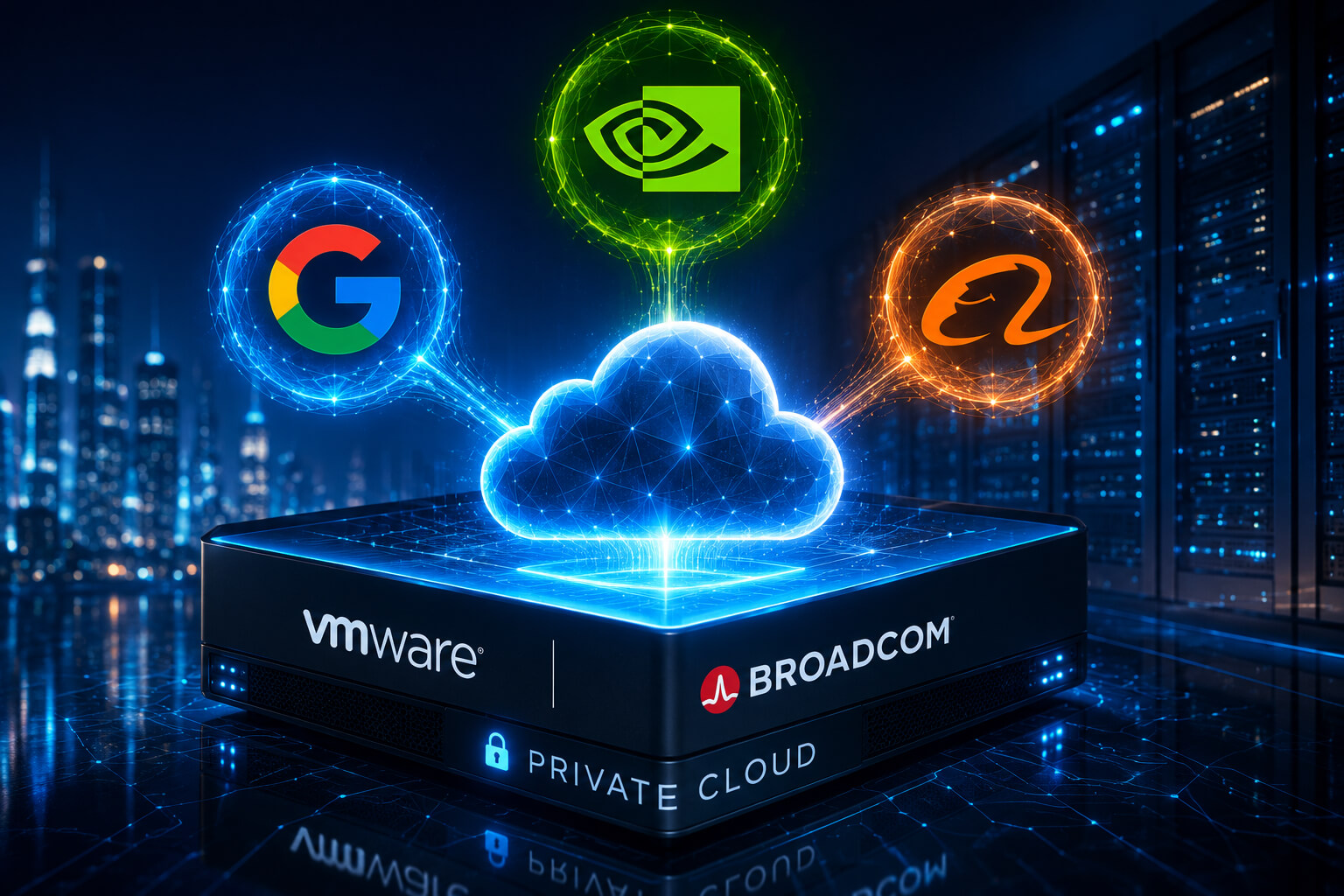
Broadcom wants enterprises to run more of their AI without sending sensitive data to an external cloud. With VMware Cloud Foundation AI models, organisations can benefit from powerful AI capabilities while keeping their data secure on-premises.
At VMware Explore 2026, the company announced a major expansion of AI support for VMware Cloud Foundation (VCF). Several leading AI models have now been validated to run directly on the platform.
The lineup includes models from Google DeepMind, NVIDIA, NEC, Alibaba Cloud and Z.ai. Enterprises can deploy them on-premises and offer AI models as internal services.
It is another sign that private AI is moving beyond experiments. Companies increasingly want powerful models closer to their own data, infrastructure and security controls.
VMware Cloud Foundation Gets Five Major AI Models
Broadcom has validated five notable AI model families for VMware Cloud Foundation. They include NVIDIA Nemotron 3, Google DeepMind Gemma 4 and NEC cotomi. Alibaba Cloud’s Qwen 3.7-Max and Z.ai’s GLM 5.2 are also included. Companies can run these models inside private infrastructure instead of relying only on public AI services. Broadcom wants VCF to become a common platform for enterprise AI inference.
Google DeepMind’s Gemma 4 Comes to Private AI
Google DeepMind’s Gemma 4 is one of the models validated for VCF. Broadcom describes it as an open-weight, multimodal model family built for developers and researchers. Local execution is a big part of the pitch. Companies can use Gemma 4 for autonomous AI agents while keeping workloads within their own infrastructure. That could appeal to businesses with strict data or compliance requirements.
NVIDIA Nemotron 3 Targets Enterprise AI Agents
NVIDIA’s Nemotron 3 family is also joining the validated lineup. The models are designed around multimodal and agentic AI workloads. Nemotron 3 combines a hybrid Mamba-Transformer mixture-of-experts architecture with a one-million-token context window. Broadcom sees the model supporting longer-running enterprise agent workflows. The important part for businesses is where those workloads can run. They can remain inside a VMware-based private cloud.
Alibaba’s Qwen 3.7-Max Moves On-Premises
Alibaba Cloud’s Qwen 3.7-Max adds another major model option. It supports multimodal reasoning and a one-million-token context window. Broadcom is positioning the integration around sovereign and on-premises AI. Enterprises can use the Qwen model while maintaining greater control over their infrastructure. That matters for organizations that cannot freely move sensitive information into external AI platforms.
NEC Brings Japanese-Language AI to VMware
NEC’s cotomi brings a more specialized angle to the announcement. The proprietary model focuses heavily on Japanese language and business use cases. NEC says cotomi combines fast processing with improved token efficiency. Running it through VCF also keeps sensitive corporate information inside controlled infrastructure. For Japanese enterprises, that mix of language capability and private deployment could be particularly useful.
Z.ai Adds GLM 5.2 for Local Coding and Reasoning
Z.ai’s GLM 5.2 completes the newly validated group. The open-source model targets coding, reasoning and multi-step autonomous workflows. Companies can deploy those capabilities locally through VMware Cloud Foundation. That gives developers another option for building agents without routing every interaction through an external service. Local deployment can also provide more control over data and hardware resources.
VMware Can Run More Than 150 Open-Source AI Models
The five highlighted models are only part of the story. Broadcom says VCF can run more than 150 open-source models through vLLM. VCF uses vLLM as its default model runtime. The platform also supports mixed computing infrastructure from AMD, Intel and NVIDIA. That gives enterprises more freedom when selecting CPUs and GPUs for AI workloads. Broadcom clearly wants to avoid making private AI dependent on one hardware stack.
Broadcom Wants AI Models Delivered Like an Internal Service
Broadcom is also pushing a “model as a service” approach. An IT team could host approved models within the company’s private cloud. Different departments could then access those models through shared infrastructure. Teams would not need to deploy separate AI stacks for every project. This could make governance easier while reducing duplicated computing resources. It also gives IT departments more control over which models employees can use.
Private AI Is Becoming a Bigger Enterprise Priority
Broadcom says demand for private AI inference is already growing. Its Private Cloud Outlook 2026 found that 56% of enterprises are running or planning production AI inference on private clouds. Privacy is one reason. Security, governance and AI costs are also pushing companies in this direction. Keeping models near enterprise data can reduce some of the complications created by moving sensitive information elsewhere.
VMware AI Factory Pushes AI From Servers Into Production Faster
The model announcement sits inside Broadcom’s wider VMware Private AI Cloud strategy. The company also introduced VMware AI Factory at VMware Explore 2026. It automates much of the infrastructure needed to deploy AI workloads. Broadcom says the system can cut deployment from weeks to hours in some environments. It handles hardware provisioning, software setup and ongoing lifecycle management. The goal is to make private AI feel less like a custom infrastructure project.
Broadcom Is Going After AI Token Costs Too
Running AI privately still comes with a major problem: cost. Broadcom is trying to tackle that through shared GPU resources and model infrastructure. VCF can pool GPUs across an organization instead of dedicating hardware to individual workloads. It also provides monitoring for token throughput, latency and computing resources. That could help companies understand what their internal AI applications actually cost to operate.
Private AI Could Become the Enterprise Alternative to API-Only AI
Public AI APIs remain convenient, but enterprises do not always want their most sensitive workloads leaving company infrastructure. Broadcom is betting heavily on that tension. VMware Cloud Foundation gives businesses another route. They can select established AI models while keeping inference closer to their own data.
The interesting part is choice. Google, NVIDIA, Alibaba, NEC and Z.ai models can sit on the same private-cloud foundation. More than 150 open-source models can run there too. Hardware choices span AMD, Intel and NVIDIA.
Broadcom is not trying to build the model that wins enterprise AI. It is trying to own the infrastructure where companies run whichever model wins.
Sources
Broadcom — VMware Cloud Foundation Brings Leading AI Models to the Private AI Cloud
Read the original Broadcom announcement
Broadcom — VMware Private AI Cloud
Read the VMware Private AI Cloud announcement
