


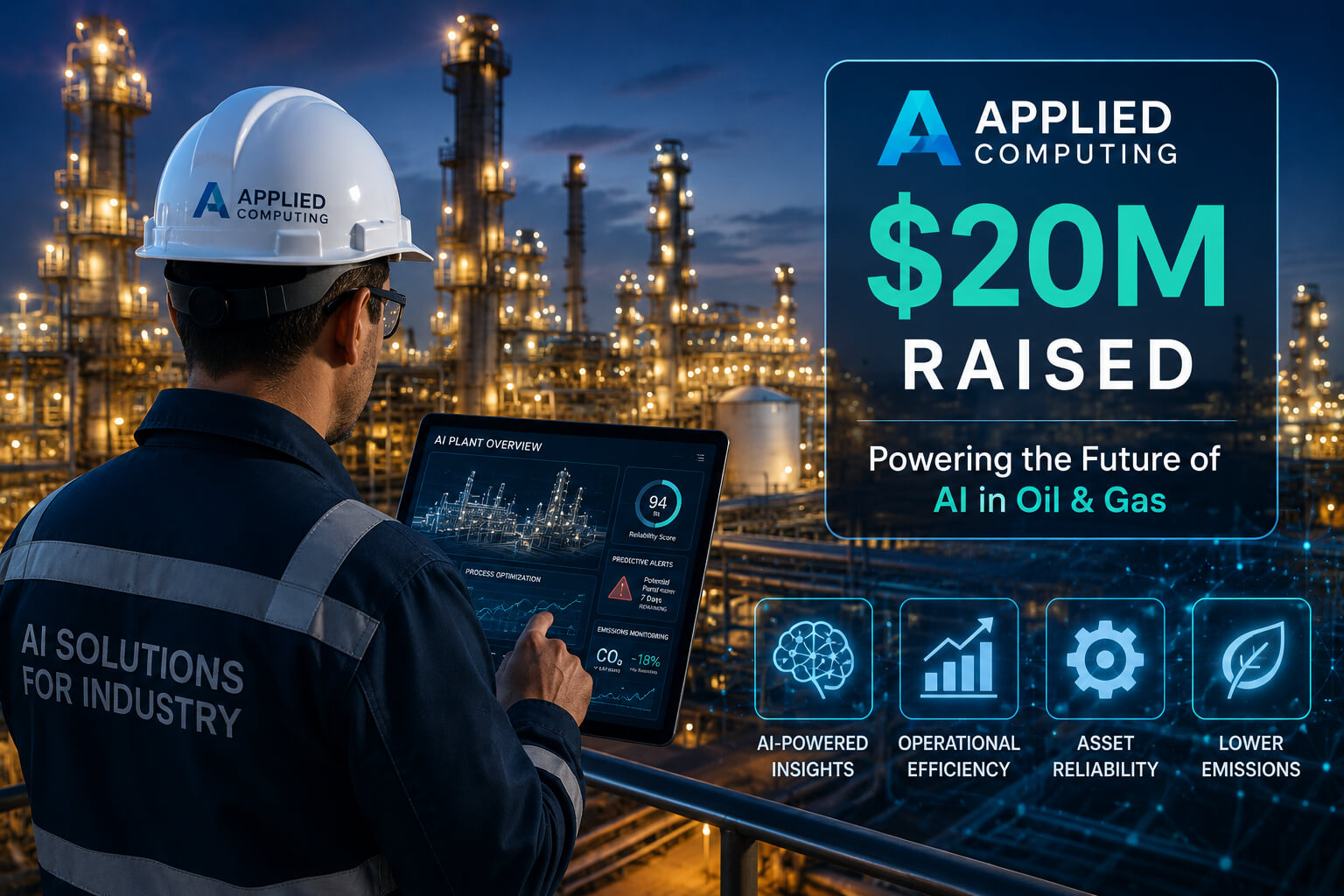
AI is no longer sitting politely inside office software. Applied Computing oil plant AI is now transforming industries beyond the office, including complex environments like oil plants.
It is moving into refineries, petrochemical sites, and oil and gas plants where pressure, heat, equipment failure, and production delays are not small problems. That is the space Applied Computing wants to enter more aggressively after raising $20 million in Series A funding for its industrial AI platform.
The London-based startup is building Orbital, a foundation AI model designed for energy and industrial plants. Not a general chatbot. Not a dashboard with a few alerts. The idea is to create an AI system that can understand plant-wide operations using sensor data, physics, and language-based interaction.
That sounds ambitious because it is.
Why Applied Computing Is Targeting Industrial Plants
Oil, gas, refining, and petrochemical facilities already produce huge amounts of data. Sensors track temperature, pressure, flow, viscosity, and many other conditions across complex equipment networks.
The problem is that much of that data does not turn into useful decisions fast enough.
According to reports, Applied Computing says industrial plants often use less than 8% of the data they collect. That leaves a large gap between what the plant knows and what operators can actually act on in real time.
Orbital is being built to close that gap.
The company wants its AI model to help operators predict failures before they happen, optimize production, improve energy efficiency, and reduce downtime. In a plant where a small operational issue can become expensive very quickly, that kind of intelligence has obvious appeal.
The $20M Funding Round
Applied Computing’s $20 million Series A was led by engineering company KBR, with participation from Databricks Ventures, according to reports.
That investor mix is interesting. KBR brings deep industrial and engineering exposure, while Databricks connects the story to enterprise data infrastructure. Applied Computing is not just pitching AI to energy companies from the outside. It is trying to sit closer to the technical systems that already run industrial operations.
The funding is expected to support research, international growth, and wider deployment of Orbital across oil, gas, and petrochemical sites.
Orbital Is Not a Normal AI Tool
Most people still think of AI as something that writes emails, summarizes PDFs, or answers customer questions.
Orbital is pointed at a different problem.
Industrial plants are physical systems. They follow chemical, mechanical, and operational rules. A bad recommendation is not just an awkward sentence on a screen. It can affect equipment, output, safety, and emissions.
That is why Applied Computing’s approach matters. Orbital reportedly combines time-series data, physics-based models, and language capabilities so engineers can work with plant data in a more usable way.
In simpler terms, the model is not only reading data. It is being shaped to understand how industrial processes behave.
AI in Oil and Gas Is Getting More Serious
Oil and gas companies have used AI for years in areas such as equipment monitoring, drilling optimization, maintenance planning, and production forecasting. But the current wave is different.
Foundation models are being pushed into specialized industries, not just consumer apps. Energy companies want systems that can interpret messy operational data, support engineers, and make plants more efficient without requiring every decision to pass through slow manual analysis.
Applied Computing is part of that shift.
The company is betting that industrial AI needs its own models, trained and designed for harsh, high-value environments. A refinery is not a spreadsheet. A petrochemical plant is not a support inbox. The data behaves differently, and the stakes are higher.
The Bigger Question Around AI-Controlled Infrastructure
There is also a tension here.
AI can help plants become safer, cleaner, and more efficient. It can catch warning signs early. It can reduce waste. It can help operators respond faster when something starts drifting out of range.
But industrial AI also raises questions about trust.
How much control should an AI model have inside a facility filled with high-pressure equipment and flammable materials? Who validates the recommendations? How do operators know when to override the system? And what happens when the model is right technically but wrong operationally?
These are not abstract concerns. They are the real barriers that separate a promising demo from a system that plant managers actually trust.
Applied Computing Is Chasing a Difficult Market
Applied Computing’s $20 million raise shows that investors see a serious opportunity in industrial AI. The market is large, the pain points are obvious, and energy operators are under pressure to improve efficiency while managing costs and emissions.
Still, this will not be an easy category.
Oil, gas, and petrochemical companies do not adopt mission-critical technology casually. Systems need to be reliable, explainable, secure, and able to work with old infrastructure. Engineers need confidence. Executives need measurable returns. Operators need tools that help them, not another layer of software noise.
That is the real test for Applied Computing.
The funding is important, yes. But what matters more is whether Orbital can move AI from industrial promise to daily plant operations without losing the trust of the people running those plants.
Sources
- Times of AI: Applied Computing Raises $20M for Oil Plant AI
- TechCrunch: Applied Computing wants to give oil and gas operators an AI model for the entire plant
- The Next Web: Applied Computing raises $20M to build a foundation model for oil and gas
- Tech.eu: Applied Computing lands $20M to expand foundation AI for energy
- The Times: Applied Computing taps Shell veteran as president
