


Apple may be changing the rhythm of its Mac chip roadmap, and the reason is not hard to guess.
AI is no longer something that lives only in cloud servers, keynote demos, or small software features buried inside apps. It needs silicon. More memory bandwidth. Faster neural processing. Better graphics performance. More room for local models to run without making the machine feel like it is dragging itself uphill.
According to reports citing Bloomberg’s Mark Gurman, Apple is expected to release a base M6 chip, but may skip higher-end M6 Pro and M6 Max versions as it moves faster toward the M7 generation. The shift would be unusual for Apple Silicon, which has usually followed a more predictable pattern across base, Pro, Max, and Ultra chips.
Apple May Skip High-End M6 Chips
The interesting part is not just the M6.
It is what Apple may not release.
Reports say Apple still plans to bring out a standard M6 chip for entry-level Macs, possibly starting later in 2026. But the bigger Pro and Max versions may be dropped, with Apple instead pushing those higher-performance machines toward the M7 family.
That sounds like a small roadmap adjustment. It is not.
Apple built a lot of trust around Apple Silicon by making each generation feel orderly. M1, then M2, then M3, and so on. Buyers could roughly understand what was coming. Creators knew what to wait for. Developers could plan around it.
Now AI appears to be bending that schedule.
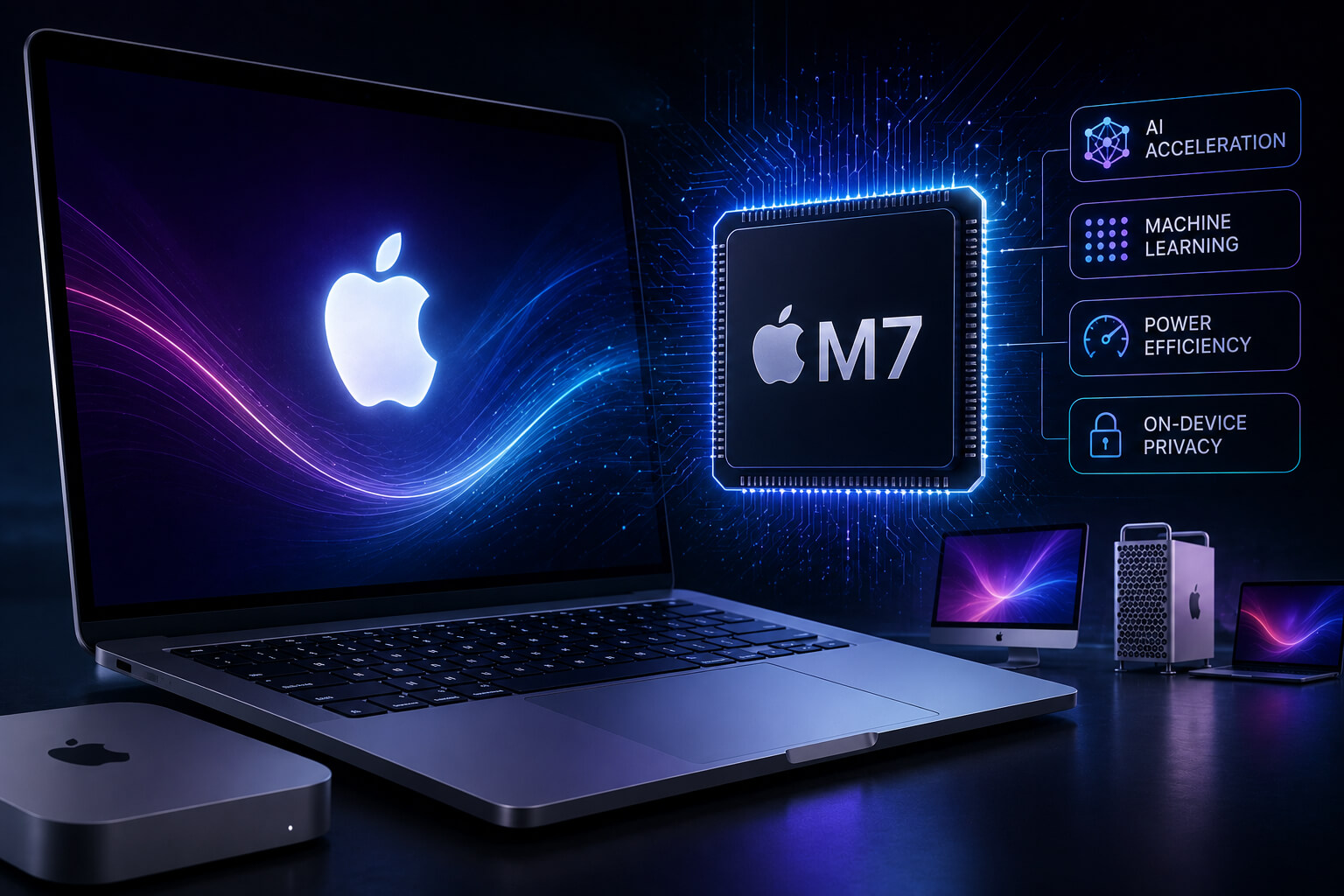
Why the M7 Chip Matters for AI
The M7 generation is reportedly being designed with stronger AI performance in mind. That matters because Apple’s AI strategy has always leaned toward doing more on the device instead of sending everything to external servers.
That fits Apple’s privacy story. It also creates a hardware problem.
Running AI locally needs power. Not only raw power, either. It needs memory bandwidth, neural engines, GPU performance, and efficient system design. A laptop that can run heavier AI tasks locally without burning through battery life becomes much more important as Apple tries to make Apple Intelligence feel useful rather than decorative.
Some reports say the base M6 could bring up to 200GB/s of memory bandwidth, compared with 153GB/s on the M5, along with GPU and Neural Engine upgrades. Higher-end M7 chips are expected to push that further for professional Macs.
This is where the Mac starts to look different.
Not visually. Internally.
The MacBook Pro Could Get Caught in the Middle
For MacBook Pro buyers, this creates an awkward question.
Buy the next M6 MacBook Pro, or wait for the M7 machines?
That depends on what Apple actually ships. A base M6 MacBook Pro could still be fast, efficient, and useful for everyday professional work. But if the real AI jump lands with M7 Pro and M7 Max, then power users may hesitate.
Video editors. Developers. 3D artists. AI builders. Anyone working with local models or heavier creative pipelines may look at the M6 and wonder whether it is a bridge product.
Apple has done this before in quieter ways. Some models become stepping stones. Useful, polished, expensive stepping stones.
Apple’s AI Problem Is Also a Hardware Problem
Apple has been criticized for moving slower than rivals in generative AI software. Google, OpenAI, Microsoft, Anthropic, Meta, and others have dominated most of the AI conversation.
But Apple has one advantage that is easy to overlook.
It controls the device, the chip, the operating system, and the app ecosystem.
That is powerful if the hardware is ready.
A stronger Apple Silicon roadmap could allow more AI features to run locally across Mac, iPad, and eventually other devices. The company’s Neural Engine already plays a role in Apple Silicon, and recent research has shown how Apple’s neural processing hardware and machine-learning software can be used to accelerate certain large language model workloads more efficiently.
Still, hardware alone will not fix Apple’s AI perception problem.
Users do not buy chip roadmaps. They buy features that feel useful.
M7 Ultra Could Point Beyond Macs
The M7 Ultra is the part that feels bigger than laptops.
Reports suggest Apple may use future high-end chips not only for Macs, but also for server-related AI hardware. One report noted that an M7 Ultra could support extremely large unified memory configurations and become central to a new Apple server product.
That would make sense.
If Apple wants more control over its AI stack, it cannot depend entirely on outside infrastructure. The company may still use cloud partners, but custom silicon gives Apple leverage. It can optimize for its own models, its own privacy rules, and its own devices.
That is very Apple.
Late to the noise. Quiet with the architecture. Then suddenly everything is locked together.
Apple Is Not Just Chasing Faster Macs
The bigger story is simple: Apple Silicon is becoming an AI strategy.
The M6 may still arrive, but the attention is shifting to M7, M7 Pro, M7 Max, M7 Ultra, and eventually M8. That sounds like a chip roadmap. Really, it is Apple deciding how much AI should happen on the machine in front of you.
Cloud AI is powerful, but local AI feels different. It is faster in the right cases. More private. Less dependent on network quality. More personal.
Apple knows that.
The risk is timing. If Apple moves too slowly, users may see its AI features as behind. If it moves too fast, Mac buyers may feel trapped between generations.
Either way, the old Mac upgrade cycle is starting to look less predictable.
AI did that.
Source: https://www.macrumors.com/
