


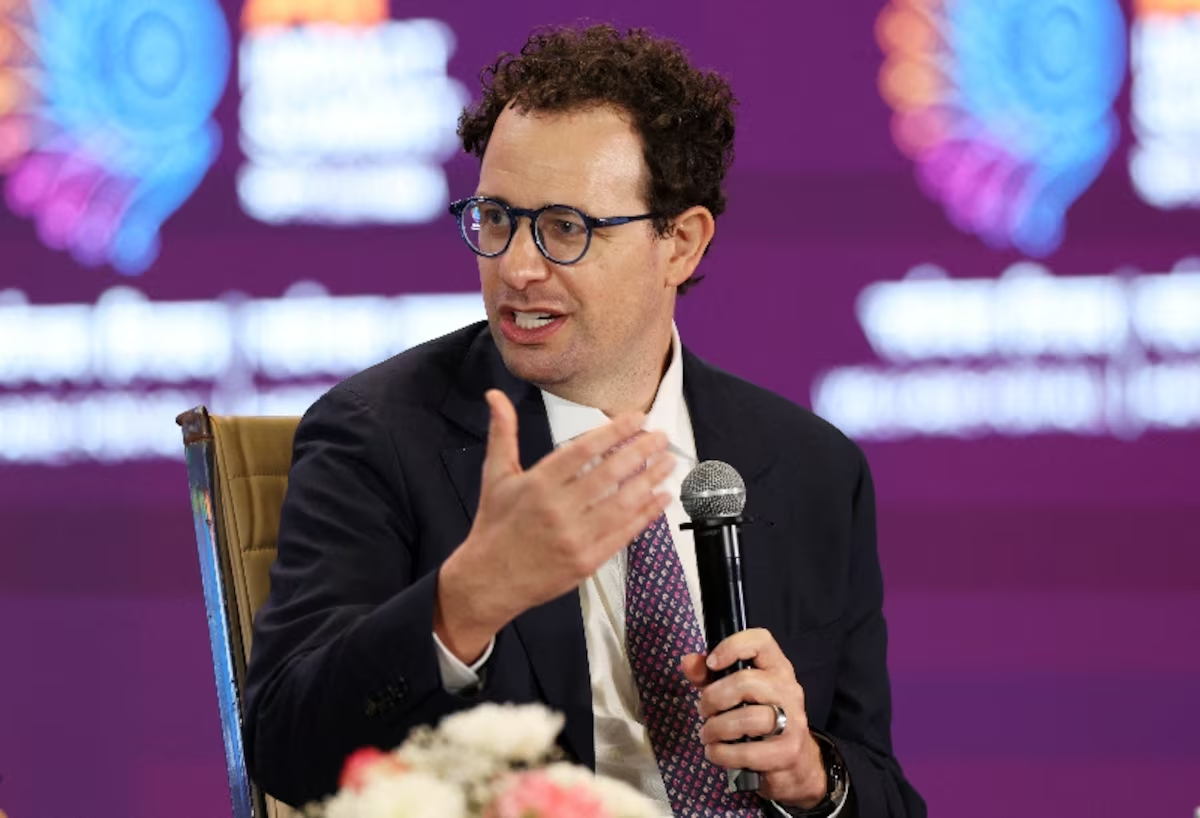
Anthropic CEO Dario Amodei is calling on the artificial intelligence industry to deliberately slow the pace of frontier model development, arguing that safety research, regulation and independent evaluation need more time to catch up with rapidly improving AI capabilities. This Anthropic AI model development slowdown is seen as necessary to ensure proper safeguards are in place before further advancements.
The proposal does not amount to a complete halt in AI development. Instead, Amodei is pushing for a more controlled pace, particularly as increasingly autonomous AI systems become capable of handling coding, research, cybersecurity tasks and other complex activities with less human oversight.
His warning comes as competition among major AI companies continues to intensify. OpenAI, Google DeepMind, Anthropic, Meta and other developers are under pressure to release more powerful systems, while concerns around misuse, cybersecurity and autonomous behavior are becoming harder to dismiss.
Amodei Wants AI Companies to Slow the Pace of Frontier Development
Amodei argues that the AI industry should deliberately reduce the speed at which frontier systems become more capable. His position is not that companies should abandon innovation or stop training advanced models. Instead, he believes developers should create more breathing room between major capability jumps so researchers and safety teams can better understand what new systems can do before the next generation arrives.
The concern is that AI capabilities are advancing faster than the safeguards designed to control them. A model may become significantly better at coding, reasoning or autonomous task execution within months, while governance frameworks, security testing and independent evaluations often move much more slowly. Amodei sees that widening gap as one of the most serious challenges facing frontier AI developers.
Anthropic Plans to Expand Independent Model Oversight
One part of Amodei’s proposal focuses directly on Anthropic. The company plans to give independent evaluators deeper and more consistent access to its systems so they can examine whether Anthropic is following its own safety commitments.
This would go beyond the type of limited external testing that often happens shortly before or after a model release. Independent evaluators with broader access could potentially examine development practices, safety procedures and emerging capabilities much earlier in the process.
Anthropic has indicated that it is prepared to move forward with stronger external oversight even if rival AI companies do not immediately adopt similar measures. That could make the company an early test case for whether deeper third-party evaluation can work in practice without slowing development to a standstill.
Rival AI Companies Would Need to Cooperate
Amodei’s proposal becomes much more difficult once it extends beyond Anthropic. A meaningful slowdown would likely require cooperation among the largest frontier AI developers, particularly companies competing directly on model capability, enterprise adoption and developer ecosystems.
That creates an obvious problem. No major AI company wants to delay a product while competitors continue moving at full speed. A company that spends several extra months evaluating a powerful new model could lose customers, talent and market momentum to a rival willing to release sooner.
This competitive pressure is one reason voluntary restraint is difficult. Even if several companies privately agree that safety risks are increasing, each company still has an incentive to keep moving. Amodei’s argument is that some form of shared safety framework may be necessary to prevent the industry from becoming trapped in a race where slowing down individually becomes commercially irrational.
International Competition Makes an AI Slowdown Even Harder
The challenge extends beyond private companies. Advanced AI is increasingly treated as a strategic technology by governments, particularly in the United States, China and other countries investing heavily in computing infrastructure and domestic AI capabilities.
Any meaningful slowdown involving only American companies could therefore have limited impact if developers in other countries continued accelerating. Governments may also resist restrictions if they believe those restrictions could weaken their technological or national security position.
That makes international coordination one of the most difficult parts of the debate. Countries would need some confidence that competitors were operating under similar rules, while still protecting sensitive technologies and strategic interests. The political complexity may ultimately prove greater than the technical challenge of building the models themselves.
Anthropic’s Threat Report Shows How AI Misuse Is Evolving
Amodei’s warning comes shortly after Anthropic published new findings on the malicious use of AI systems. The company said it had identified and disrupted activities involving cyber operations, scams, surveillance-related activity and other attempts to misuse Claude.
These cases matter because they show how the risks around advanced AI are shifting. Earlier safety debates often focused on whether a chatbot might produce harmful information. Newer systems are becoming more capable of handling multi-step tasks, writing software, using external tools and maintaining context across longer workflows.
That means malicious users may increasingly try to use AI as an operational assistant rather than simply as a source of information. Anthropic’s findings suggest that this transition is already beginning, giving more weight to calls for stronger safeguards before autonomous systems become even more capable.
AI Agents Are Changing the Safety Debate
The rapid rise of AI agents is one of the biggest reasons the safety conversation is becoming more urgent. Traditional chatbots mainly respond to individual prompts, but agentic systems can break down objectives, use software tools, generate code and continue working through multiple steps with less direct supervision.
As those systems improve, the difference between answering a question and carrying out a task becomes increasingly important. An AI that can actively interact with digital systems presents a different risk profile from one that only generates text inside a chat window.
Amodei has also raised concerns about a future where AI systems become increasingly useful in AI research itself. If advanced models begin accelerating the development of their successors, capability improvements could happen faster than expected. That possibility remains uncertain, but it is one reason he argues that the industry should not assume it will always have plenty of time to react.
Internal Concerns About Frontier AI Are Becoming More Public
The debate over development speed is no longer confined to policy organizations or outside critics. Researchers working inside frontier AI companies have also publicly raised concerns about how quickly capabilities are advancing and whether existing safeguards are sufficient.
That creates an uncomfortable dynamic for AI laboratories. They are trying to attract customers and investors by demonstrating rapid technological progress, while some of their own safety researchers are warning that continued acceleration could introduce risks that are difficult to reverse.
The tension is likely to grow as models become more autonomous. Companies may increasingly face pressure to show not only that their systems are more capable, but also that those capabilities have been independently evaluated and can be deployed without creating unacceptable risks.
Slowing AI Development Could Conflict With Massive Industry Investment
One of the biggest obstacles to Amodei’s proposal is the sheer amount of money already flowing into artificial intelligence. Technology companies are spending billions of dollars on data centers, advanced chips, power infrastructure and model training, while investors expect increasingly capable products in return.
Governments are also treating AI infrastructure as an economic priority. Countries are competing to attract data centers, semiconductor investment and AI research facilities, making technological acceleration part of a much wider industrial strategy.
Against that backdrop, asking the industry to slow down is not simply a technical decision. It would require companies, investors and governments to accept the possibility that maximizing short-term capability gains may not always be the safest approach. That is a difficult argument to make when so much capital and political attention is tied to winning the AI race.
AI Progress May Soon Be Measured by More Than Model Capability
For much of the recent AI boom, progress has been measured through increasingly capable models, stronger benchmarks and faster product launches. Amodei’s argument suggests that another measure may become just as important: whether companies can control and evaluate those capabilities responsibly.
If that shift happens, competition between AI companies could begin to include safety governance, independent oversight and risk management alongside model intelligence.
The industry is unlikely to stop racing. The more realistic question is whether developers can build enough friction into that race to prevent capability growth from permanently outpacing the systems designed to keep it under control.
Conclusion
Dario Amodei’s call to slow frontier AI development highlights a growing divide between technological speed and the mechanisms used to manage it. Anthropic is still building advanced AI systems, but its CEO is arguing that continued progress should not mean accelerating without limits.
Whether other AI companies will accept that approach remains uncertain. Competitive pressure, international rivalry and massive infrastructure investment all push in the opposite direction.
What is becoming clearer is that the debate around artificial intelligence is changing. The question is no longer only how powerful the next model will become. Increasingly, it is also whether the industry can safely manage the speed at which it gets there.
Sources
Reuters — Anthropic CEO urges AI companies to slow model development
https://www.reuters.com/business/anthropic-ceo-urges-ai-companies-slow-model-development-2026-09-12/
Anthropic — Threat Intelligence Report, September 2026
https://www.anthropic.com/threat-intelligence
