


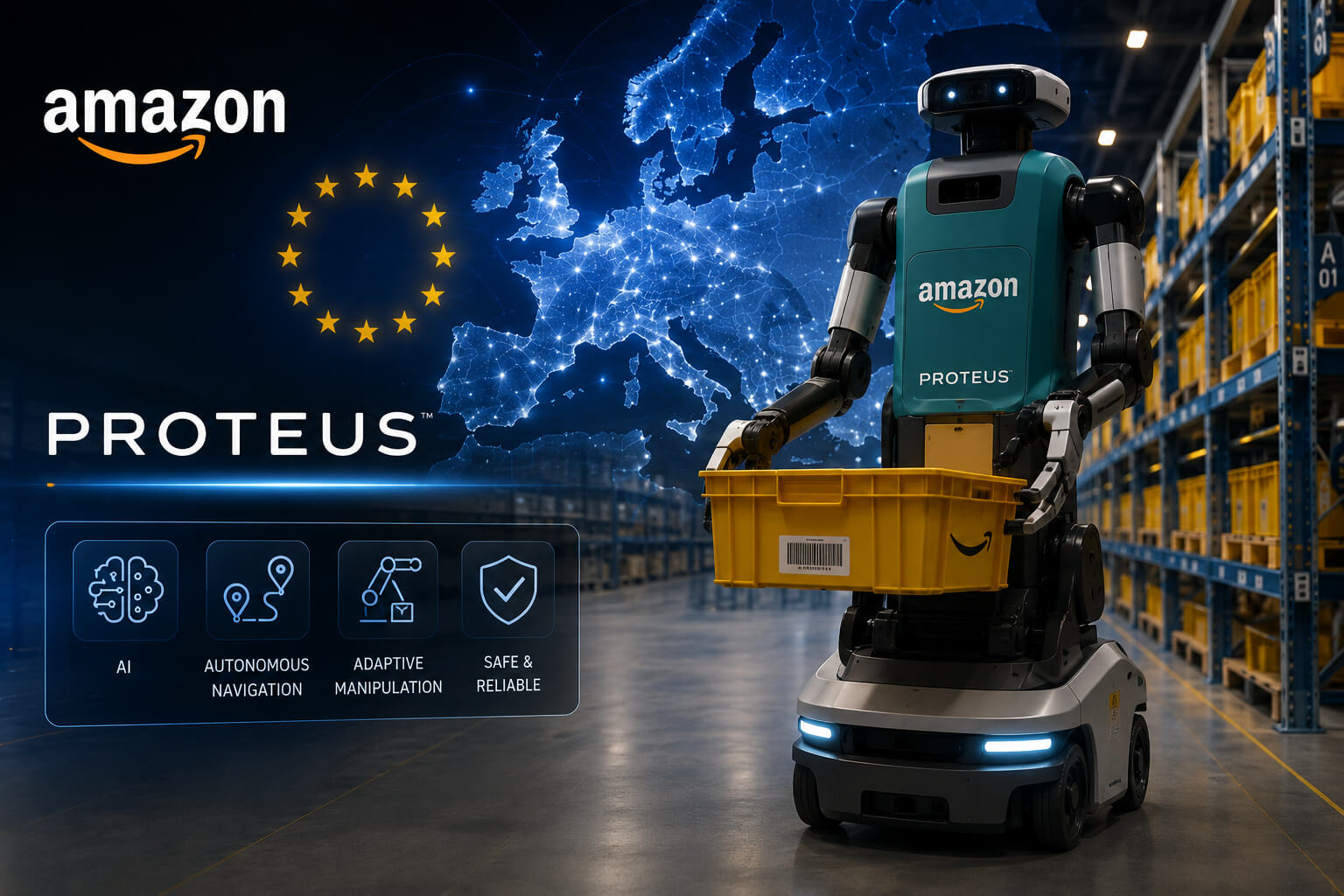
Amazon is expanding its AI-powered warehouse robotics strategy in Europe with an upgraded version of its Proteus robot. This system is designed to move heavy carts and respond to natural-language instructions.
The move is part of a wider automation push across Amazon’s European operations. This includes new robotics deployments, workforce expansion plans, and a major €10 billion investment in the region.
The upgraded Proteus was revealed during Amazon’s Delivering the Future event in London. At the event, the company highlighted how artificial intelligence and robotics are becoming more deeply integrated into fulfillment centers.
Proteus Gets Natural-Language Capabilities
Proteus is one of Amazon’s key warehouse robots. It is designed to move carts weighing up to 800 pounds while navigating fulfillment centers autonomously using sensors.
The latest version adds a major AI upgrade: the ability to understand natural-language instructions.
Instead of relying only on fixed commands, the upgraded Proteus can interpret everyday instructions and turn them into coordinated material-movement tasks. As a result, the robot can determine priorities, routes, and timing based on what it is asked to do.
The development signals a broader shift in warehouse automation. Robots are moving beyond repetitive task execution and becoming more flexible assistants inside logistics operations.
Amazon Plans European Rollout
Proteus is already operating in 25 fulfillment centers in the United States. Amazon now plans to bring the upgraded version to European fulfillment centers within the first half of next year.
The rollout shows Amazon’s growing confidence in advanced robotics as a core part of its logistics network.
Robots like Proteus can help Amazon to move materials around more efficiently and reduce the amount of physically demanding work that workers must do. In addition, they can improve the speed of fulfillment operations.
STARK and Vulcan Join Amazon’s Robotics Push
Proteus is not the only robot Amazon is bringing into the spotlight.
The company also introduced STARK, a robot designed to lift heavy totes from conveyor systems and place them into carts for transport. STARK was first unveiled in Barcelona, Spain. It is expected to roll out to 15 fulfillment centers across Europe by 2027.
Amazon is also scaling up its Vulcan robot that is designed to handle objects that need more delicate treatment. Vulcan employs vision systems and tactile sensing to more precisely identify, grip and manipulate items. This reduces the likelihood of damaging them.
Vulcan began in Spokane, Washington, and has already expanded to a facility in Hamburg, Germany. Amazon plans to deploy its robotics network in more European locations as it continues to scale its operations.
Amazon’s €10 Billion European Investment
The robotics expansion is part of a larger plan to invest €10 billion, or about $11.6 billion, across Amazon’s European operations over the coming years.
Amazon also said it plans to increase its European workforce by 25,000 people. This will happen even as automation becomes more common across its fulfillment network.
The company says its robots support workers rather than replace them. According to Amazon, systems such as Proteus, STARK, and Vulcan handle repetitive, heavy, and physically demanding tasks. As a result, employees can focus on work that requires human judgment and oversight.
AI Robotics Is Moving to the Heart of Logistics
Amazon’s latest foray into robotics is a prime example of a key trend in the tech and logistics worlds: the rise of AI-enabled physical automation.
Warehouse robots are no longer restricted to basic movement or fixed routines. AI, sensors, computer vision and natural-language controls make it possible to build these systems to be more adaptive and useful in complex real-world environments.
This could mean faster fulfillment, better safety, more efficient warehouse layouts and better handling of goods for Amazon across its global operations.
It also raises wider questions about the future of work in logistics as companies weigh automation against hiring, training workers and operating efficiently.
Why It Matters
Amazon’s rollout of its Proteus robot matters because it highlights the speed at which AI is moving out of software and into the physical world.
Natural-language robotics might change how warehouse workers interact with machines. This makes robots easier to direct and more useful in fast-moving fulfillment settings.
Amazon’s expansion could spark a battle to develop more sophisticated AI-powered automation in logistics. Rivals may be under pressure to deploy smarter robots that cut costs, improve speed and take on more complex jobs.
The impact on workers is more complex. Amazon says these systems are meant to reduce repetitive and physically demanding work. However, broader automation trends will continue to reshape the kinds of jobs available inside warehouses.
The bigger story is that AI is no longer just powering chatbots and digital tools. It is increasingly controlling machines that move, lift, sort, and operate inside real-world industrial environments.
For more Breaking AI news, visit: https://breakingai.news
