


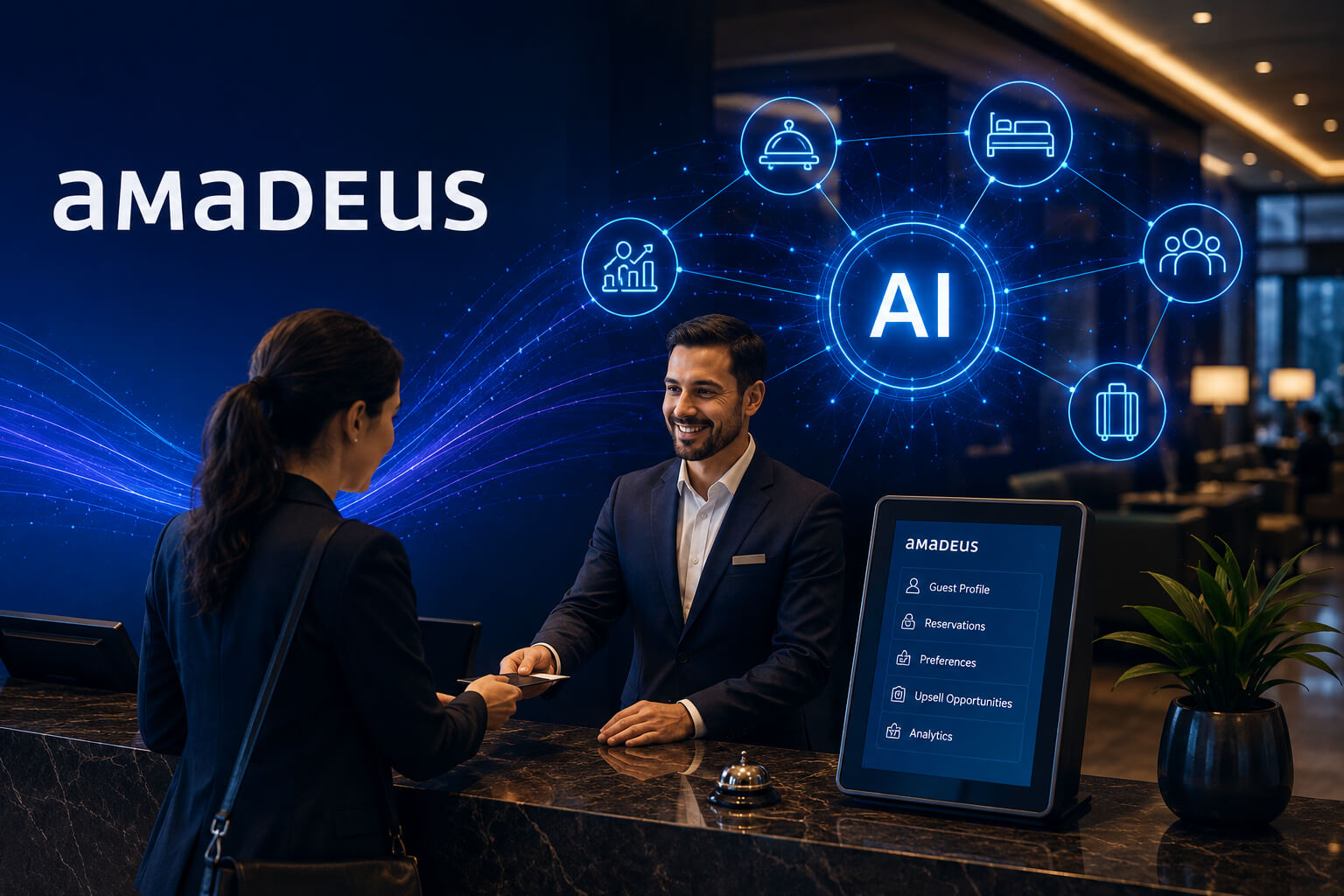
Amadeus Broadens AI Strategy Across Hospitality Sector Amadeus is accelerating its artificial intelligence strategy across the hospitality sector. It is announcing a broader AI strategy to help hotels maintain visibility, capture demand and improve guest experiences in an increasingly AI-driven travel marketplace.
As travelers increasingly turn to AI assistants and conversational platforms to research, plan and book trips, hospitality companies feel the pressure to get with the program. Amadeus says its revised AI approach will help hoteliers engage with travelers across both AI-empowered channels and hotel-owned platforms. At the same time, hotels can maintain control over pricing, merchandising and transactions.
AI is the new front door to hotel bookings
The travel-booking journey is evolving fast. Instead of starting their search on traditional search engines or hotel websites, many travelers are now looking for inspiration, recommendations and bookings through conversations powered by AI.
Amadeus is looking to support this shift by helping hotels become discoverable in these emerging AI environments. It does this by making hotels easier to find, book and manage through intelligent commerce tools that reduce operational complexity.
The company is positioning itself as a central technology layer for AI-enabled travel commerce. It offers hotel partners tools that connect demand generation, booking, payments, advertising, and operational intelligence.
Amadeus Moves Toward Agentic Commerce in Hospitality
A major part of the new strategy is Amadeus’ move into agentic commerce for hotels. Agentic commerce refers to AI systems that can help users complete tasks, such as searching, comparing, booking, and paying, inside conversational experiences.
Amadeus is working with Google and other industry partners on the Universal Commerce Protocol for Lodging, a framework intended to support AI-driven hotel commerce. The goal is to create a common structure that allows hotels to participate more effectively in AI-powered booking experiences.
Alongside this industry initiative, Amadeus is launching an AI commerce solution. This will allow hotels to join AI-powered travel marketplaces and support embedded booking experiences inside AI assistant channels.
For hotels, this could create new ways to reach travelers who are no longer browsing in traditional ways. Instead of only competing on search results pages or online travel agencies, hotels may need to compete inside AI-generated recommendations and conversational booking flows.
AI Search Optimization Becomes Critical for Hotels
Amadeus is also introducing Performance Manager – AI Search, a tool designed to help hotels improve how their content appears in AI-generated results.
This highlights the increasing shift from traditional search engine optimization to generative engine optimization, commonly known as GEO. As AI systems summarize, recommend, and rank travel options, hotels need structured, accurate, and helpful content that AI platforms can understand.
For hoteliers this means visibility in AI search may soon be as important as visibility on Google, booking platforms and metasearch engines.
Amadeus Max brings AI assistants to hotel operations
The expansion also includes a significant piece in the form of Amadeus Max, an AI assistant layer that runs across the Amadeus hospitality portfolio.
Amadeus Max has been designed to enable hotel professionals to interact with existing Amadeus tools in a natural way. With Amadeus Max, hotel professionals can gain insights and complete workflows faster. The assistant can support decision-making, simplify processes, and eventually execute approved actions across multiple products.
The company says Amadeus Max for Advisor is already live. It allows hotel professionals to ask questions in natural language and access insights from tools such as Demand360, Agency360, and RevenueStrategy360.
Amadeus Max is also being integrated into Microsoft Teams and launched on mobile. This gives hotel teams more flexible access to AI-powered insights.
AI Tools for Advertising, Sales, and Events
Amadeus plans to extend AI across more areas of hospitality operations.
For advertising, Amadeus Max for the Amadeus Travel Advertising Platform will use travel demand insights and prescriptive intelligence. This helps optimize campaign spending across channels.
Amadeus Max will bring agentic automation to Amadeus Delphi and Amadeus MeetingBroker for sales and events. It could help hotels deal with group and event requests more effectively by interpreting RFPs, scoring potential business, writing proposals and checking real-time availability.
These features illustrate how Amadeus targets not just consumer-facing AI booking tools. They also target back-office hotel workflows that impact revenue, sales productivity and guest service.
Why this matters for the hospitality industry
Amadeus’ enhanced AI strategy is a good example of a key trend in travel technology: AI is becoming embedded in the whole hospitality lifecycle.
Hotels aren’t just using AI for chatbots or customer service anymore. AI is now being utilized for discovery, search visibility, booking, advertising, revenue intelligence, sales workflows and guest personalization.
The rise of AI-driven travel planning holds both promise and peril for hotel operators. Those who get ahead of the curve could unlock new demand channels and operate more efficiently. However, those who don’t optimize for AI discovery could become less visible as travelers lean into AI assistants to determine where to stay.
Amadeus’ latest move suggests that AI-driven commerce could become a key battleground of competition for the hospitality industry.
The Bigger Picture
The hospitality industry is entering a new phase where AI assistants could change how travellers choose hotels, compare offers and make bookings.
Amadeus’ move to expand its AI portfolio is aimed at providing hotels with the infrastructure they need to survive in that environment. Its focus on agentic commerce, AI search, operational assistants and automated sales workflows shows how quickly AI is moving out of the experimental phase. In other words, it is entering the domain of real business use.
The message for hotels is clear. AI is no longer a future trend. It’s becoming a core part of how travel demand is created, captured and converted.
