


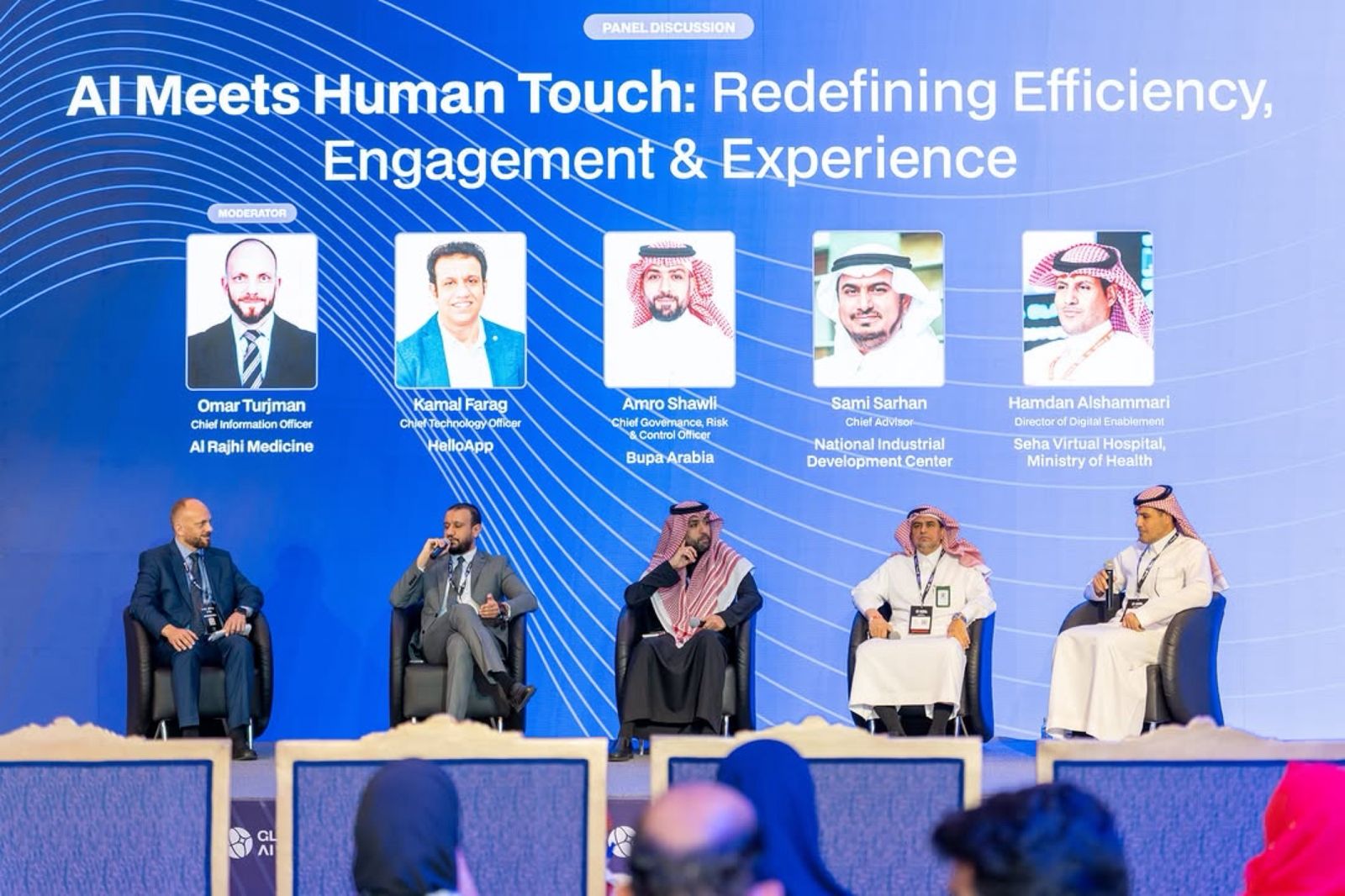
At Global AI Show Riyadh 2026, the panel discussion “AI Meets Human Touch: Redefining Efficiency, Engagement & Experience” explored one of the more uncomfortable truths in enterprise AI: automation is powerful, but customers still know when something feels cold, careless, or disconnected.
The session was moderated by Omar Turjman, Chief Information Officer at Al Rajhi Medicine, with insights from Kamal Farag, Chief Technology Officer at HelloApp, Amro Shawli, Chief Governance, Risk & Control Officer at Bupa Arabia, Sami Sarhan, Chief Advisor at the National Industrial Development Center, and Hamdan.
The conversation did not treat AI as a magic customer service machine. It looked at the harder part: how organizations can use AI to move faster without losing trust, context, and the very human ability to understand emotion.
The Trust Problem Behind Automated Decisions
AI can answer faster than a human agent. It can process more requests, route more cases, analyze more conversations, and reduce repetitive work. That is the easy part to sell.
The harder question is whether organizations should require human-in-the-loop checkpoints for automated AI decisions, especially when those decisions affect customer trust, brand reputation, or sensitive service outcomes.
Not every AI interaction needs human review. That would defeat the purpose of automation. But some moments clearly do. Complaints. Medical concerns. Insurance disputes. Financial decisions. Emotional conversations. High-value customers. Angry customers. Confused customers. The situations where one wrong automated response can damage years of brand credibility.
That is where human oversight still matters. Not as decoration. Not as a fallback button hidden somewhere in the interface. As a real operating layer.
AI-to-Human Handoffs Need to Stop Feeling Broken
One of the biggest frustrations in customer experience is the handoff problem. A customer explains everything to a chatbot, gets transferred to a human, then has to repeat the entire story again.
That is not efficiency. That is just automation creating extra work for the customer.
The panel raised an important point around frameworks for seamless AI-to-human handoffs while preserving full conversation context. This is where many organizations still struggle. They deploy AI at the front door, but the human agent receives only a fragment of the interaction, or worse, no useful context at all.
A proper handoff should carry the customer’s intent, history, sentiment, unresolved issue, urgency level, previous responses, and recommended next action. The human agent should not enter the conversation blind. The customer should not feel like they have been passed from one disconnected system to another.
Good AI service orchestration is not only about answering questions. It is about knowing when to step aside.
Sentiment Analysis Makes Service Less Static
Customer service often follows fixed scripts. That works until the customer’s tone changes.
Real-time sentiment analysis changes the rhythm. It gives organizations a way to read live customer reactions and adjust service strategies while the interaction is still happening. A frustrated customer may need faster escalation. A hesitant customer may need reassurance. A confused customer may need simpler language. A loyal customer with a bad experience may need a different response from a first-time user asking a basic question.
The idea is not to let AI “guess feelings” in a shallow way. The better use is pattern recognition. Tone. Word choice. Repetition. Silence. Escalation signals. Emotional pressure. These small signals can help virtual agents and human teams respond with more awareness.
That matters because speed alone does not create a better customer experience. Sometimes speed makes a bad experience worse.
AI-Augmented Empathy Is the Hard Part
The panel also explored how organizations can architect AI-augmented empathy, a phrase that sounds polished but points to a very real challenge. Can virtual agents recognize complex emotions? Can they respond to distress, frustration, urgency, disappointment, or fear in a way that feels appropriate?
This is not about making bots pretend to be human. That can easily become strange, even manipulative. It is about designing AI systems that know the difference between a routine question and a sensitive moment.
A customer asking for store hours does not need emotional intelligence. A customer dealing with a denied claim, delayed medical support, financial stress, or a serious complaint does.
AI systems need emotional routing, escalation rules, sentiment awareness, and language controls. They need to know when to soften the response, when to clarify, when to escalate, and when not to over-automate the moment.
Efficiency Without Experience Is a Weak Win
A big theme from the discussion was the tension between efficiency and experience. Organizations want AI because it reduces workload, improves response time, and scales service delivery. No surprise there.
But efficiency alone is not enough.
If customers feel ignored, misunderstood, or trapped inside an automated loop, the brand loses. Even if the system technically worked. Even if the dashboard shows faster resolution times. Even if the call volume dropped.
The better question is not whether AI can handle more customer interactions. It can. The better question is whether it can improve the interaction without stripping away the human judgment that makes service feel trustworthy.
Human Touch Becomes a Design Choice
The future of customer experience will not be fully human or fully automated. It will sit somewhere in the middle, and that middle needs serious design.
Human touch cannot be added at the end like a nice feature. It has to be built into the service architecture. Human-in-the-loop checkpoints. AI-to-human handoff frameworks. Real-time sentiment loops. Escalation triggers. Context preservation. Empathy-aware virtual agents. Governance around automated decisions.
That is the work.
The panel at Global AI Show Riyadh 2026 made one thing clear: AI can make service faster, but speed is not the same as care. Organizations that understand that difference will build better customer experiences. The ones that do not may end up with automation that looks efficient on paper and feels exhausting in real life.
