


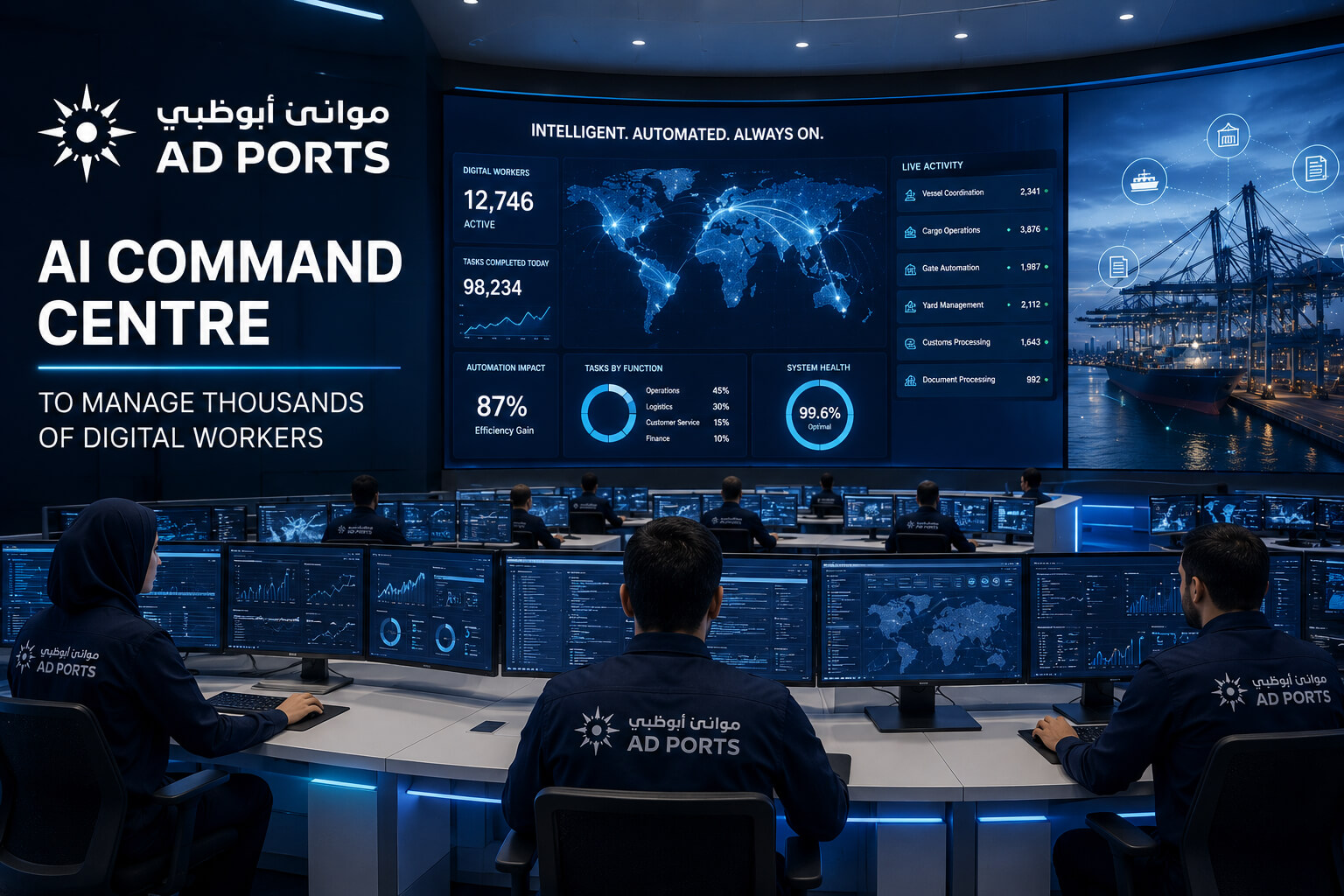
AD Ports Group has launched a new AI-powered command centre in Abu Dhabi. This marks a major step in the use of artificial intelligence across global port, logistics, maritime, and free zone operations.
The new intelligence hub, called IHQ, is designed to manage thousands of digital workers across 20 global workstreams. These AI-enabled workflows support operations across AD Ports Group’s major business areas. For example, they include ports, economic cities and free zones, maritime and shipping, logistics, and digital services.
The launch highlights how artificial intelligence is moving beyond pilot projects and into live industrial operations. For port operators, AI can help improve efficiency and reduce delays. Additionally, it can optimise vessel movement, support workforce planning, and manage complex logistics tasks in real time.
AD Ports AI Command Centre Supports Large-Scale Automation
IHQ was inaugurated at AD Ports Group’s Digital District at Zayed Port in Abu Dhabi. The platform brings together AI agents and automation systems that can support daily operational decisions across multiple business units.
According to the company, the AI command centre is already being used in areas such as port and berth optimisation and vessel arrival coordination. It is also being used for software development and talent acquisition.
This makes AD Ports Group one of the more advanced examples of industrial AI adoption in the ports and logistics sector. While many global port operators are still testing AI systems, AD Ports is deploying agentic AI across live operational workflows.
AI Agents Are Changing Port and Logistics Operations
The new AI headquarters builds on AD Ports Group’s broader digital transformation strategy. The company has spent two decades investing in digital systems. Moreover, it has increasingly focused on using autonomous AI agents to improve business performance.
The AI tools are designed to take on repetitive, data-heavy, time-sensitive tasks. For instance, they can optimize vessel speeds, balance container use, and optimize workforce scheduling.
The company has already identified tools that help reduce fuel consumption, increase container utilization and cut HR processing times as examples of AI-enabled systems. These use cases show how AI can deliver measurable improvements in large-scale logistics environments.
Supporting the UAE’s National AI Strategy
The launch of IHQ coincides with the UAE’s broader ambition to be a global leader in artificial intelligence by 2031.
AD Ports Group is not a government entity. However, its AI strategy is aligned with the country’s broader focus on digital transformation, smart infrastructure, cybersecurity and responsible AI deployment.
Leadership from the UAE Cybersecurity Council was also present at the launch. This underscores the importance of security and governance as AI systems take on an increasingly important role in critical infrastructure and global trade operations.
Human-AI Teams in the Future of Logistics
AD Ports Group’s AI strategy is based on human augmentation, not replacement. The company’s strategy focuses on using AI agents to help employees by taking care of repetitive and operationally complex tasks. Meanwhile, human teams focus on strategic decisions, creativity and oversight.
The model is indicative of a broader trend in enterprise AI adoption. Companies now move beyond automating individual tasks to forming hybrid teams. These teams integrate human and AI collaboration across business processes.
This could be a significant competitive advantage for the logistics and ports sector. Ports handle massive amounts of cargo, complicated scheduling, vessel coordination, workforce management and global supply chain pressures. AI systems can help operators make decisions quicker and respond better to disruptions.
Why This Matters
The launch of the AI Command Centre of AD Ports highlights the growing role of artificial intelligence in the future of global trade infrastructure.
As ports, logistics companies, and maritime operators face growing pressure to improve speed, sustainability, and reliability, AI command centres could become a key part of next-generation operations.
AD Ports Group’s IHQ is an example of how agentic AI can move from experimental use cases into real-world industrial deployment. If it works, it could help change how other port operators and logistics firms use AI in their own operations.
Conclusion
AD Ports Group’s new AI command centre represents a major milestone in the adoption of industrial AI in the Middle East. IHQ shows how AI can manage thousands of digital workers across 20 workstreams to support port operations, logistics, maritime services, workforce planning and digital transformation at scale.
With the UAE’s continued investment in artificial intelligence, AD Ports Group’s latest launch could be a major case study in the use of AI agents in critical infrastructure and global supply chains.
