


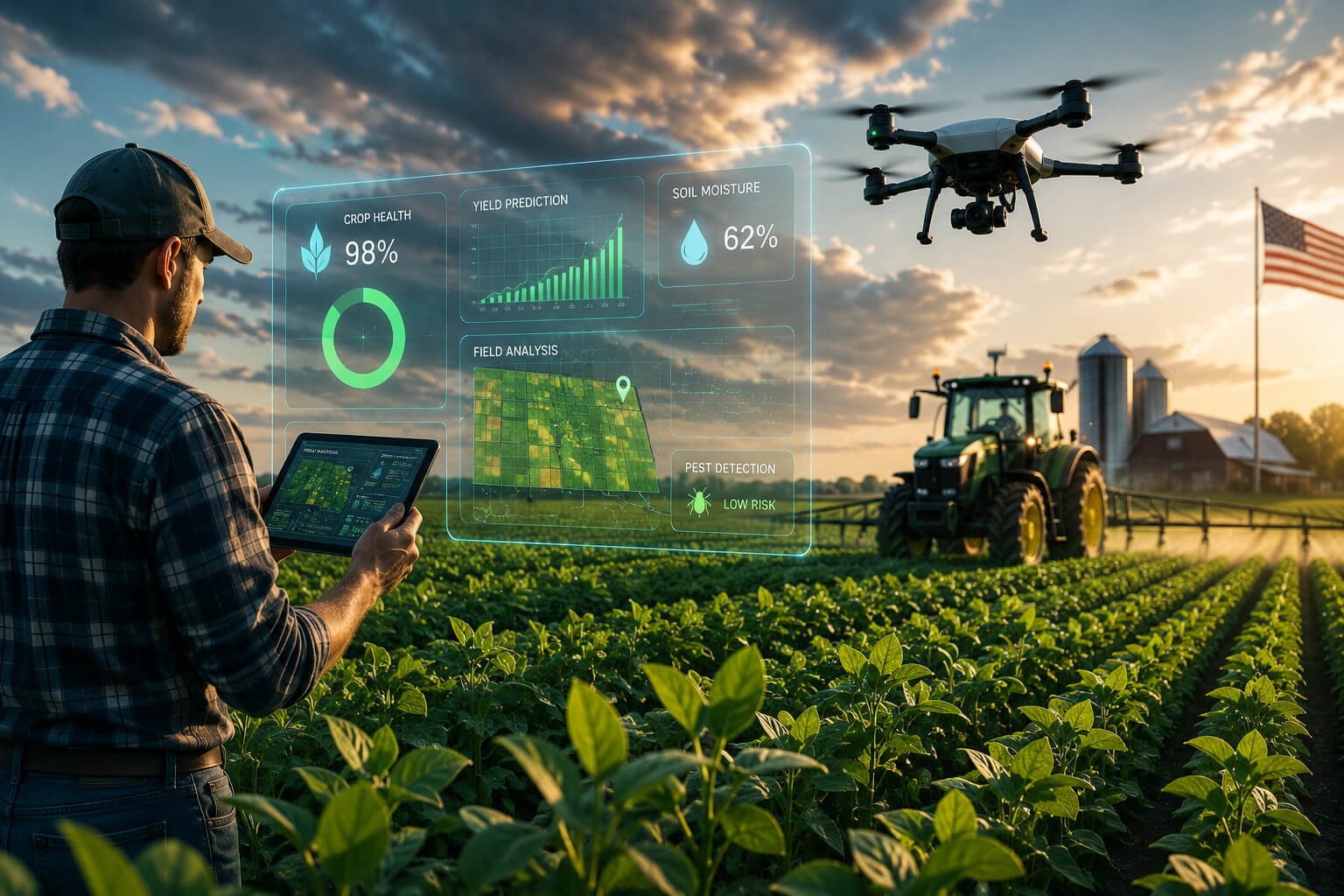
Artificial intelligence may be heading further into the field. Literally. A new bipartisan proposal known as the FARM AI Act is drawing attention because it would bring more artificial intelligence support into U.S. agriculture, especially through research funding, farmer education, and workforce training.
The idea is simple enough on the surface. Farms are getting more technical. Equipment is getting smarter. Data is becoming more important. But many producers still do not have the money, training, or local support needed to actually use AI tools in their daily operations. That is the gap the bill is trying to close.
The FARM AI Act Wants USDA Programs to Catch Up
The FARM AI Act, formally called the Fostering Agricultural Research and Modernization through Artificial Intelligence Act, would modernize several U.S. Department of Agriculture programs so they can better support AI in farming.
According to 13News Now, the bill would update USDA research and workforce programs to help bring AI into agriculture. The measure has also been described as a way to expand access to technology for American farmers, especially as precision agriculture becomes more important.
This is not just about putting flashy software on farms. The bill points toward practical uses: better crop monitoring, stronger data tools, precision nutrient application, disease detection, water conservation, and faster decision-making.
That is where AI starts to matter for farmers. Not as a buzzword. As something that could help them know what is happening across their land before problems get bigger.
Farmers Still Face Real Barriers to AI
There is a reason this bill is focused on access. AI tools can be expensive. Rural broadband is still uneven in many areas. A lot of small and mid-sized farmers do not have in-house technical teams sitting around waiting to manage farm data or machine learning systems.
The legislation would try to address that through USDA grants, education programs, and workforce development. It would make AI research eligible under the USDA’s Agriculture and Food Research Initiative and prioritize AI through the Agriculture Advanced Research and Development Authority.
That sounds bureaucratic, but it matters. If AI stays locked inside big agribusiness companies and research labs, smaller producers may fall behind. If USDA programs start treating AI as part of the future of agriculture, the technology has a better chance of reaching rural communities instead of only large operations with deep pockets.
Education May Be the Most Important Part
One of the more interesting parts of the FARM AI Act is its focus on farmer education. The bill would equip USDA Extension services with resources to help farmers understand and responsibly adopt AI and precision agriculture technologies. That matters because adoption is not only about buying software. Farmers need to know what the tool does, what data it uses, how accurate it is, and whether it actually improves the operation.
Bad AI in agriculture could waste money. Worse, it could lead to poor decisions around water, fertilizer, pests, livestock, or yields. Good training reduces that risk.
The bill would also expand USDA grants and fellowships to help prepare the next generation of agricultural workers for AI-driven farming. In other words, it is not only about today’s farmers. It is also about the rural workforce that will need to understand sensors, data systems, automation, robotics, and farm analytics in the years ahead.
North Carolina Has a Clear Interest in This
North Carolina is not just a random backdrop here. Senator Ted Budd of North Carolina led the Senate version of the bill with a bipartisan group of lawmakers, including Senators Adam Schiff, Jim Banks, Catherine Cortez Masto, Mike Rounds, and Lisa Blunt Rochester. The bill has support from North Carolina State University and the North Carolina Life Sciences Organization.
That support makes sense. North Carolina has a strong agriculture sector and a growing technology ecosystem. AI in farming sits right between those two worlds. North Carolina State University’s College of Agriculture and Life Sciences said the legislation could help accelerate innovation and workforce development across the agricultural sector. NCLifeSci also pointed to two major barriers facing farmers: lack of capital to adopt AI tools and shortage of trained rural workers to implement them.
That is probably the real story here. The problem is not that AI has no place in farming. The problem is getting it from research papers and pilot projects into barns, fields, irrigation systems, and farm offices.
A House Version Is Now Moving Too
The FARM AI Act is also gaining movement in the House. Representatives Zach Nunn of Iowa and Don Davis of North Carolina introduced a House companion version of the bipartisan bill. The proposal would strengthen USDA research, support responsible AI adoption through Extension services, expand rural workforce training, and create a senior USDA “AI in Agriculture Advisor” role to coordinate federal AI efforts.
That advisor role could become important if the bill advances. Agriculture AI touches many areas at once: research, food security, rural labor, data standards, farm equipment, sustainability, and national competitiveness. Without coordination, the effort could easily become scattered.
AI in Agriculture Is Not Coming Later. It Is Already Here
The bigger picture is hard to miss. AI is already being tested and used in agriculture through yield mapping, smart irrigation, pest detection, automated equipment, livestock monitoring, crop modeling, and climate-related forecasting. What the FARM AI Act does is bring federal policy closer to what is already happening on the ground.
The question is not whether AI will enter agriculture. It already has. The question is whether farmers outside the biggest and richest operations will have a fair shot at using it.
That is why this bill matters. Not because it suddenly makes farming futuristic, but because it acknowledges something rural communities already know: the next version of agriculture will need better tools, better training, and better access. And if lawmakers are serious about food security, that cannot be limited to a handful of large players.
Sources
- 13News Now: North Carolina bill would bring AI to agriculture
- U.S. Senator Ted Budd: FARM AI Act announcement
- Carolina Journal: Budd introduces bipartisan FARM AI bill supported by NC State
- FedScoop: USDA AI grants, research, and farmer education proposal
- National Hog Farmer: Lawmakers introduce bill to boost AI in farming
