


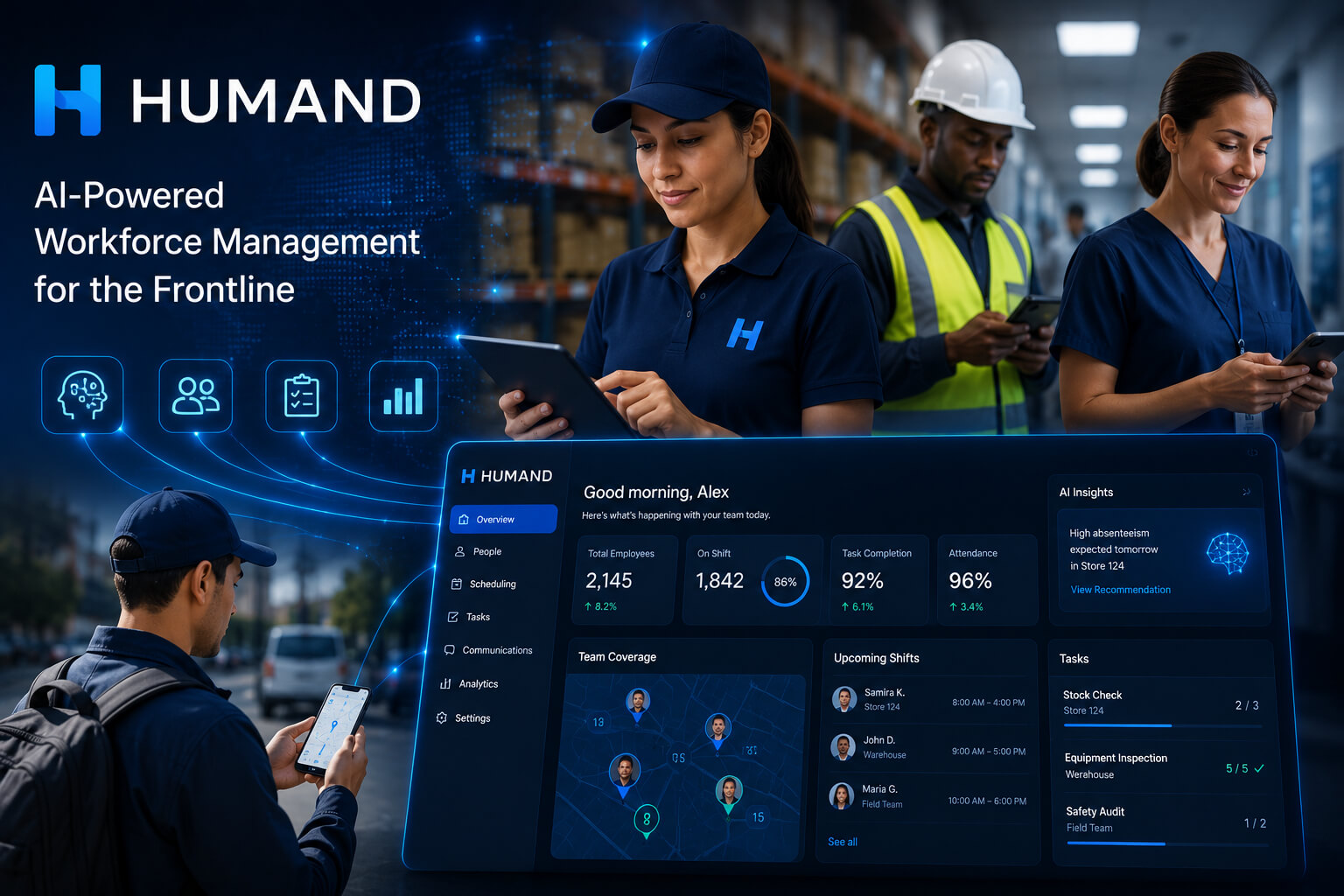
Frontline workers make up most of the global workforce, yet many of them still sit outside the digital systems companies use every day. As businesses consider the impact of an AI frontline workforce, the digital divide becomes even more apparent. Many workers have no corporate email. HR portals are often difficult to access. A desktop computer is not waiting at the start of every shift. Instead, communication may depend on a phone, a manager, a paper form, or a WhatsApp message that may or may not reach the right person.
Humand is trying to close that gap with an AI-powered platform built for operational workers in stores, factories, hotels, restaurants, distribution centers, airlines, healthcare facilities, and other frontline-heavy industries.
The company’s pitch is simple enough: give every worker one digital place to request support, receive company updates, complete onboarding, access benefits, handle training, and stay connected with the organization. But the bigger story is what happens when AI starts moving into those everyday HR workflows.
AI Is Moving Into Repetitive HR Requests
Humand recently raised US$66 million in Series A funding, a round the company says will help it integrate AI across its platform. That matters because frontline workforce management is full of repetitive tasks. Payroll clarifications. Vacation requests. Lost badge replacements. Uniform requests. Overtime claims. Questions about company policies.
These are not glamorous AI use cases. They are also exactly where companies lose thousands of hours. Humand says OXXO processes more than 1 million employee tickets each year through its platform, covering issues such as payroll, vacations, and badge replacements. Before AI, many of those tickets needed a human HR team member to review and resolve them manually.
Now, the company wants AI to handle a large share of those repetitive requests automatically. That could be a real shift for HR teams. Not because AI replaces the whole department. That is too neat, too dramatic. The more realistic version is messier: AI takes the simple tickets, summarizes performance reviews, builds training modules, and leaves HR teams with fewer repetitive admin loops.
Frontline Workers Were Not Designed Into Enterprise Software
A lot of workplace technology assumes one thing: the employee has a desk. That assumption breaks fast in the frontline world. Retail workers are serving customers. Factory workers are operating machines. Hotel staff are at reception desks or moving through floors. Restaurant workers are on shift. Delivery and logistics teams are rarely sitting in front of a laptop.
Traditional enterprise tools also usually require a corporate email address. Many frontline workers do not have one. Humand works around this by allowing employees to log in using a personal email or employee ID. The platform also brings multiple functions into one mobile app instead of expecting workers to download separate tools for chat, HR, onboarding, company news, training, and vacation management.
That detail matters. Frontline adoption is not won by adding more software. It is won by making the software feel almost invisible. Humand’s interface borrows from apps people already understand. Chat feels familiar. The news feed feels familiar. The goal is not to make workers learn enterprise software. It is to make workplace systems feel closer to everyday mobile apps.
AI-Generated Training Could Speed Up Onboarding
One of Humand’s newer AI features focuses on training content. Instead of building a course from scratch, HR teams can upload a PDF outline, describe the training objective, and let the AI generate a corporate training or onboarding module in seconds.
That sounds small until you think about companies with thousands of operational workers across dozens or hundreds of locations. Training delays become expensive. Inconsistent onboarding becomes risky. Updates to procedures take too long to reach everyone. Managers end up repeating the same instructions over and over.
AI-generated training does not solve every quality issue. Companies still need review, accuracy checks, and proper internal controls. But it can make the first draft of onboarding and learning materials much faster. For frontline industries, speed matters.
Mexico Is Becoming a Key Market for Humand
Humand launched in Mexico in 2021, and the country has since become its primary market. The company says it now works with major names including La Comer, Viva Aerobus, OXXO, Siemens, Centro Médico ABC, and Salud Digna, along with thousands of mid-sized businesses that also need to digitize internal processes.
Its next target is bigger: more than 10,000 active corporate clients in Mexico. That ambition comes at an interesting time. Mexico is moving toward a gradual reduction of the workweek to 40 hours, along with mandatory digital disconnection rules. For employers, that means better records, cleaner compliance, and more reliable tracking of shifts and working hours.
Humand says its time-tracking and digital clock tools can help companies maintain auditable records and reduce exposure to labor penalties. In other words, this is not just employee engagement software anymore. It is becoming compliance infrastructure too.
The Frontline AI Race Will Not Look Like Office AI
A lot of AI discussion still revolves around white-collar work. Emails. Documents. Spreadsheets. Coding. Presentations. Meeting notes. Frontline AI will look different. It will show up in shift records, employee tickets, onboarding flows, training modules, policy questions, internal announcements, safety updates, and payroll disputes.
Less flashy. More operational. That may be why this market is worth watching. The companies that win frontline AI will not just build smart assistants. They will need to understand messy workplaces, low-friction mobile design, labor rules, HR bottlenecks, and workers who do not have time to fight with complicated software.
Humand seems to understand that problem. And with fresh funding behind it, the company is now trying to turn AI into something frontline workers and HR teams actually use every day.
Source: Mexico Business News: Digitizing the Frontline Workforce Through AI
