


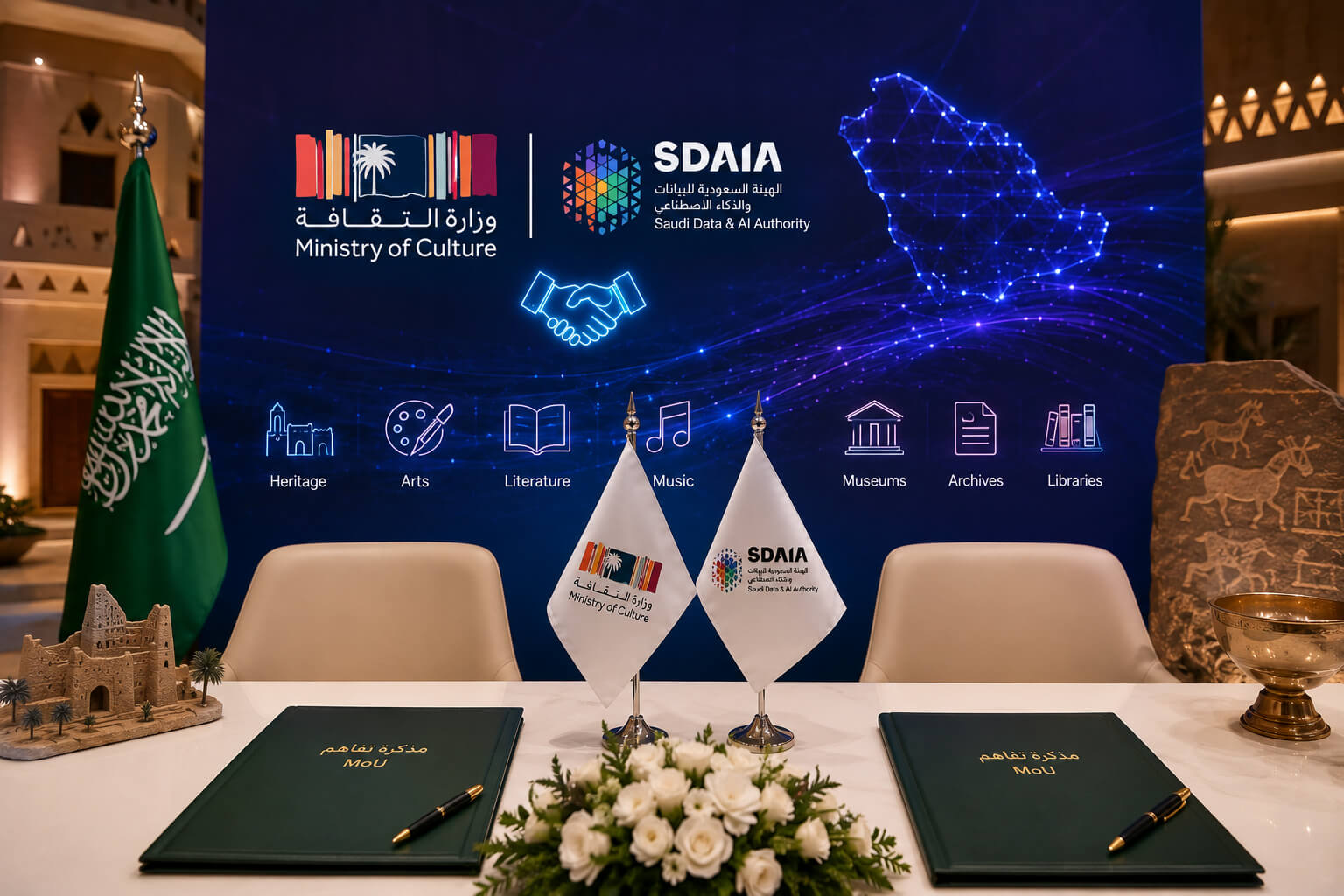
Saudi Arabia is bringing artificial intelligence deeper into its cultural economy. The Kingdom’s Ministry of Culture and the Cultural Development Fund have signed a trilateral memorandum of understanding with the Saudi Data and Artificial Intelligence Authority, better known as SDAIA. The agreement is designed to explore AI programmes that can support creators, cultural enterprises, and institutions across Saudi Arabia’s officially recognised cultural sectors.
It is not the usual AI story about banking, healthcare, cloud infrastructure, or data centers. This one moves into museums, heritage, fashion, film, music, theatre, literature, culinary arts, and other creative fields that are now being treated as part of Saudi Arabia’s broader technology and investment agenda.
Saudi Arabia Wants AI Inside Its Cultural Economy
The MoU comes as Saudi Arabia continues to mark 2026 as the Year of Artificial Intelligence, a national push aimed at widening AI adoption across public and private sectors. For the cultural sector, the timing feels intentional. Saudi Arabia has been building culture into a serious economic pillar under Vision 2030, not just as a soft-power project but as a business ecosystem. That means funding, governance, startups, creative SMEs, and now more structured use of AI.
The agreement focuses on creators and cultural enterprises across the Kingdom’s 16 cultural sectors. These include areas such as heritage, museums, libraries, literature, music, theatre, film, architecture, fashion, and culinary arts. That range matters. AI in culture is not one single use case. It could mean digital heritage preservation, smarter museum experiences, AI-supported translation, creative production tools, fashion design systems, content archiving, audience analytics, or new ways for cultural businesses to scale.
Why the Ministry of Culture AI MoU Matters
Culture has not always received the same AI investment attention as finance, healthcare, logistics, or energy. But that gap is starting to close. A specialised study by the Cultural Management Platform found that AI applications already touch all 16 of Saudi Arabia’s recognised cultural sectors. That suggests the issue is no longer whether AI belongs in culture. It is more about how to govern it, fund it, and make sure creators can actually use it without losing control of their work.
That is where the Ministry of Culture’s role becomes important. The MoU gives the ministry room to help shape the policy environment around cultural AI. That includes intellectual property, data use, ethical standards, professional frameworks, and regulations that could make investors and creators more confident about building AI-powered cultural projects.
This part is less flashy than an AI tool launch. Still, it may be the more important piece. Cultural AI can become messy quickly when questions about ownership, originality, training data, and creative rights are left unanswered.
SDAIA Adds National AI Expertise to the Culture Push
SDAIA’s involvement gives the agreement more weight. As Saudi Arabia’s main data and AI authority, SDAIA is expected to bring technical and strategic expertise into the partnership. The Ministry of Culture brings the sector knowledge. The Cultural Development Fund brings the financing and investment angle.
That combination shows how Saudi Arabia is trying to avoid treating AI as a standalone technology project. Instead, the Kingdom is plugging AI into existing national development sectors, including culture.
For creators, this could open the door to competitions, hackathons, funding programmes, and AI initiatives built specifically for cultural work. The Ministry of Culture and affiliated commissions have already supported competitions and hackathons aimed at attracting innovators in this space.
Cultural Development Fund Builds the Investment Side
The Cultural Development Fund has become one of the main vehicles behind Saudi Arabia’s cultural economy ambitions. Since its launch in 2021, the fund has delivered more than SAR770 million, or about $205 million, in financial support to 165 cultural projects. It has also supported more than 1,630 creatives and entrepreneurs.
Its Q1 2026 performance showed a 30% year-on-year increase in financial returns, an estimated SAR4.1 billion contribution to GDP, more than 12,540 jobs created, and about SAR1.1 billion in private sector contributions. Those numbers help explain why AI is being introduced now. Saudi Arabia already sees culture as an investable sector. AI could make that sector more scalable, more data-driven, and possibly more exportable.
The fund has also backed major investment vehicles, including a SAR375 million film fund managed by MEFIC Capital and a SAR300 million fashion fund managed by Merak Capital. That gives the AI MoU a clearer business context: culture is being positioned as both a creative field and a growth market.
AI in Saudi Culture Is Moving Beyond Experimentation
The agreement does not mean every Saudi cultural sector will suddenly become AI-led overnight. That would be too neat, and probably not realistic. But it does show a direction.
Saudi Arabia is preparing the groundwork for AI to become part of how cultural institutions operate, how creators build, and how cultural businesses attract funding. The focus is not only on tools. It is also on rules, standards, and investment confidence.
That may be the bigger story here. AI in culture is often talked about as a threat to artists or a shortcut for content production. Saudi Arabia appears to be framing it differently: as infrastructure for a creative economy that wants to grow faster, reach wider audiences, and sit closer to the country’s national AI strategy.
Whether that works will depend on execution. Creators will need access, not just announcements. Cultural businesses will need funding that matches real market demand. And the policy side will need to protect creative rights without slowing innovation too much.
For now, the message is clear enough. Saudi Arabia does not want AI limited to factories, hospitals, banks, and government systems. It wants the technology inside its cultural future too.
