

Close Menu
    What's Hot
    Technology & Innovation

    Mila and Mozilla Build Open Source AI Foundation for Private, Local Deployment

    By Art RyanSeptember 18, 20260

    Mila and Mozilla are pushing their open source AI partnership into a much bigger project.…

    OpenAI Launches New Framework to Publicly Report AI Model Misalignment

    September 18, 2026

    UAE Sends 50+ AI Leaders to US as Agentic AI Government Push Accelerates

    September 18, 2026

    Abu Dhabi Crown Prince Chairs First Executive Council Meeting Using Agentic AI

    September 18, 2026
    Facebook X (Twitter) Instagram
    Facebook X (Twitter) Instagram
    Breaking AI News
    Friday, September 18
    • Home
    • Events
    • Videos
      • Machine Can Think Summit 2026
      • Step Dubai Conference 2026
    • Technology & Innovation

      Mila and Mozilla Build Open Source AI Foundation for Private, Local Deployment

      September 18, 2026

      OpenAI Launches New Framework to Publicly Report AI Model Misalignment

      September 18, 2026

      UAE Sends 50+ AI Leaders to US as Agentic AI Government Push Accelerates

      September 18, 2026

      Abu Dhabi Crown Prince Chairs First Executive Council Meeting Using Agentic AI

      September 18, 2026

      UAE F&B Manufacturers Lead Global Industrial AI Adoption, Schneider Electric Study Finds

      September 18, 2026
    • Business & Marketing

      WTO Says AI Is Becoming Deeply Embedded in Global Trade

      September 15, 2026

      OpenAI Delays 2026 IPO as Altman Raises AI Safety Concerns

      September 14, 2026

      Ireland Takes Europe’s AI Lead as Business Adoption Jumps to 65%

      September 14, 2026

      UK Economy Grows 0.4% as AI and Cloud Computing Help Power July Expansion

      September 12, 2026

      Mistral Raises €3 Billion to Push Sovereign, Open-Weight AI Toward the Frontier

      September 12, 2026
    • Industry Applications

      Abu Dhabi Crown Prince Chairs First Executive Council Meeting Using Agentic AI

      September 18, 2026

      UAE F&B Manufacturers Lead Global Industrial AI Adoption, Schneider Electric Study Finds

      September 18, 2026

      Egypt and Intel Launch AI Training Push for One Million Citizens a Year

      September 17, 2026

      Jordan Launches First Local AI Compute Platform Klstrai at Aqaba Digital Hub

      September 17, 2026

      UAE Launches Factory Forward to Speed Up AI and Industry 4.0 Adoption

      September 16, 2026
    • Trends & Insights

      UAE Sends 50+ AI Leaders to US as Agentic AI Government Push Accelerates

      September 18, 2026

      TypeSafe Emerges From Stealth With Jev, an AI Model Built for Fast Software Decisions

      September 17, 2026

      OpenAI, Anthropic and Google DeepMind Hold Weeks of Talks on AI Safety

      September 16, 2026

      Pinterest Makes AI Search 7.3x Faster With NVIDIA-Powered Multimodal Infrastructure

      September 15, 2026

      WTO Says AI Is Becoming Deeply Embedded in Global Trade

      September 15, 2026
    • AI in Travel

      Zeal Connect Launches AI-First Zeal CRM for Travel Operations at Arabian Travel Market 2026

      September 17, 2026

      UniFocus Launches Claira, an AI-Native Platform for Hotel Workforce and Operations Management

      September 17, 2026

      CHTA Puts Hospitality Workers at the Heart of Caribbean AI Transformation

      September 16, 2026

      ATM 2026 Puts AI at the Center of Travel’s Next Big Rebuild

      September 16, 2026

      Dubai Puts AI at the Center of Tourism’s Next Phase as Travel 2040 Takes Shape

      September 15, 2026
    Breaking AI News
    Home » Saudi Arabia Launches National AI Risk Framework as AI Oversight Gets More Serious
    Ethics & Society

    Saudi Arabia Launches National AI Risk Framework as AI Oversight Gets More Serious

    Art RyanBy Art RyanJuly 15, 2026Updated:July 15, 2026No Comments5 Mins Read
    Facebook Twitter Pinterest LinkedIn Tumblr Email
    Saudi Arabia AI risk framework
    Share
    Facebook Twitter LinkedIn Pinterest Email

    Saudi Arabia is putting more structure around artificial intelligence, and this time the focus is not just investment, data centers, or new AI products.

    It is risk.

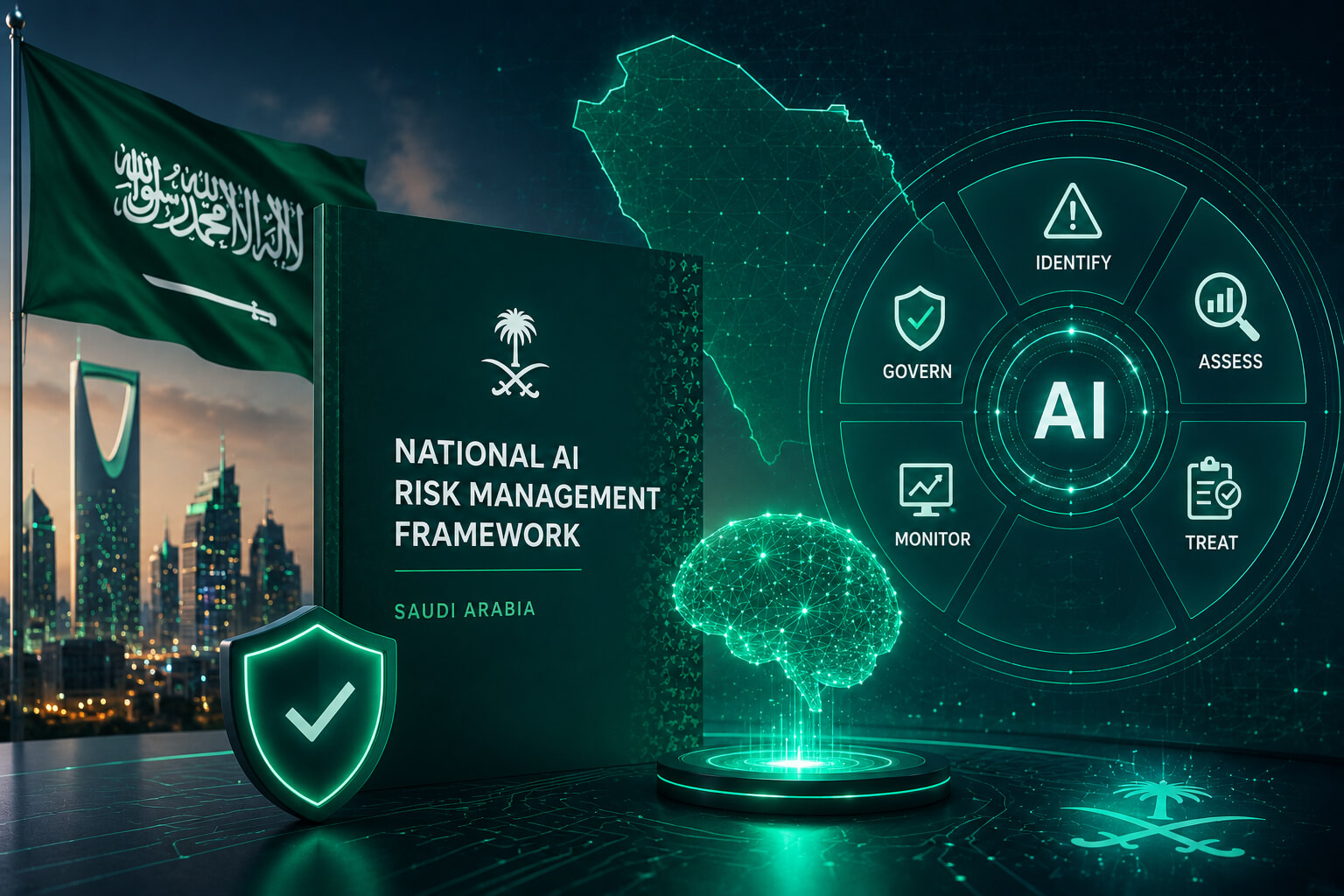
    The Saudi Data and Artificial Intelligence Authority (SDAIA) has published a National Artificial Intelligence Risk Management Framework designed to help government and private entities identify, assess, treat, and monitor AI-related risks. The framework gives organizations a shared national method for handling AI systems before, during, and after deployment.

    That may sound like policy language. It is. But it also says something bigger about where Saudi Arabia’s AI strategy is heading.

    The Kingdom does not only want AI adoption to move fast. It wants the rules, controls, and accountability systems to move with it.

    Saudi Arabia Moves AI Risk Into a National Framework

    SDAIA’s new framework gives public and private organizations a common way to manage AI risk across different sectors and levels of digital maturity. It covers the full risk cycle, from defining the scope of an AI system to continuous monitoring after it is already operating.

    That last part matters.

    AI systems are not like traditional software that stays mostly predictable once deployed. Models can drift. Outputs can change. Decisions can be hard to explain. A tool that works safely in one environment may behave differently when data, users, or use cases shift.

    SDAIA’s framework openly treats AI risk as something different from ordinary software risk. That is probably the right starting point.

    The Four Phases of Saudi Arabia’s AI Risk Framework

    The framework follows four connected phases.

    First, organizations define the context and scope of the AI system. That means understanding where the system will be used, who it affects, what decisions it supports, and what level of risk may be involved.

    Then comes risk identification and assessment. This stage looks at what could go wrong, how likely it is to happen, and how serious the impact could be.

    After that, entities are expected to treat the risk. Not every problem gets the same response. Some systems may need stronger technical controls. Others may require operational changes, contractual protections, insurance, limits on use, or even full avoidance if the risk is too high.

    The final phase is continuous monitoring and review. In simple terms, organizations cannot just approve an AI system once and forget about it. They need to keep watching it.

    That is where AI governance often gets difficult. The launch is only the beginning.

    Seven Risk Categories, One Shared Method

    The framework classifies AI risks into seven main categories and is built around principles such as transparency, accountability, privacy, and integrity. SDAIA says risk levels are calculated through a matrix that connects probability with potential impact, allowing organizations to classify risks in a more consistent way.

    This matters because AI regulation can easily become fragmented.

    One ministry may assess risk one way. A bank may use another system. A healthcare provider may apply a stricter internal standard. A startup may have almost no formal process at all.

    A national framework does not automatically fix that. But it gives everyone a common reference point.

    Developers can use it while designing systems. Operators can use it when managing live AI tools. Policymakers can use it to spot regulatory gaps. That wider audience is important because AI risk does not sit in one department anymore.

    Why This Matters for Saudi Arabia’s AI Push

    Saudi Arabia has been building AI into its national transformation agenda for years. SDAIA is the Kingdom’s central authority for data and AI, and the new risk framework aligns with the National Strategy for Data and Artificial Intelligence.

    The timing also fits the broader national push around AI in 2026. Earlier this year, Saudi Arabia designated 2026 as the Year of Artificial Intelligence, with guidelines intended to unify national efforts and promote high-impact AI initiatives across the country.

    That makes this framework more than a compliance document.

    It is part of the plumbing behind Saudi Arabia’s AI ambitions. Big AI programs need trust. Trust needs rules. Rules need a repeatable process.

    Not exciting, maybe. But necessary.

    AI Adoption Is No Longer Just About Speed

    The most interesting part of the framework is what it signals.

    Saudi Arabia is not slowing down on AI. But it is making clear that speed alone is not enough.

    As AI spreads into predictive models, natural language processing, image and video analysis, and intelligent automation, the risk surface grows. Bias, privacy exposure, security failures, poor explainability, incorrect outputs, and uncontrolled deployment all become harder to ignore.

    For businesses, this means AI projects may need stronger documentation and risk controls from the start. For government entities, it could push more consistent AI governance across departments. For developers, it means risk management can no longer be treated as something added at the end.

    That is probably the real story here.

    Saudi Arabia is trying to make AI governance part of the system, not a side note.

    Sources:

    • Middle East AI News — Saudi Arabia launches national AI risk framework
    • Saudi Data & AI Authority (SDAIA)
    • Saudi Press Agency — Year of Artificial Intelligence 2026 guidelines
    Share. Facebook Twitter Pinterest LinkedIn Tumblr Email
    Art Ryan

    Related Posts

    Mila and Mozilla Build Open Source AI Foundation for Private, Local Deployment

    September 18, 2026

    OpenAI Launches New Framework to Publicly Report AI Model Misalignment

    September 18, 2026

    UAE Sends 50+ AI Leaders to US as Agentic AI Government Push Accelerates

    September 18, 2026

    Comments are closed.

    Latest News

    Mila and Mozilla Build Open Source AI Foundation for Private, Local Deployment

    September 18, 2026

    OpenAI Launches New Framework to Publicly Report AI Model Misalignment

    September 18, 2026

    UAE Sends 50+ AI Leaders to US as Agentic AI Government Push Accelerates

    September 18, 2026

    Abu Dhabi Crown Prince Chairs First Executive Council Meeting Using Agentic AI

    September 18, 2026
    Facebook X (Twitter) Pinterest Vimeo WhatsApp TikTok Instagram LinkedIn YouTube Spotify Reddit Snapchat Threads

    AI University

    • Global Universities
    • Universities in Africa
    • Universities in Asia
    • Universities in Europe
    • Universities in Latin America
    • Universities in Middle East
    • Universities in North America
    • Universities in Oceania

    AI Tools & Apps Directory

    • AI Productivity Tools
    • AI Coding Tools
    • AI Voice Tools
    • AI Video Tools
    • AI Image Generators
    • AI Writing Tools

    Info

    • Home
    • About Us
    • AI Organizations & Associations
    • Contact Us
    • Cookie Policy
    • Copyright Policy
    • Disclaimer
    • Editorial Policy
    • Terms and Conditions

    Subscribe to Updates

    Get the latest creative news from FooBar about art, design and business.

    © 2026 Breaking AI News.
    • Privacy Policy

    Type above and press Enter to search. Press Esc to cancel.

    Sign Up

    Want to stay ahead In Artificial Intelligence?

     Sign up now and get exclusive breaking AI news and special updates—FREE!