


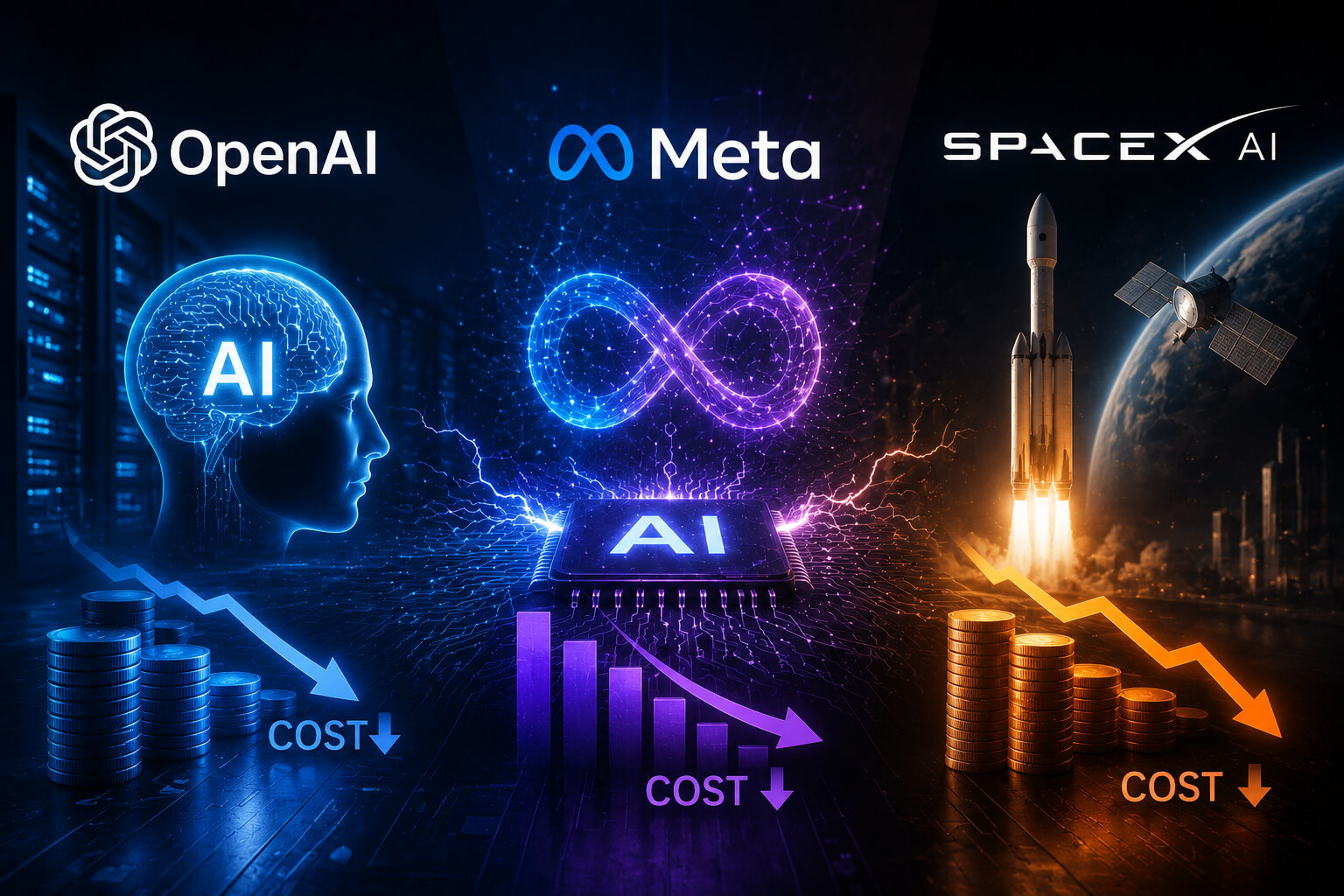
The AI race is starting to sound different. Increasingly, the focus is shifting towards cost-efficient AI models that deliver performance without breaking the bank.
For the past few years, the loudest brag was simple: bigger model, better benchmark, more power, more chips, more data centers. That still matters. Nobody is pretending frontier AI has suddenly become cheap or easy.
But the message coming from OpenAI, Meta and Elon Musk’s xAI is changing. The new flex is cost.
Bloomberg reported that the latest competition among major AI labs is moving toward more cost-efficient AI models, as companies look for ways to make advanced systems cheaper to run and easier to sell to businesses. That shift is not small. It may decide which AI companies actually build huge long-term businesses, and which ones only win headlines.
AI Companies Are Learning That Expensive Intelligence Has a Limit
AI models can be impressive and still be too expensive.
That is the uncomfortable part of the current AI boom. A chatbot that answers quickly is one thing. However, a model that helps write code, generate video, support customers, analyze contracts, search company data, and run inside enterprise workflows is something else. Each prompt costs money. Tokens carry a price. Eventually, every product team using AI at scale has to ask the same boring question: can we afford this?
That is why cost-efficient AI models are suddenly getting more attention.
Businesses are no longer only asking which model is “best.” They are asking which model is good enough, fast enough, reliable enough, and cheap enough to use every day.
At the Sun Valley conference, OpenAI CEO Sam Altman reportedly said business leaders were focused on how to reduce AI costs and get better returns from AI spending. That says plenty. The AI hype cycle is still alive, but the CFO has entered the room.
Meta Wants to Compete on Price
Meta’s strategy looks especially aggressive.
Mark Zuckerberg has been pushing Meta deeper into AI infrastructure, models and developer tools. Now the company appears ready to use pricing as a weapon. Zuckerberg said Meta’s new model API would cost around 25% of what some competing AI models charge, while criticizing rival pricing as extreme, according to reports citing his Bloomberg interview.
That is a very Meta move.
For years, Meta tried to shape the AI market through open models and broad developer access. Giving models away helped Meta gain influence, but influence does not always become revenue. Charging for model access changes the story. It puts Meta closer to OpenAI, Anthropic and Google, but with a sharper price pitch.
The message is basically: use our AI because it is cheaper.
Not as glamorous as “superintelligence.” Probably more useful to companies trying to control software bills.
OpenAI Still Has the Brand, But Cost Pressure Is Rising
OpenAI remains the name most people associate with modern generative AI. ChatGPT gave the company a consumer advantage, an enterprise advantage, and a cultural advantage that rivals are still chasing.
But OpenAI also faces a difficult balance.
It needs to keep releasing powerful models while making them affordable enough for mass use. That is harder than it sounds. Better reasoning, faster coding, multimodal tools and agentic systems all require serious compute. More compute means more cost unless the model architecture, infrastructure, routing and inference systems improve.
This is where AI competition gets less flashy and more technical.
The next winner may not simply be the lab with the smartest model. It may be the lab that can deliver strong answers using less compute, fewer tokens, better routing, smaller specialized models, and smarter infrastructure.
That kind of efficiency does not always make a viral demo. It does make a business model stronger.
xAI Adds More Pressure to the AI Model Race
Elon Musk’s xAI is also part of the pressure building around cost and performance.
The company has been racing to position Grok as a serious rival to OpenAI, Meta, Google and Anthropic. Musk’s broader advantage is infrastructure ambition. His companies are comfortable building at extreme scale, and xAI has tied its identity closely to massive compute capacity and fast model iteration.
But even here, cheaper operation matters.
A giant AI cluster may help train and serve powerful models. It does not automatically solve the economics of selling AI to millions of users or thousands of businesses. If xAI wants Grok to compete beyond Musk’s own ecosystem, efficiency will matter as much as personality, speed or benchmark scores.
The AI market is not short of models anymore. It is short of models that companies can use without watching costs explode.
The AI Industry Is Moving From Benchmarks to Unit Economics
This is the part that feels different.
AI companies used to compete mainly on capability. Which model had the best reasoning score? Some raced to write better code. Others pushed into images, audio, and video. Everyone wanted to claim the biggest leap.
Those questions still matter, but they are not enough.
A model that performs beautifully in a demo can become painful in production. Customer support teams need predictable pricing. Developers need stable APIs. Startups need margins. Large companies need procurement approval. Nobody wants to build a product around an AI system that becomes too expensive when users actually show up.
That is why routing is becoming more important. Some tasks may need a frontier model. Many do not. A simple classification, summary, product description, spreadsheet cleanup or email draft can often be handled by a smaller and cheaper model. Companies are starting to understand that using the most powerful model for every task is like hiring a surgeon to open every envelope.
Technically possible. Financially silly.
Cheaper AI Could Make Adoption Move Faster
If OpenAI, Meta and xAI keep pushing model costs down, AI adoption could move faster across software, media, retail, finance, healthcare and business operations.
Lower prices make experimentation easier. They also make it safer for companies to add AI features without immediately worrying that usage will destroy margins. This is especially important for startups and smaller businesses using AI that cannot absorb massive token bills.
There is another angle too.
Cheaper AI may change which companies win. Meta could pull more developers into its ecosystem if it can undercut rivals. OpenAI can defend its lead by keeping the best balance of quality and efficiency. Meanwhile, xAI could become harder to ignore if it pairs powerful models with aggressive infrastructure economics.
The AI model race is not slowing down. It is becoming more practical.
Less “look what this model can do once.”
More “can this model do it a billion times without bankrupting the customer?”
That question may define the next stage of artificial intelligence.
Source: Bloomberg
