


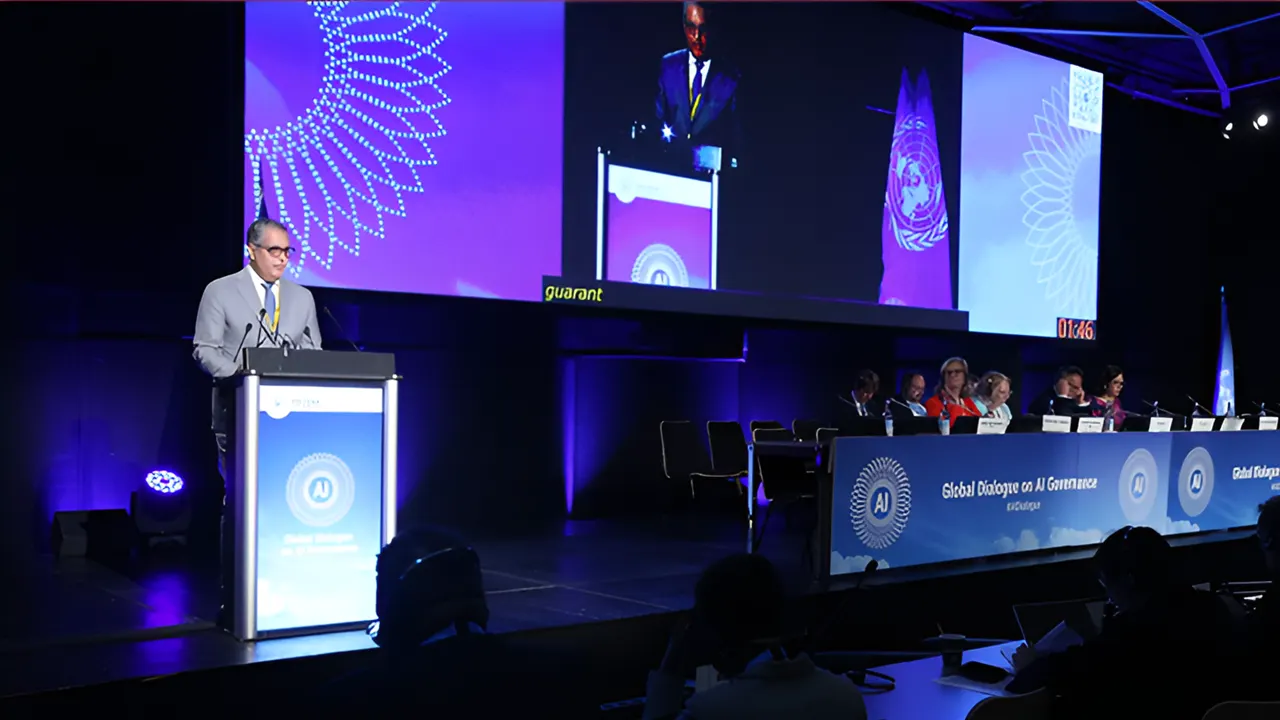
Qatar has entered the global AI governance conversation with a new message: countries with the biggest data centers, the largest AI firms, or the deepest technology budgets should not be the only ones shaping artificial intelligence ethics.
The country launched the Global Alliance for AI Ethics, also known as GAAIE, during the inaugural United Nations Global Dialogue on AI Governance in Geneva. The announcement was made by Qatar’s Minister of Communications and Information Technology, H.E. Mohammed bin Ali Al Mannai, during a high-level government session focused on inclusive and interoperable AI governance.
Qatar Wants a Wider AI Ethics Conversation
The new alliance is an initiative of Hamad Bin Khalifa University, part of Qatar Foundation. Its goal is to create a global platform where different cultural traditions, ethical systems, and regional perspectives can help shape how AI is governed.
That detail matters. A lot of AI policy discussion still comes from a narrow group of powerful countries and companies. The same names keep appearing. Familiar concerns dominate the debate. Old assumptions about innovation, regulation, risk, and economic growth continue to shape the conversation.
Qatar appears to be pushing for something broader. Not just another AI forum with polished speeches, but a channel where emerging economies and underrepresented regions can have a real say in the technical and regulatory frameworks now being built around artificial intelligence.
Why the Global Alliance for AI Ethics Matters
AI governance is becoming one of the most important policy fights of the decade. Governments are trying to regulate models that move faster than traditional lawmaking. Companies want room to innovate. Civil society groups want stronger guardrails. Developing economies do not want to be left behind again.
The Global Alliance for AI Ethics is being positioned around that tension.
According to the announcement, the alliance will support multi-stakeholder dialogue on AI ethics while drawing from different global traditions and values. The larger aim is to make sure AI frameworks are not designed only around the priorities of dominant AI-producing nations.
That may sound diplomatic, but the point is direct: AI systems will affect everyone, so the rules should not be written by only a few.
Three Priorities for AI Governance
During the announcement, Qatar’s minister outlined three major priorities for global AI governance.
The first is closing gaps in computing infrastructure, data, and talent. This is a major issue for countries that want to build AI capacity but do not have the same access to advanced chips, cloud infrastructure, research labs, or skilled AI workers.
The second is interoperability. Different countries are already building different AI rules. Without some level of alignment, businesses, governments, and users could end up dealing with fragmented systems that do not work well across borders.
The third priority is keeping human rights and human oversight at the center of AI systems. That part is not new, but it is becoming harder to ignore as AI moves into public services, education, finance, healthcare, surveillance, media, and national infrastructure.
Qatar’s AI Strategy Is Becoming More International
The launch of GAAIE also fits into Qatar’s broader digital and AI ambitions. The country has already tied its technology push to Qatar National Vision 2030 and its National AI Strategy, with investment going into digital infrastructure, computing capacity, and scientific research.
This new alliance gives Qatar a more visible role in the international AI policy space. It is not trying to compete with the United States, China, or Europe on frontier model scale. At least, that is not the story here.
The positioning is different. Qatar is presenting itself as a bridge-builder between established AI powers and emerging economies, especially on ethics, regulation, and governance.
AI Ethics Is No Longer a Side Topic
For years, AI ethics was treated like an add-on. A panel discussion after the product launch. A policy paper after the investment announcement. Something important, but not urgent.
That has changed.
AI is now moving into systems that decide, recommend, monitor, predict, generate, and automate. The question is no longer whether ethics should be part of AI governance. The question is who gets to define those ethics.
Qatar’s Global Alliance for AI Ethics is entering that debate at a time when countries are racing to shape the next layer of AI rules. Whether the alliance becomes influential will depend on who joins, what frameworks it produces, and whether its ideas move beyond dialogue into policy.
But the signal is clear enough. Qatar wants a seat at the table, and it wants that table to be bigger.
