


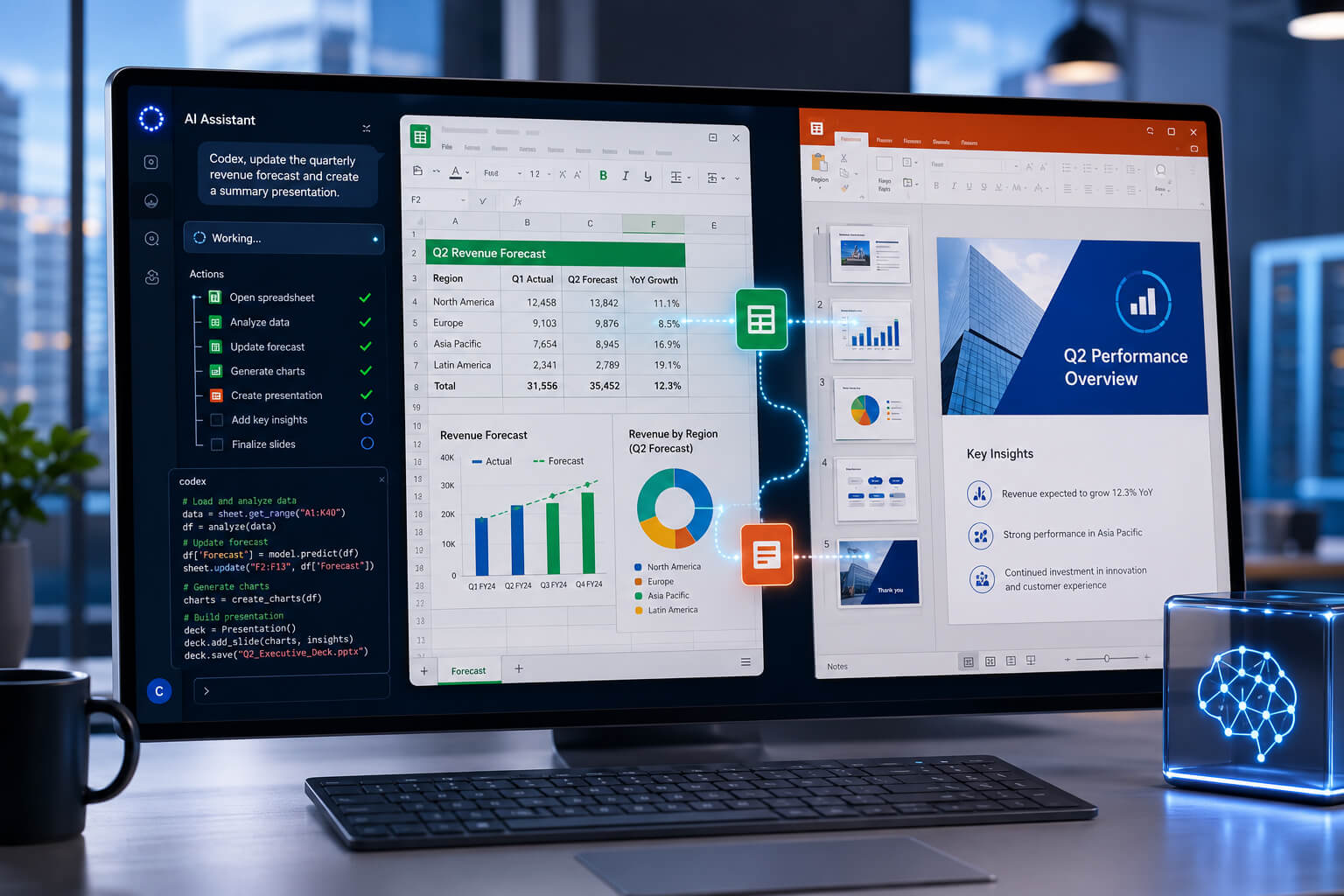
OpenAI is reportedly working on improved Excel and PowerPoint controls for Codex, signaling a major step in the evolution of AI agents for workplace productivity.
According to recent findings, OpenAI appears to be testing Microsoft Office-specific controls that could allow Codex to interact more directly with Excel spreadsheets and PowerPoint presentations. Instead of relying only on screen-based automation, the new controls may use Office add-ins to give Codex a more structured way to understand and edit documents.
The feature has not been officially announced by OpenAI. However, if released, it could make Codex more useful for professionals who regularly work with spreadsheets, reports, financial models, business dashboards, and presentation decks.
OpenAI Codex May Move Beyond Basic Screen Automation
Most AI agents that operate desktop apps currently depend on computer-use systems. These systems read what appears on the screen, move the cursor, click buttons, and type commands like a human user.
While this approach is flexible, it can also be unreliable. A changed menu, a pop-up window, a misplaced click, or a complex spreadsheet layout can interrupt the workflow. For applications like Excel and PowerPoint, where structure matters, simple screen control may not be enough.
The reported Excel and PowerPoint controls suggest OpenAI is exploring a deeper form of automation. With Office add-ins, Codex could potentially access document elements more directly. In Excel, this may help the AI understand cells, tables, formulas, ranges, and workbook structure. In PowerPoint, it could help Codex manage slides, layouts, text boxes, images, and formatting with greater accuracy.
Why Excel and PowerPoint Controls Matter
Excel and PowerPoint remain essential tools across business, finance, consulting, sales, marketing, education, and enterprise operations. Many organizations rely on spreadsheets for analysis and presentations for communication.
If Codex gains stronger control over these apps, users may be able to ask it to complete tasks such as:
Updating spreadsheet data
Editing formulas
Cleaning tables
Reorganizing workbook content
Creating presentation slides
Reformatting layouts
Updating charts and visuals
Preparing business reports
This could reduce repetitive manual work and make AI-assisted productivity more practical for everyday office tasks.
A Step Toward More Reliable AI Agents
The move also reflects a wider shift in AI development. AI companies are no longer focused only on chatbots that answer questions. They are now building agents that can complete multi-step tasks across apps and workflows.
For OpenAI, Codex has already grown beyond its original role as a coding assistant. By adding stronger support for workplace software, Codex could become a more general-purpose productivity agent.
This is important because reliability remains one of the biggest challenges in AI automation. Screen-based control can work across many apps, but it is often fragile. App-specific integrations, on the other hand, may allow AI agents to operate with better context and fewer mistakes.
OpenAI Competes in the AI Productivity Race
The reported Codex controls also place OpenAI deeper into the competition for AI-powered productivity tools. Microsoft has already built Copilot across Word, Excel, PowerPoint, Outlook, and other Microsoft 365 apps.
If OpenAI brings similar document-level control to Codex, it could expand how users interact with office software. Instead of switching between an AI assistant and a document, users may be able to let Codex work directly inside the file.
This could be especially useful for analysts, finance teams, consultants, executives, and knowledge workers who spend large parts of their day managing spreadsheets and presentations.
No Official Launch Timeline Yet
At the moment, OpenAI has not confirmed when or whether these Excel and PowerPoint controls will become publicly available. The features appear to be in testing and may still change before launch.
Still, the direction is clear. OpenAI is exploring ways to make Codex more capable inside everyday productivity tools. If the company releases these controls, Codex could become a stronger workplace assistant for handling documents, data, and presentations.
What This Means for the Future of AI Workflows
The reported OpenAI Codex Excel and PowerPoint controls show how AI agents may evolve in the coming years. Instead of simply watching screens and clicking buttons, future agents may work through structured app integrations that understand the content inside documents.
For businesses, this could make AI automation more dependable. For users, it could mean less time spent on repetitive editing and more time focused on analysis, strategy, and decision-making.
OpenAI has not yet made an official announcement, but the testing points to a broader future where AI agents become active collaborators across the tools people already use every day.
