


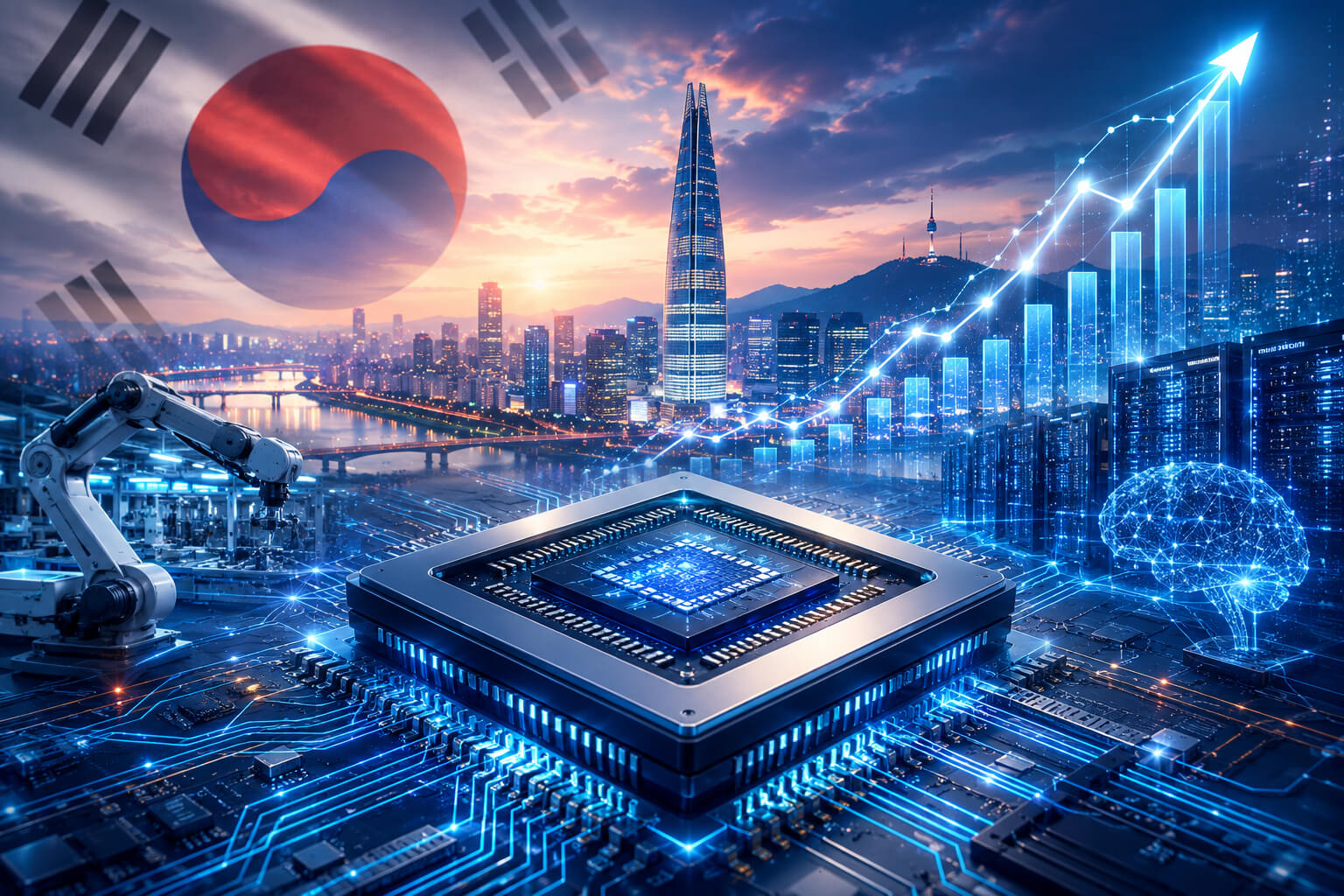
South Korea is making one of the biggest artificial intelligence infrastructure bets in the world, with Samsung Electronics and SK Hynix leading a massive semiconductor investment plan worth around $519 billion.
The investment is designed to strengthen the country’s position in the global AI race by expanding domestic chip production, building advanced semiconductor hubs, and supporting the growth of AI data centers. As demand for AI models, cloud computing, high-bandwidth memory, and advanced processors continues to rise, South Korea is moving to secure the physical infrastructure needed to power the next phase of digital growth.
The plan places semiconductors at the center of the country’s AI economy. Instead of treating AI only as a software revolution, South Korea is focusing on the full technology stack: chips, data centers, energy capacity, industrial regions, and domestic technology champions.
South Korea Pushes Deeper Into AI Semiconductors
Samsung Electronics and SK Hynix are expected to play a central role in the new semiconductor push. Both companies are already major players in the global memory chip market, and their technologies are critical to AI systems that require faster data processing and higher memory performance.
The proposed investment will support a new semiconductor hub in South Korea’s southwestern region. This is part of a wider government-backed effort to expand chip manufacturing beyond existing industrial centers and create a more balanced national technology ecosystem.
For South Korea, the timing is important. AI demand has created a global race for advanced chips, especially memory products used in data centers and AI accelerators. High-bandwidth memory, or HBM, has become especially important because it helps AI systems process large amounts of data more efficiently.
By expanding semiconductor capacity, South Korea aims to protect its leadership in memory chips while also capturing more value from the AI boom.
Why AI Data Centers Matter
The semiconductor investment is closely connected to South Korea’s AI data center strategy. AI models require enormous computing power, and that demand is increasing as companies deploy generative AI, automation tools, robotics, and enterprise AI systems.
South Korea’s broader AI infrastructure plan includes major investment in data centers, with local conglomerates such as SK Group, GS Group, and Naver expected to support the expansion. The country is targeting large-scale capacity growth, with plans that could eventually reach more than 18 gigawatts of AI data center power by 2035.
This matters because data centers are becoming the new industrial backbone of the AI economy. Countries that can combine chip production, energy infrastructure, and cloud-scale computing capacity will have a stronger position in global AI development.
South Korea’s strategy reflects this reality. Chips power data centers. Data centers run AI systems. AI systems create more demand for advanced chips. This cycle is pushing governments and companies to invest heavily in infrastructure before capacity becomes a national constraint.
Samsung and SK Hynix Strengthen Korea’s AI Position
Samsung and SK Hynix are not only important to South Korea’s economy. They are also deeply connected to the global AI supply chain.
SK Hynix has gained strong momentum because of its role in high-bandwidth memory, a key technology used in AI computing. Samsung, meanwhile, remains one of the world’s largest semiconductor manufacturers and continues to invest heavily in advanced chip development.
Together, both companies give South Korea a powerful advantage. While many countries are trying to build AI ecosystems from the ground up, South Korea already has globally competitive semiconductor companies, manufacturing expertise, and strong industrial supply chains.
The new investment plan builds on those strengths. It is not just about increasing chip output. It is also about turning South Korea into a larger AI infrastructure hub that can support manufacturing, data processing, cloud workloads, and next-generation industrial applications.
A Regional Development Strategy
South Korea’s AI chip investment also has an economic development goal. By placing new semiconductor and AI infrastructure projects outside traditional technology hubs, the government aims to support regional growth and reduce concentration around Seoul and existing industrial centers.
New fabs, packaging facilities, and data centers could create jobs, attract suppliers, and support local economies. This regional strategy shows how AI infrastructure is becoming part of national economic planning, not just technology policy.
The country is effectively using AI and semiconductors as tools for both global competition and domestic development. If successful, the investment could create new industrial clusters that support long-term growth across multiple regions.
South Korea’s AI Economy Depends on Infrastructure
The global AI race is increasingly being shaped by infrastructure. Software innovation remains important, but the countries with the strongest chip supply, energy capacity, and data center networks may gain the biggest long-term advantage.
South Korea understands this shift. Its $519 billion semiconductor plan shows that AI leadership is no longer only about building better models. It is also about having the hardware, power, and industrial capacity to run them at scale.
As AI adoption grows across finance, healthcare, manufacturing, mobility, defense, and consumer technology, demand for advanced chips will continue to rise. South Korea’s strategy puts Samsung, SK Hynix, and other domestic players at the center of that growth.
What This Means for the Global AI Race
South Korea’s semiconductor and AI data center plans could strengthen its role as one of the most important technology economies in the world. The country is already a leading chip producer, but this investment signals a deeper ambition: to become a core infrastructure provider for the AI age.
The move also adds pressure on other major economies. The United States, China, Japan, Taiwan, and the European Union are all trying to secure semiconductor supply chains and AI computing capacity. South Korea’s latest push shows that the competition is becoming more capital-intensive and infrastructure-driven.
For businesses, the message is clear. AI growth will depend not only on models and applications, but also on the countries and companies that can supply the chips and computing power behind them.
South Korea’s $519 billion chip bet is more than a technology investment. It is a national strategy to power the AI economy, strengthen industrial competitiveness, and secure a larger role in the future of global computing.
