


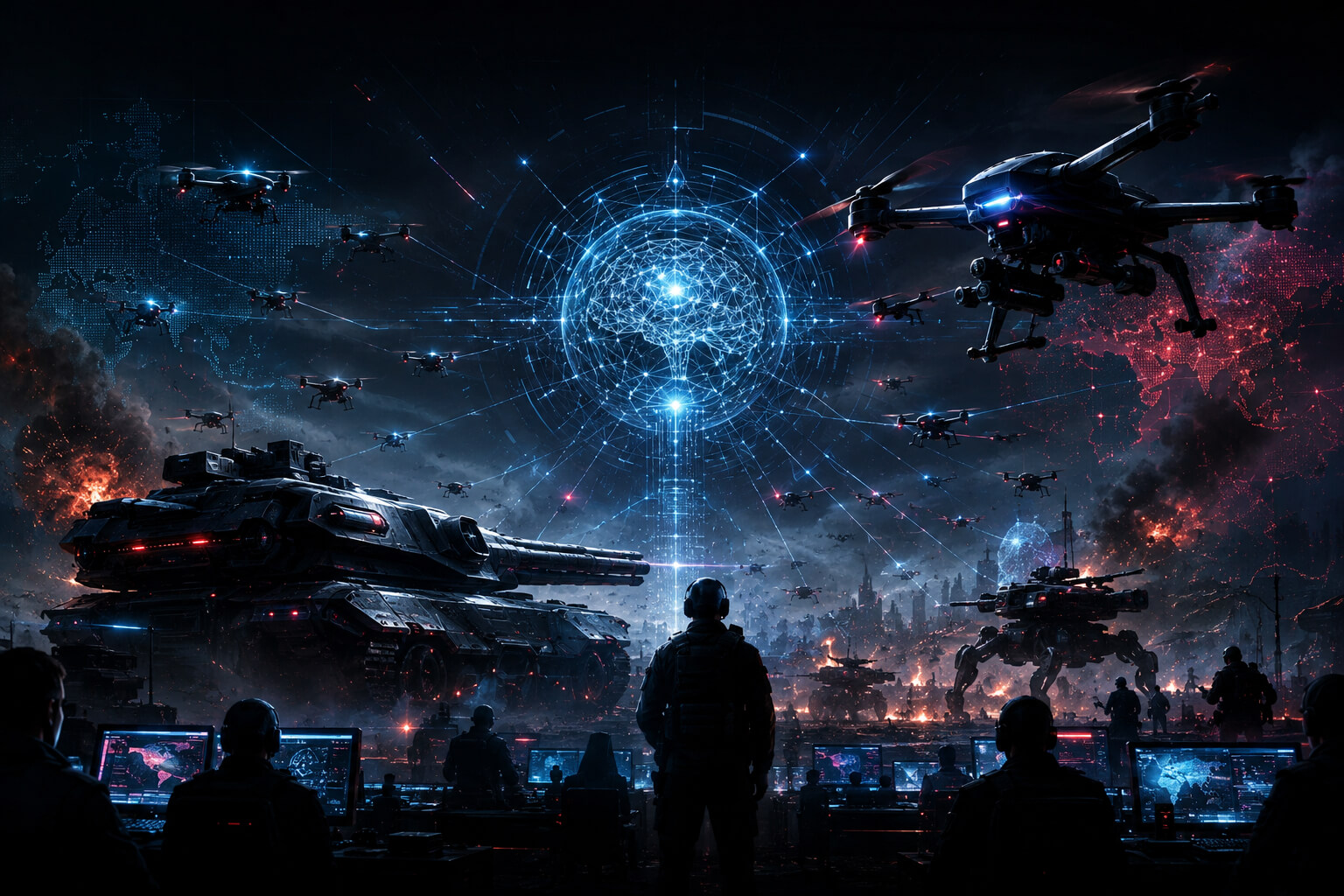
Artificial intelligence is no longer a future consideration for military strategy. It’s already being used to accelerate surveillance, intelligence analysis, targeting workflows, and battlefield decision-making.
A new report from The Verge highlights how the growing conflict between Anthropic and the U.S. Department of Defense has brought one of the most urgent AI policy questions into public view. That question is: where should the line be drawn when AI systems are used in war?
At the center of the debate are two major concerns: domestic mass surveillance and weapons that can identify, track, and kill targets without meaningful human involvement. Anthropic has reportedly tried to preserve limits around these use cases. Meanwhile, the Pentagon pushes for broader access to advanced AI tools under “any lawful use” terms.
AI Is Already Embedded in Military Operations
The idea of AI-powered warfare may sound futuristic, but the technology has been part of military development for decades. The U.S. military has long funded AI research. Today’s systems now help process huge amounts of data from drones, satellites, sensors and surveillance networks.
One pivotal moment was Project Maven, a Department of Defense initiative to use A.I. to process drone footage. The project became controversial in 2018 when thousands of Google employees protested the company’s involvement. They argued that AI tools built for military intelligence could eventually support lethal operations.
Although Google stepped away from the contract, other companies moved in. Over time, Project Maven evolved into a broader system capable of object detection, tracking, and large-scale intelligence analysis.
Anthropic’s Red Lines Are Being Tested
Anthropic, the company behind Claude, has become a key player in this debate. The company has allowed some military and national security use of its AI systems. However, it has also tried to maintain limits on certain applications.
According to the report, Anthropic has resisted use cases involving mass surveillance of Americans and fully autonomous lethal weapons. Those limits are notable because many of the other big AI companies have become more receptive to defense contracts.
The Department of Defense has signed agreements with several big tech companies to bring AI into classified environments. These include Google, Microsoft, Amazon Web Services, Nvidia, OpenAI, Oracle, SpaceX and others.
It indicates the rapidly growing military AI market. It also shows just how hard it may be for one company to maintain strict ethical parameters when competitors are willing to adopt broader ones.
The Human-in-the-Loop Problem
One of the biggest questions in AI warfare is whether humans are truly making life-or-death decisions or simply approving AI-generated recommendations.
U.S. policy has long required “appropriate levels” of human judgment over the use of force. But critics argue that AI systems can compress decision-making timelines so dramatically that human oversight becomes more symbolic than meaningful.
If an AI system can locate targets, assess surveillance data and recommend an action in seconds, the human role may be one of quick confirmation rather than considered judgment. That raises serious concerns about accountability, civilian harm, and compliance with international humanitarian law.
Autonomous Weapons Remain Poorly Defined
The debate is also complicated by the lack of a clear global definition of “lethal autonomous weapons.”
Some systems, such as automated missile defenses, have operated for decades with limited human involvement because they must respond faster than a person can react. Supporters often argue that these defensive systems are different from offensive autonomous weapons.
But critics say the line between defensive and offensive technology is not always clear. A system designed to protect one asset may still be capable of engaging targets automatically. Moreover, the same underlying technology can be adapted for different military purposes.
International forums have discussed autonomous weapons for years, but major powers have not agreed on a binding global framework.
Silicon Valley’s Military AI Shift
The relationship between Silicon Valley and the military has changed dramatically since the original Project Maven backlash.
In the late 2010s, many tech workers were vehemently opposed to building AI for the military. Today, more AI companies are bidding for defense contracts. At least a few have revised their policies to allow national security applications.
The shift mirrors a broader reality: sophisticated AI models are increasingly becoming strategic assets. Governments are keen to get their hands on the most powerful systems. Additionally, AI companies are pressured by investors, clients and national security agencies to get involved.
The result is a new era where commercial AI labs are being tightly integrated with defense infrastructure.
Speed vs. Safety The Speed vs. Safety Debate
Military leaders often argue that speed is essential. In a conflict, faster intelligence and faster decision-making can provide a significant advantage.
But speed can also increase risk. When AI systems compress complex decisions from days or hours to seconds, there may be less time to verify information, assess civilian risk, or question whether the system is wrong.
This is especially dangerous in war where mistakes can have irreversible consequences.
Now the debate is not if AI will come to the battlefield. It already has. The question is how much control humans will have as these systems become more powerful.
Why it matters
AI warfare matters because it could change the nature of conflict, who is held responsible and how quickly decisions about life and death are taken.
The debate over Anthropic, the Pentagon and autonomous weapons shows that AI companies are no longer just creating consumer-facing chatbots or business solutions. Instead, they are now entering the realm of national security systems and the tangible effects of those systems.
Without clearer rules, stronger oversight and international agreement, the world could be on a path toward a future in which AI plays a larger role in surveillance, targeting and the use of military force. This could happen before society has fully decided what limits should exist.
For more Breaking AI news visit: https://breakingai.news
