


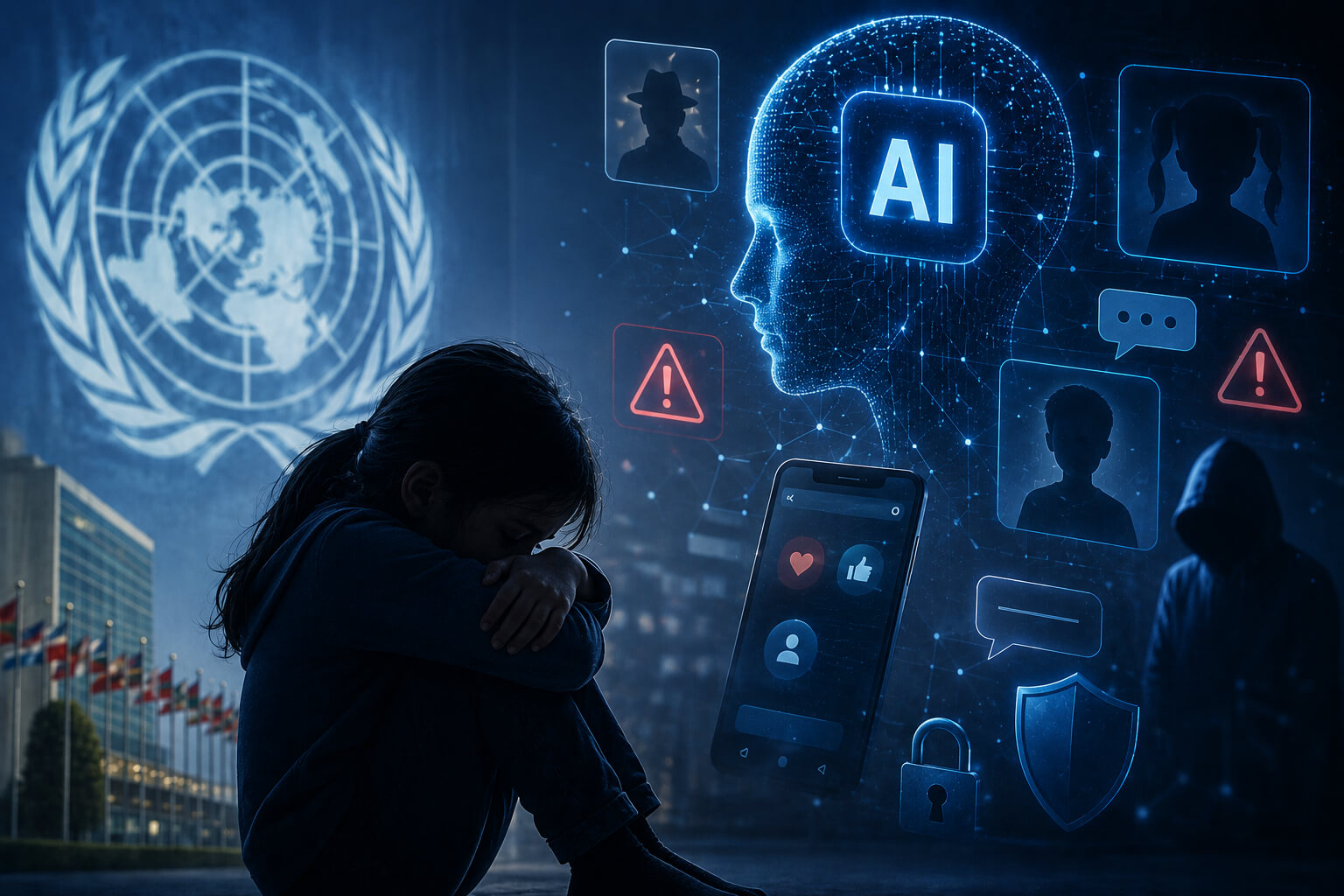
Artificial intelligence is moving fast. Too fast, according to United Nations Secretary-General António Guterres. There are growing concerns about AI impact on children, as this rapidly developing technology shapes young people’s lives in ways we are only beginning to understand.
His warning is not really about some far-off sci-fi version of AI. It is about children using the internet right now. Social media. Messaging apps. AI chatbots. Image generators. Recommendation systems. The digital spaces where young people already spend a huge part of their lives.
Guterres has warned that AI is advancing faster than regulation, faster than public understanding, and in some cases faster than the people building it can fully control. The concern is clear: if governments, tech companies, schools, and parents do not move quickly, children may end up carrying some of the heaviest risks of the AI era.
AI Is Already Inside Children’s Digital Lives
Children are not waiting for some official AI rollout. They are already using it.
AI tools now sit inside search engines, learning apps, games, video platforms, social feeds, and chat services. Some children use generative AI for homework. Others encounter AI without even knowing it, through algorithms that decide what videos they see, what ads follow them, or what content gets pushed into their feed.
That is part of the problem. AI does not always arrive with a label.
For adults, this can already be confusing. Children face sharper risks. They may not know when an image is fake. Chatbot answers can seem too trustworthy. In some cases, they may not recognize manipulation, grooming, or synthetic content designed to look real.
The UN has repeatedly warned that many AI systems were not designed with children in mind, even though children are among the people most exposed to them.
The Deepfake Problem Is Getting Darker
One of the biggest concerns is AI-generated abuse material.
Deepfake tools can create fake images, voices, and videos with frightening speed. What once required advanced technical skill can now be done with easy-to-use tools. That changes the threat level for children.
The UN has warned about the rise of harmful AI-generated content, including deepfakes, grooming, cyberbullying, and sexual extortion. These are not abstract harms. They can damage a child’s safety, privacy, mental health, and reputation in ways that are difficult to undo once content spreads online.
The worst part is scale.
AI can help bad actors create fake content faster, automate targeting, impersonate trusted people, and exploit children across platforms. It can also make reporting and removal harder because new content can appear again and again, slightly changed each time.
That is why the UN’s warning feels urgent. The technology is not slowing down politely while lawmakers debate definitions.
Guterres Says Global Rules Are Falling Behind
Guterres has called for stronger international cooperation on AI governance. His broader message is that AI is developing at a speed that no single country can manage alone.
That matters for child safety because online harm does not respect borders. A child in one country can be targeted by someone in another. A platform may be based somewhere else. The AI tool may be trained, hosted, or distributed across multiple jurisdictions.
So the old approach of fragmented rules looks weak.
The UN is pushing for more coordinated action around AI safety, rights, accountability, and child protection. The challenge is obvious: governments want innovation, companies want speed, and children need protection before the damage becomes normal.
AI Can Help Children Too, But That Is Not the Whole Story
This is where the conversation gets tricky.
AI is not only a threat. It can help children learn, translate languages, access educational support, receive healthcare guidance, and use tools that were once unavailable to them. For children with disabilities or limited access to quality education, AI could be genuinely useful.
But “AI can help” should not become an excuse to ignore the risks.
A tool built for adults may not be safe for children. A chatbot that gives confident but wrong answers can mislead young users. A recommendation engine optimized for attention can push harmful content. An image generator without proper safeguards can become a weapon for harassment.
The UN’s position is not anti-AI. It is more direct than that: children’s rights need to be built into AI systems from the start, not added later after scandals pile up.
Tech Companies Are Now Part of Child Protection
For years, online safety discussions often focused on parents and schools. That is no longer enough.
AI companies, social platforms, app developers, and cloud providers are now deeply involved in the environments children use. That gives them responsibility.
Age-appropriate design, stronger detection of synthetic abuse material, faster takedown systems, privacy protections, safety testing, and clearer reporting tools are no longer optional extras. They are becoming basic expectations.
Governments also have a role, but regulation alone will not catch every harm in real time. Platforms need to design systems that assume children may be present, even when the product is not marketed directly to them.
Because they are present. That is the reality.
The Bigger Question: Who Is AI Being Built For?
The warning from Guterres lands at a moment when the AI industry is racing ahead. New models are arriving. Agents are becoming more capable. Video tools keep improving. Automation systems are spreading quickly. Every week, something gets faster, cheaper, or more convincing.
But child safety rarely gets the same level of hype.
That imbalance is the uncomfortable part. AI is being built for productivity, entertainment, advertising, education, and profit. But if children are part of the user base, directly or indirectly, then safety cannot stay in the footnotes.
The real question is not whether children will use AI. They already are.
The question is whether the world will build rules, tools, and protections quickly enough to make that exposure safer.
Right now, the UN is warning that the answer is not yet good enough.
