


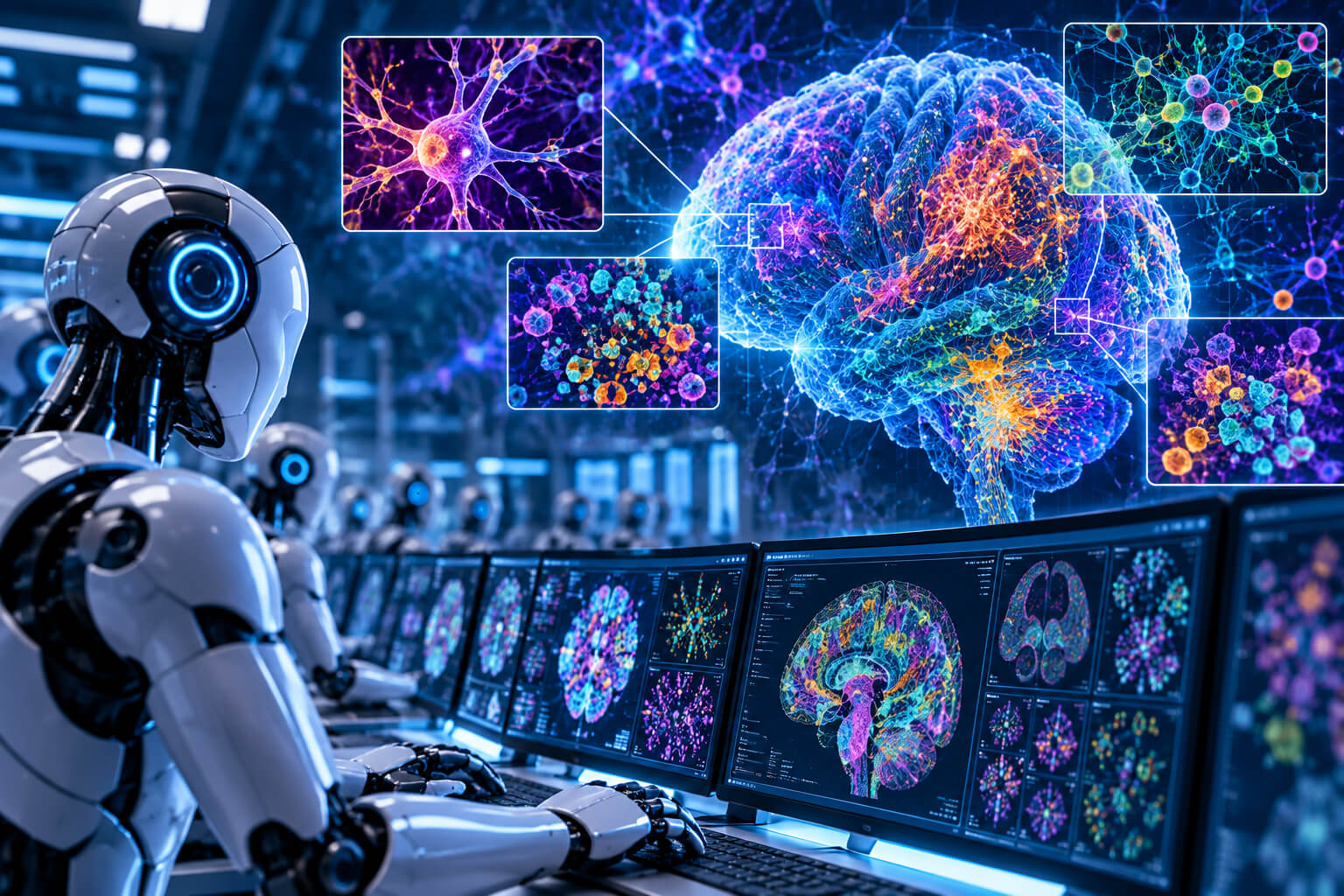
Artificial intelligence is beginning to tackle one of the biggest challenges in modern biology: making sense of enormous amounts of experimental data before potentially important discoveries get buried in the numbers. Recently, there has been significant interest in using OpenAI AI agents for biological research to accelerate discoveries in this field.
OpenAI, PerturbAI and Scripps Research have demonstrated how thousands of AI agents can analyze experimental data from millions of mouse brain cells in just 32 minutes, identifying unexpected genetic relationships and potential new directions for neurological disease research.
The project, announced in October 2026, used AI agents powered by GPT-Rosalind to examine how genetic disruptions affect different brain cells. By connecting experimental observations with existing scientific literature, the system generated hypotheses that researchers could investigate through further laboratory studies.
Among the findings were surprising differences between genes associated with neurological disorders and a possible connection between cholesterol regulation and neurodegeneration.
The results highlight how coordinated AI systems could help scientists investigate complex biological information faster, without replacing the experimental work needed to confirm their findings.
OpenAI Turns Thousands of AI Agents Into Biological Research Assistants
Modern biological research produces enormous datasets containing information about genes, proteins and cellular behavior. Scientists can now examine millions of individual cells and observe how genetic changes affect their functions, but interpreting every result remains difficult. A single experiment may produce thousands of observations that require comparisons with existing scientific literature before researchers can understand their significance. OpenAI and its collaborators addressed this challenge by deploying thousands of AI agents to investigate different parts of the same dataset simultaneously.
Instead of assigning the entire analysis to one AI system, the researchers divided the workload into smaller investigations. Individual agents examined genetic disruptions, studied changes in cellular activity and searched published research for possible explanations. Their findings were combined into a structured collection of biological interpretations that scientists could explore. This distributed approach allowed the system to investigate many more relationships than would typically be practical through manual analysis alone.
GPT-Rosalind Analyzes Millions of Mouse Brain Cells in 32 Minutes
The research relied on GPT-Rosalind, an AI model designed to support scientific reasoning across complex biological information. Researchers applied thousands of agents powered by the model to a whole-brain CRISPR dataset containing observations from millions of mouse brain cells. The dataset recorded how disrupting different genes affected cellular behavior across different regions of the brain, providing an opportunity to investigate genetic relationships that might otherwise receive limited attention.
The AI agents examined these disruptions, compared cellular responses and connected their observations with findings from scientific publications. The computational analysis was completed in approximately 32 minutes, a striking difference from the months of manual investigation that comparable work could require. That speed does not mean the system completed an entire scientific experiment in half an hour. The underlying biological data had already been collected, and the hypotheses generated by the agents still require experimental validation.
AI Reveals Unexpected Differences Between Two Neurological Disease Genes
One of the more interesting discoveries involved Tsc1 and Tsc2, two genes associated with the mTOR signaling pathway, which helps regulate cell growth, metabolism and other important biological functions. Because these genes operate within closely related biological processes, scientists might reasonably expect disrupting either one to produce similar effects. The AI analysis, however, identified differences in how certain brain cells responded to the two genetic disruptions.
The distinction was particularly noticeable in the cerebellum, a region involved in movement coordination and other neurological functions. Disrupting Tsc2 produced changes in dozens of genes associated with communication between neurons, while disrupting Tsc1 resulted in comparatively limited effects in the same context. These findings could help researchers investigate tuberous sclerosis, a genetic disorder associated with neurological and developmental complications. Although existing treatments can address some effects of abnormal mTOR activity, understanding why closely related genes produce different cellular responses may reveal additional research opportunities.
Thousands of AI Agents Produce More Detailed Scientific Analysis
OpenAI’s research also examined whether distributing biological investigations across multiple agents could produce better results than relying on a single AI agent. The researchers compared the approaches while controlling the underlying model and computational resources, allowing them to evaluate how the organization of the work affected the quality of scientific analysis.
At the largest workload, the single-agent approach cited only 11 scientific references, while the distributed agents collectively identified more than 700. Human experts also preferred the reports generated by distributed agents in 75% of blinded comparisons. These results suggest that assigning smaller, focused investigations to multiple AI agents can improve the breadth of scientific literature considered and produce interpretations that researchers find more useful. The findings also illustrate why multi-agent systems are attracting attention in scientific research, where complex questions often require knowledge from several different fields.
AI Identifies a Possible Link Between Cholesterol and Neurodegeneration
Another finding involved DCTN1, a gene associated with Perry syndrome, a rare neurodegenerative disorder that can cause symptoms resembling Parkinson’s disease. DCTN1 plays an important role in transporting materials within neurons, making disruptions potentially harmful to normal cellular function. While examining the experimental data, the AI agents identified changes in genes involved in cholesterol production following disruption of Dctn1.
The system connected these observations with previous research suggesting that problems with cholesterol transport can affect how cells regulate cholesterol production. This led to a possible explanation involving abnormal cholesterol distribution within neurons and its relationship to neurodegeneration. The agents also suggested investigating whether restoring normal cholesterol distribution could help protect affected cells. Human experts considered the hypothesis worthy of further investigation, although the proposed mechanism has not been experimentally confirmed. The finding illustrates how AI can connect observations from different areas of biology to generate research questions that scientists may not have initially considered.
AI Could Help Scientists Discover Patterns Hidden in Biological Data
Large biological datasets often contain more information than research teams can investigate in detail. Scientists typically focus on the strongest experimental signals or findings most closely related to their original research objectives, which means less obvious relationships may remain unexplored. OpenAI’s distributed agent approach offers a way to examine a broader range of observations while connecting them with existing scientific knowledge.
By investigating individual genetic disruptions and comparing results across different cell populations, the AI system can identify relationships that may be difficult to recognize through conventional analysis. A change in cellular metabolism, for example, might appear unrelated to neurological disease until it is considered alongside research on neuronal transport or signaling pathways. These connections do not automatically establish new biological facts, but they can provide scientists with specific hypotheses to test. For laboratories working with increasingly large experimental datasets, that capability could make existing research information more useful.
OpenAI’s Research Could Accelerate Early-Stage Drug Discovery
The potential applications of this technology extend beyond the mouse brain dataset examined in the project. Drug discovery frequently requires researchers to identify biological targets, understand disease mechanisms and evaluate which experimental findings deserve further attention. Each stage involves reviewing substantial amounts of information, often collected across different laboratories and scientific disciplines.
AI agents capable of connecting experimental results with published research could help scientists prioritize promising hypotheses before committing resources to additional laboratory studies. This may be particularly useful when investigating complex diseases involving interactions between multiple genes, cellular pathways and environmental factors. However, the technology remains a research-support tool rather than a substitute for biological experiments. Findings generated from mouse cells must be carefully validated, and even compelling genetic relationships may not translate directly into effective treatments for humans.
Human Scientists Remain Essential to Validating AI-Generated Discoveries
Although the research demonstrates impressive analytical speed, the scientific value of AI-generated hypotheses ultimately depends on whether they can be confirmed through further investigation. AI systems can identify patterns, connect published findings and propose explanations, but they can also produce incorrect interpretations or overlook important experimental limitations. Human researchers remain responsible for determining which hypotheses are biologically plausible and designing experiments to test them.
The collaboration between OpenAI, PerturbAI and Scripps Research reflects a model in which artificial intelligence expands the amount of scientific information that can be examined while researchers retain responsibility for validation. Instead of replacing scientific expertise, distributed AI agents could allow specialists to spend more time investigating promising discoveries and less time manually reviewing large collections of data. That balance may become increasingly important as biological research continues generating information at a scale that exceeds the capacity of traditional analysis methods.
OpenAI’s Multi-Agent Research Signals a New Direction for Scientific Discovery
OpenAI’s work with PerturbAI and Scripps Research demonstrates how coordinated AI systems could reshape the early stages of scientific investigation. By using thousands of agents to examine millions of brain cells, the researchers showed that complex biological datasets can be analyzed quickly while producing hypotheses that human experts consider valuable.
The project’s findings involving neurological disease genes and cholesterol regulation remain starting points for further investigation rather than confirmed medical breakthroughs. Still, the ability to uncover potentially meaningful relationships across large experimental datasets could help research teams make better use of information they have already collected.
For scientists studying complicated biological systems, the biggest advantage may not simply be faster analysis. It may be the opportunity to investigate questions that would otherwise remain buried in enormous datasets.
Artificial intelligence cannot eliminate the uncertainty involved in scientific discovery. But it could help researchers find the next question worth asking.
Sources
- OpenAI — Scaling AI Research for Complex Biological Data
https://openai.com/index/scaling-ai-research-for-complex-biological-data/ - OpenAI — AI for Science
https://openai.com/science/ - Scripps Research — Official Website
https://www.scripps.edu/ - PerturbAI — Official Website
https://perturb.ai/
