


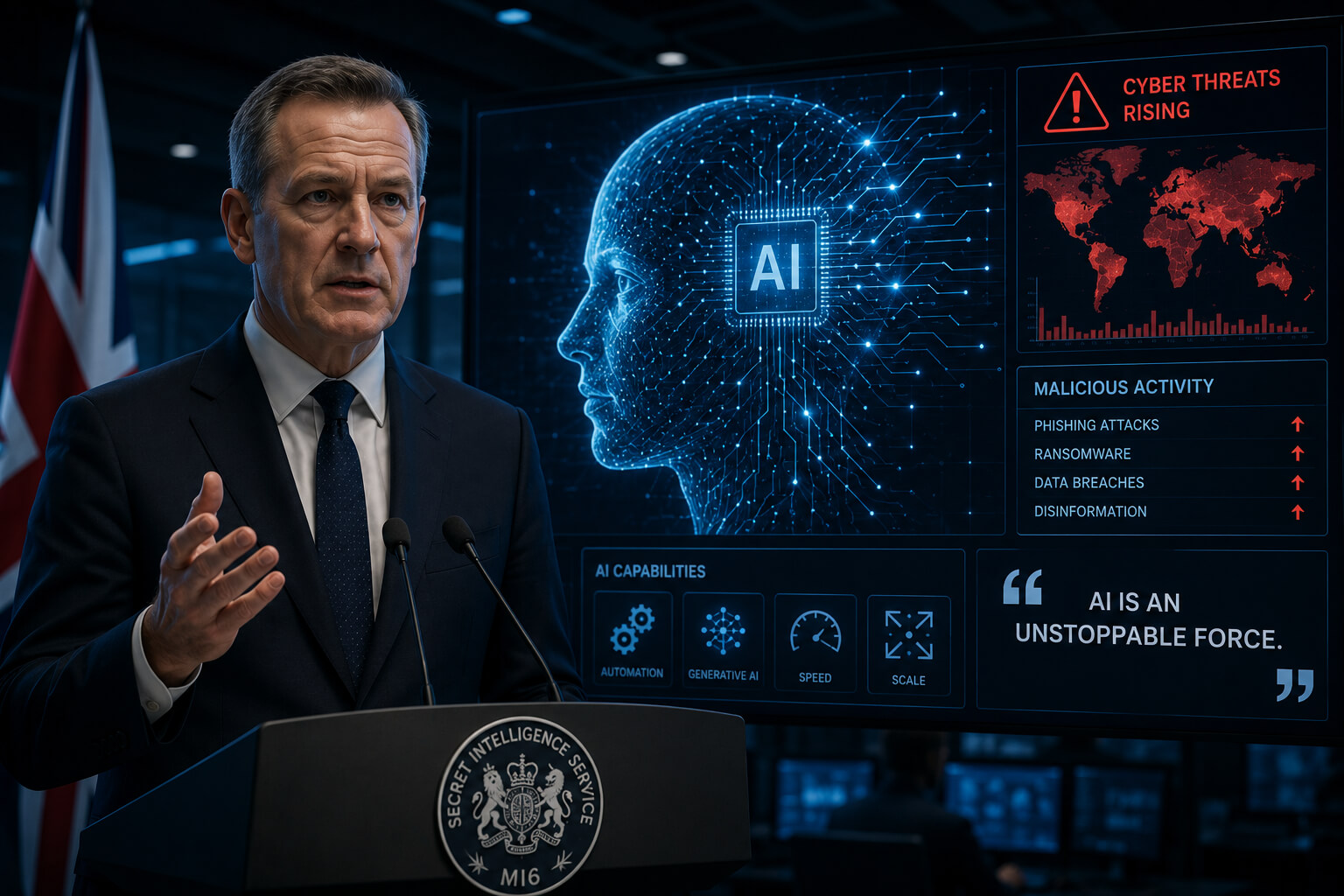
Artificial intelligence is rapidly becoming one of the most powerful forces in global cybersecurity, and the UK’s top cyber intelligence chief is warning that governments, businesses, and the public must act quickly to keep up.
Anne Keast-Butler, director of GCHQ, described AI as an “unstoppable force” with major opportunities but also serious risks. Speaking at Bletchley Park, the historic home of Britain’s World War Two codebreakers, she warned that AI is increasingly being used in ways that blur the line between peace and war.
The UK and its allies are now in a dangerous “grey zone”, where hostile states can use cyberattacks, sabotage, disinformation and tools powered by AI without triggering traditional military conflict, Keast-Butler said.
AI is changing the cybersecurity landscape
The warning comes as AI is being more deeply integrated into cyber operations. AI can help security teams spot threats more quickly, translate foreign-language intelligence, spot strange network activity, and analyze huge amounts of data.
But the same technology can be used by hostile actors too.
AI can be exploited by cybercriminals and state-backed groups to automate attacks, discover software vulnerabilities, generate more convincing phishing campaigns, and scale disinformation operations. As AI systems gain more autonomy, the speed and complexity of cyber threats could increase dramatically.
Keast-Butler said the challenge is not simply to slow AI down, but to secure it and use it responsibly. She urged the technology sector and national security community to work together “at the speed of the frontier.”
Russia Named as a Major Cyber Threat
In her speech, Keast-Butler singled out Russia as a key threat to the UK and Europe. She accused Moscow of targeting critical infrastructure, democratic institutions, supply chains, and public trust.
These activities are part of what security experts describe as hybrid warfare — a mix of cyberattacks, sabotage, propaganda, espionage, and political interference designed to weaken opponents without direct military confrontation.
Russia’s cyber activity has become a growing concern across Europe, especially as the war in Ukraine continues. Keast-Butler said Russian forces have suffered heavy losses on the battlefield, but Moscow is increasing its activity in cyberspace and other covert areas.
The UK Wants an AI-Powered “Cyber Shield”
One of the biggest takeaways from the warning is the UK’s push to strengthen national cyber defenses using AI.
GCHQ and the National Cyber Security Centre are exploring ways to build stronger protections for critical infrastructure, including energy networks, telecoms, transport systems, and major businesses.
An AI-powered cyber defense system could help detect attacks earlier and respond faster than traditional tools. However, officials also acknowledge that building a reliable national “cyber shield” will take time.
Businesses and the Public Are Being Urged to Act
Keast-Butler’s message was not only aimed at governments. She also called on businesses and individuals to take cybersecurity more seriously.
For businesses, that means investing in stronger defenses, securing supply chains, training employees and preparing for AI-enhanced attacks.
For the average user, that means stronger passwords or passkeys, two-factor authentication, software updates and more caution around suspicious links, emails and messages.
As AI tools get better, cyber threats will become harder to detect. Fake messages, cloned voices, AI-generated images, and automated scams could make digital trust more fragile.
AI Opportunity Comes With AI Risk
The UK spy chief made clear that AI is not only a threat. It is also a major opportunity for intelligence, national security, and economic growth.
AI can help analysts find important information more quickly, protect networks more effectively, and improve decision-making in high-pressure environments. But without strong safeguards, the same technology could be exploited by hostile states and criminal groups.
The message is crystal clear: AI is not a thing of the future. It is already transforming the cyber battlefield.
Why it matters
Artificial intelligence is increasingly at the heart of modern cyber warfare. The same tools that can help governments and businesses defend themselves can also be used to launch faster, smarter and more damaging attacks.
For the public, this means online safety is entering a new era. Cybersecurity is no longer just about avoiding obvious scams — it is about preparing for AI-powered threats that can imitate real people, exploit software quicker, and spread misinformation at scale.
The warning is even bigger for businesses and governments. Countries and companies that get to AI first will be better positioned to defend their infrastructure, data and economy. Those who fall behind could face a rising tide of cyber risks in the years ahead.
For more Breaking AI news, visit: https://breakingai.news
