


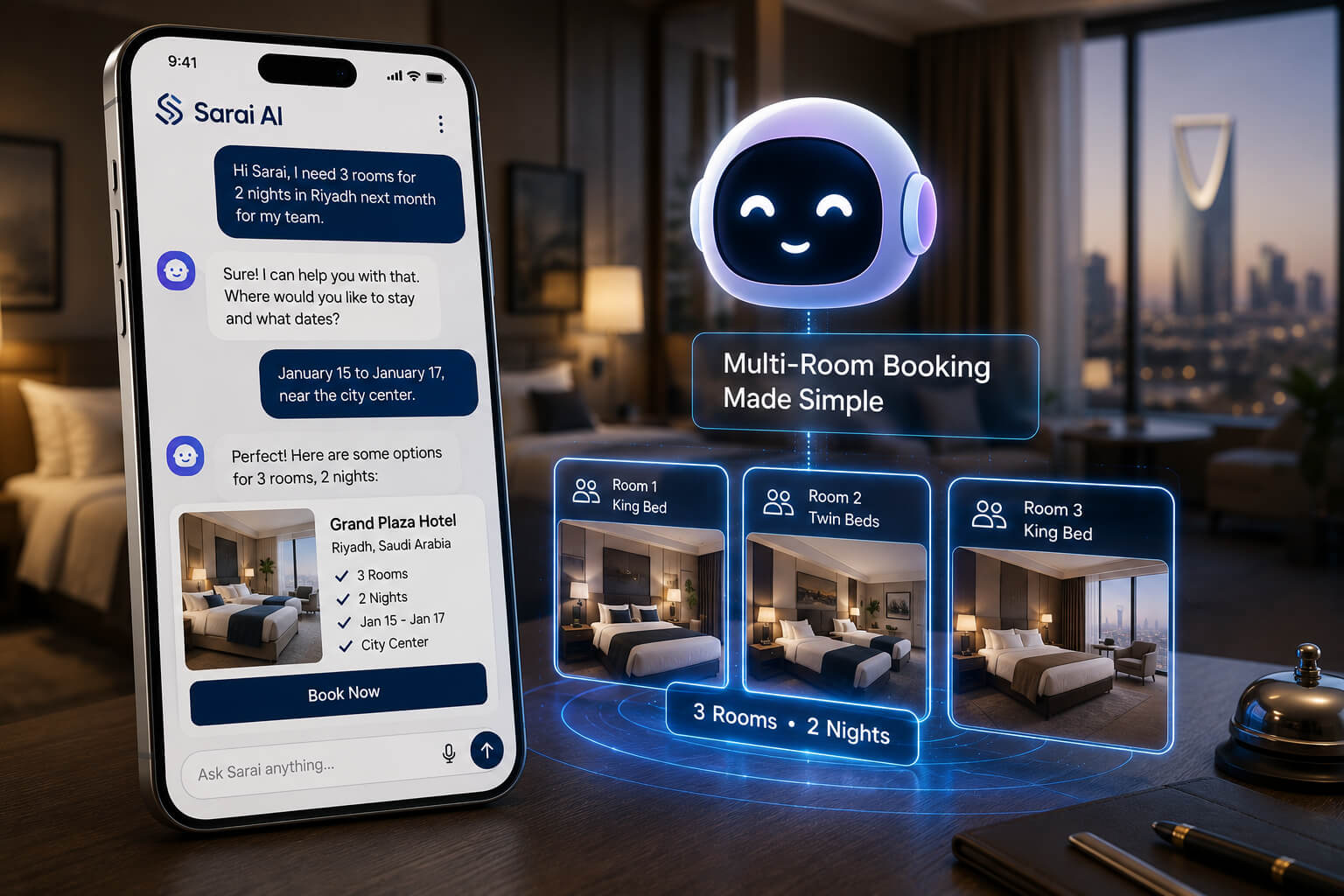
Hotel bookings are getting less like filling out a form and more like sending a message.
Mirai has announced that Sarai, its AI assistant and conversational booking engine for hotels, can now handle bookings for two or more rooms through a natural conversation. A guest can type something as simple as, “I need two rooms for a family with children,” and Sarai can move the booking forward without forcing them through separate forms or extra steps.
That might sound like a small feature. For hotels, it is not small at all.
Multi-room bookings usually mean more guests, more nights, more revenue, and more chances for the customer to abandon the process if the booking flow gets annoying. Sarai is trying to remove that friction.
Sarai Moves Beyond Simple Hotel Chatbot Tasks
Most hotel chatbots still feel limited. They answer common questions. They point guests to a booking page. Sometimes they ask users to click through menus that feel older than the hotel website itself.
Sarai is being positioned differently.
Mirai describes Sarai as an AI assistant connected directly to the hotel booking engine. It can answer questions, check availability, provide pricing, create quotes, manage reservations, and now support more complex booking requests inside the conversation.
The important part is not just that Sarai talks. Plenty of tools talk now.
The bigger shift is that Sarai can act inside the booking process. It is not only replying with information. It is helping turn intent into a reservation.
Multi-Room Bookings Matter More Than They Look
Multi-room reservations are valuable because they often represent families, groups, business trips, weddings, events, and longer stays. These are not always the easiest bookings to complete online.
According to Mirai data cited by Breaking Travel News, bookings for two or more rooms made up 9.07% of total reservations on the web booking engine up to July 2026. But those bookings generated 18.45% of room nights and 18.44% of revenue.
That is the interesting part.
The volume is not huge, but the value is almost double its share. So when a hotel loses a multi-room booking because the process is clunky, it is not losing an average booking. It may be losing one of the better ones.
Sarai Works Across More Than One Channel
The new multi-room booking feature is available across the channels where Sarai already operates. That includes webchat, WhatsApp, email, Instagram, phone, ChatGPT through Apps, and Claude through MCP.
This matters because guests do not all start in the same place anymore.
Some still go to the hotel website. Others send a WhatsApp message. Some ask questions through social media. A growing number may eventually ask an AI assistant to find and book a hotel for them.
Hotels used to design booking flows mainly for website visitors. Sarai points to a different future, where the booking engine has to follow the guest across channels instead of waiting on one page.
Sarai Can Turn Group Requests Into Qualified Leads
There is another practical detail here.
If a customer asks for more rooms than the hotel booking engine allows online, Sarai does not simply fail. It explains the limit, collects the customer’s information and stay details, then creates a qualified lead for the hotel.
That lead appears in Lobby, Mirai’s AI infrastructure dashboard, and the hotel also receives an email notification.
This is the kind of hotel tech feature that does not sound flashy, but it solves a real sales problem. A traditional booking engine might lose that guest completely. Sarai gives the hotel a way to respond while the customer is still interested.
And timing matters. Once a guest leaves, they may not come back.
Conversational Booking Is Becoming More Serious
The travel industry has talked about conversational booking for years. A lot of it sounded promising but never quite felt finished.
Now the technology is catching up.
Mirai says Sarai is built into its AI Infrastructure, which connects the booking engine, hotel knowledge base, conversational intelligence, and operational controls. The goal is to make hotel data available in a way that AI systems can understand and use.
That includes real-time availability, pricing, room details, promotions, business rules, and reservation functions.
In plain terms, Sarai is not supposed to guess. It is supposed to pull from the hotel’s actual booking system and structured data.
That is the difference between a chatbot that gives a nice answer and an AI agent that can complete a real transaction.
Hotels Are Preparing for AI Agents as Customers
This update also fits into a bigger change in travel technology.
Guests may not always browse hotel websites manually in the future. They may ask ChatGPT, Claude, Gemini, or another AI assistant to find a hotel, compare options, check availability, and complete the booking.
That creates a new problem for hotels.
Their websites need to be readable by humans, yes. But their inventory, policies, rates, and booking options also need to be understandable by machines. If an AI agent cannot interpret a hotel’s data clearly, that hotel may not appear properly in AI-driven travel planning.
Mirai’s push with Sarai suggests hotels are starting to prepare for that shift.
What This Means for Direct Hotel Sales
For hotels, the main benefit is direct booking control.
If Sarai helps guests complete bookings through the hotel’s own channels, hotels may reduce some dependence on third-party platforms. They can also keep more control over the guest relationship, booking data, pricing rules, and follow-up communication.
That does not mean online travel agencies disappear. Not even close.
But hotels have spent years trying to strengthen direct sales. AI assistants like Sarai could become another tool in that effort, especially if they handle messy booking requests that normal web forms do not manage well.
Multi-room bookings are a good example. They are valuable, but they can be awkward online. Sarai now gives hotels a more flexible way to capture that demand.
The Real Test Is Trust
The promise is clear. Guests talk. Sarai understands. The booking gets done.
But hotels still need accuracy. If an AI assistant gives the wrong rate, misses a child policy, misunderstands room combinations, or mishandles a request, the convenience disappears quickly.
That is why the connection to real booking data matters. Sarai’s value depends on how well it reflects the hotel’s actual inventory, rules, and policies.
AI in travel cannot just sound helpful. It has to be correct.
For now, Sarai’s multi-room booking update shows where hotel technology is heading. Less clicking. More conversation. More AI agents sitting between guest intent and hotel revenue.
The booking form is not dead yet.
But it is starting to feel old.
Sources
- Breaking Travel News – Sarai, Mirai’s AI assistant and conversational booking engine, now supports multi-room bookings
- Mirai – Sarai: The Conversational Intelligence of Your Hotel and Booking Engine
- Mirai – Mirai Launches Sarai, the New Generation of AI Agents for Hotels
- PhocusWire – Mirai Rebuilds Booking Engine for Conversational, Agent-Driven Travel
