


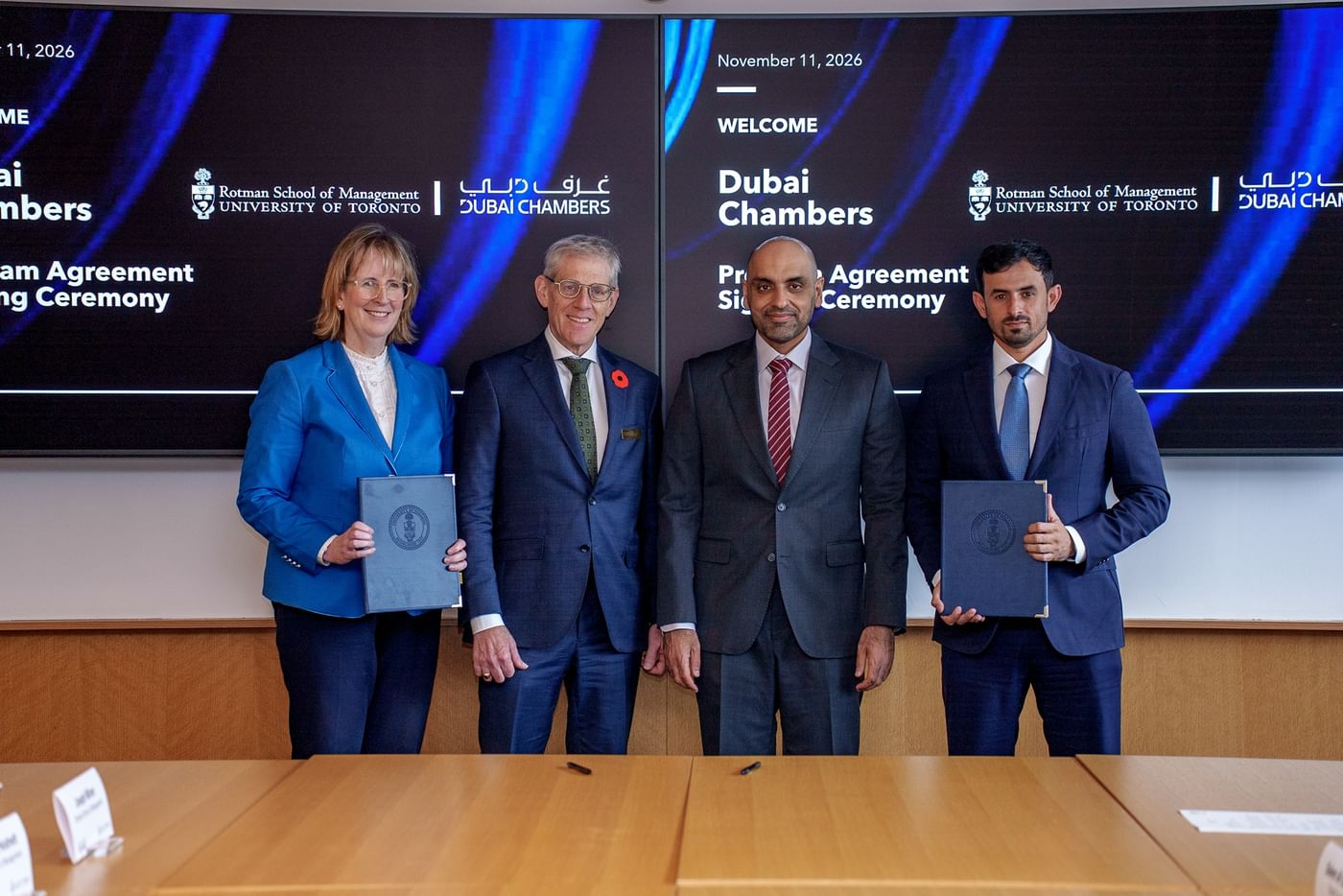
Dubai is taking another step toward making artificial intelligence part of everyday business operations. This time, the focus is on family-owned enterprises.
Dubai Chambers has signed an agreement with the University of Toronto to introduce an executive education programme designed to help family business leaders understand and adopt agentic AI. The initiative brings together the Dubai Centre for Family Businesses and the university’s Rotman School of Management, combining academic expertise with practical business applications.
The partnership reflects a growing interest in AI systems that can handle complex tasks, coordinate workflows and support decision-making with less manual intervention. For family businesses, the challenge is finding ways to use these capabilities without disrupting the leadership structures and values that have shaped their success.
Dubai Chambers Wants Family Businesses to Move Beyond Basic AI Tools
Family-owned companies have long played an important role in Dubai’s economy, but adopting emerging technologies can be complicated when business decisions involve multiple generations of leadership. The Dubai Chambers initiative aims to help these enterprises understand where agentic AI could improve efficiency, strengthen competitiveness and support long-term growth. Unlike traditional AI assistants that mainly respond to prompts, agentic AI systems can execute sequences of tasks and interact with business applications under defined rules. This opens opportunities in areas such as financial management, procurement, customer engagement and operational planning. The programme will encourage executives to examine these possibilities through the lens of their own businesses rather than adopting AI simply because competitors are doing so.
University of Toronto to Provide Practical Agentic AI Training
The executive education programme, titled Agentic AI for Family Business Leaders, will combine interactive learning sessions in Dubai with an experiential component in Toronto, Canada. Participants will explore AI strategy, organisational transformation, implementation challenges and the identification of high-value business applications. The Toronto component will include company visits intended to provide a closer look at how organisations are introducing AI into their operations. Instead of focusing entirely on theoretical concepts, the programme will guide participants toward developing practical AI implementation roadmaps. These plans are expected to address business priorities, organisational readiness, governance considerations and methods for evaluating results.
Agentic AI Could Transform Daily Operations in Family-Owned Enterprises
For many family businesses, the immediate value of agentic AI may come from improving existing processes rather than completely rebuilding their operations. A trading company could explore AI-powered procurement coordination, while a logistics business might investigate systems that monitor workflows and flag operational issues. Companies with extensive internal records could also examine how AI can organise information and make institutional knowledge easier to access. These examples illustrate potential applications rather than confirmed projects under the programme. The broader opportunity lies in reducing repetitive administrative work and giving management teams more time to focus on strategic decisions. Still, successful adoption will depend on reliable business data, appropriate oversight and a clear understanding of which processes should remain under human control.
Preserving Family Business Values While Adopting Autonomous AI
Introducing autonomous technology into a family-owned company is not simply an IT decision. These businesses often rely on personal relationships, established management practices and knowledge transferred between generations. AI systems that interact with sensitive financial information or influence operational decisions introduce new questions about accountability, privacy and governance. The Dubai Chambers programme will address these concerns by helping participants consider how AI can fit within existing organisational structures. Business leaders will examine the importance of protecting confidential information, maintaining human oversight and ensuring that technological changes support rather than weaken the company’s long-term identity. The aim is to modernise business operations while preserving the values that distinguish family enterprises.
Dubai Chambers Expands Its Broader Agentic AI Strategy
The agreement with the University of Toronto adds another dimension to Dubai Chambers’ wider efforts to encourage agentic AI adoption across the private sector. In October 2026, the organisation introduced Chamber AI Hub, a chamber-led marketplace offering specialised AI agents for different business functions. The platform was launched with 22 agents covering areas such as finance, procurement, compliance, human resources and logistics, with plans for further expansion. While the marketplace focuses on providing businesses with access to AI-powered capabilities, the university partnership addresses an equally important challenge: preparing executives to evaluate and manage those technologies. Together, the initiatives indicate that Dubai Chambers is pursuing both technology access and leadership development as part of its AI adoption strategy.
What the Partnership Means for Dubai’s AI-Driven Economy
The collaboration comes at a time when businesses are moving beyond basic AI experimentation and beginning to examine how autonomous systems might fit into everyday operations. Family enterprises present an interesting test because their management structures, succession planning and long-term relationships often differ from those of larger corporations. By introducing executive education specifically focused on agentic AI, Dubai Chambers is encouraging business leaders to approach adoption as a strategic decision rather than a short-term technology upgrade. The programme could help participating companies identify realistic applications, establish governance frameworks and prepare future leaders for increasingly automated business environments. Its eventual impact, however, will depend on whether executives translate the training into measurable improvements within their organisations.
Sources
- Emirates News Agency (WAM) — Dubai Chambers and University of Toronto Agreement — November 12, 2026. Emirates News Agency
- Dubai Chambers — Official News and Announcements — November 12, 2026. Dubai Chambers
- Zawya — Dubai Chambers and University of Toronto Agentic AI Partnership ZAWYA
- Emirates News Agency — Dubai Chambers Launches Agentic AI Marketplace
