


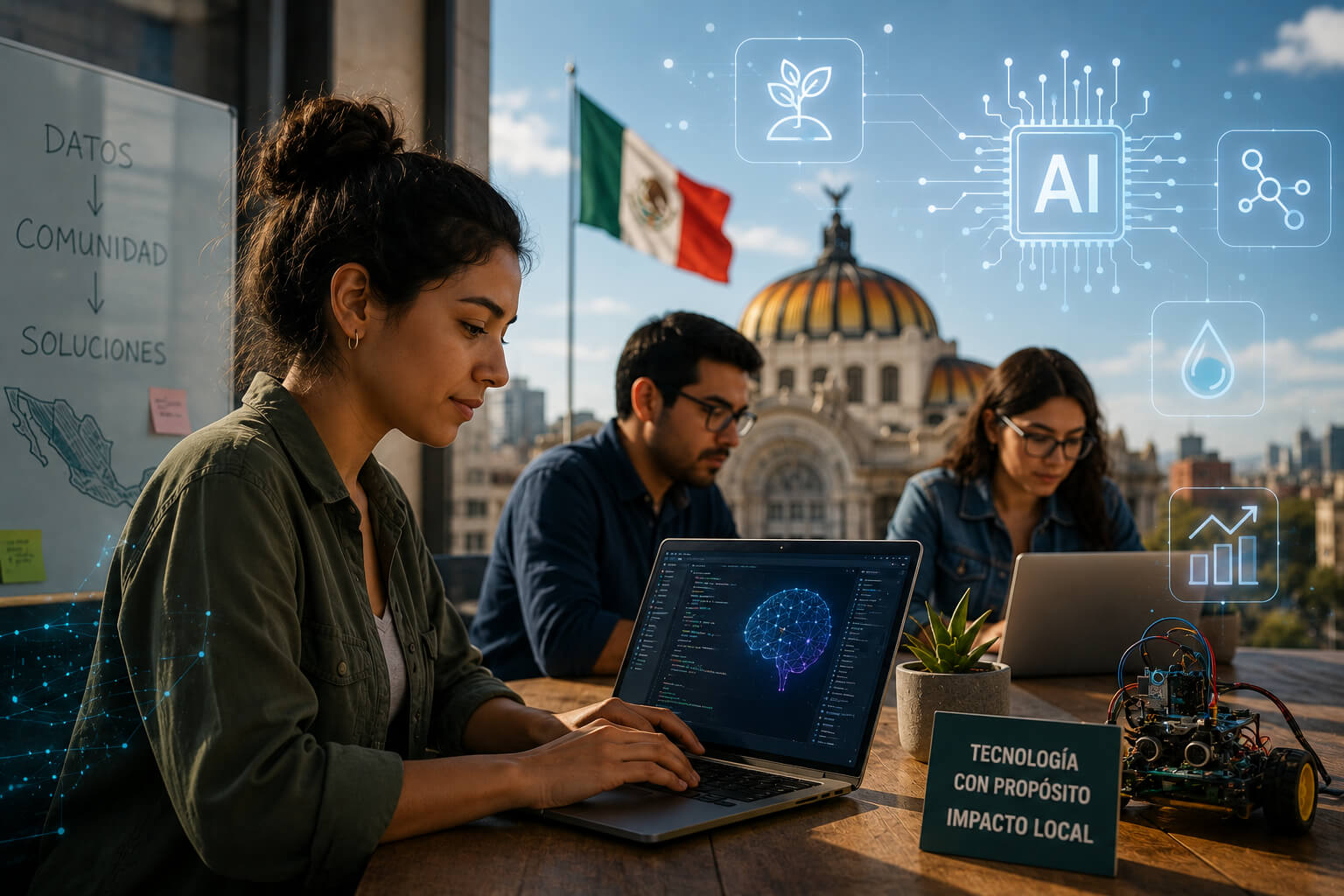
Artificial intelligence in Mexico is starting to look less like a distant promise and more like something built in workshops, classrooms, farms and neighborhood recycling projects. Increasingly, we are seeing Mexican entrepreneurs using AI to solve real-world challenges across the country.
A new group of Mexican entrepreneurs is using AI skills to address problems they already understand firsthand. Water shortages. Complicated hiring processes. Distracting technology. Poorly organized recycling systems. Students who need more individual support than a crowded classroom can provide.
These are not enormous, futuristic projects designed to impress investors with vague promises. Most remain early-stage ideas, pilot programs or small operations. That is precisely what makes them interesting.
They begin with a real problem.
Microsoft’s AI Training Reaches Millions Across Mexico
Many of the entrepreneurs featured in Microsoft’s latest report participated in the company’s Elevate skilling initiative.
Microsoft launched the program in Mexico in September 2024 as part of a wider effort to prepare workers, students, educators and public-sector employees for an economy increasingly shaped by artificial intelligence.
The initiative has already reached around 3.5 million people in Mexico. That represents roughly 70% of Microsoft’s target of training five million people in the country by the end of 2027.
Participants can access self-paced Microsoft Learn materials alongside live instruction adapted to local needs. Training covers AI fundamentals, generative AI, prompt design, responsible AI practices and the creation of AI agents.
The lessons matter, but the more revealing part comes afterward: what people decide to build with them.
AI Helps Ciudad Juárez Farmers Manage Water More Carefully
Water is not an abstract sustainability topic in Ciudad Juárez. It shapes what farmers can plant, how much they can grow and whether a season becomes profitable at all.
That reality pushed José Alejandro Del Río, Ares Arturo Molina and Héctor Hernández to develop AgriTech, an agricultural platform combining sensors, machine learning and a progressive web application.
Their system collects information about humidity, soil pH, electrical conductivity and nutrient levels. Machine learning models then analyze that data and produce recommendations related to crop health and irrigation.
The project is not simply a collection of smart sensors. Its value sits in the interpretation layer—turning measurements into information a farmer can actually use.
The three founders created their startup, Chuuk, after meeting through a 2025 hackathon. Del Río brought experience in chemical biology, Molina contributed systems engineering knowledge and Hernández entered the project as a self-taught software developer.
AI training helped the team improve its machine learning models and make the platform efficient enough to operate on limited hardware. That detail may sound small. It is not. Agricultural tools cannot depend on perfect laboratory conditions or expensive computing infrastructure.
Chuuk is now testing the platform through pilot deployments, including demonstration plots developed with the rural development department of Ciudad Juárez. The company is also exploring laboratory management software and biomedical image analysis.
The agricultural platform still needs validation, funding and larger partnerships. Even so, it shows how locally trained AI talent can work on a problem that global software companies might easily overlook.
One Entrepreneur Is Building AI Recruitment Agents
Ary Álvarez has taken a different route.
The Chihuahua entrepreneur is developing Remotto, an AI-powered recruitment platform that uses several specialized agents to search for candidates, verify identities and connect applicants with suitable jobs.
Rather than making recruiters manually browse profiles across multiple platforms, Remotto analyzes information from thousands of sources. A recruiter provides the type of candidate they need, and the system attempts to find a matching profile.
The idea reflects a broader change happening inside recruitment technology. AI tools are moving beyond résumé screening and becoming active participants in the hiring workflow.
Álvarez is also developing Tasky, a small cloud-connected productivity device that brings together calendars, notes and notifications without recreating the constant distractions of a smartphone.
That may sound slightly contradictory—a new device meant to reduce dependence on devices—but the concept addresses a recognizable problem. People need access to their schedules and reminders. They do not necessarily need social media, entertainment apps and endless notifications every time they check a meeting time.
Neither project appeared overnight.
Álvarez grew up around electronics because his father repaired appliances and modified gaming consoles. His interests moved from hardware into cybersecurity, machine learning and cloud computing. Technical AI training later helped him connect those separate skills.
He had already experienced one startup failure. An earlier project used wearable sensors and machine learning to track dog behavior, but the business struggled to secure enough funding to scale.
Instead of treating that setback as proof that the idea of entrepreneurship had failed, Álvarez redirected what he had learned into Remotto and Tasky. Sometimes the most useful outcome of a failed AI startup is not the product. It is the founder who knows what to build next.
Generative AI Supports a Community Recycling Project
Eduardo Ortiz did not begin his career in technology. He studied law and worked in civil and family litigation before the pandemic disrupted court operations and forced him to reconsider his direction.
Living near a landfill in the Mexico City metropolitan area had already made the scale of urban waste difficult to ignore.
After moving to Querétaro, Ortiz launched Escuadrón Mapache in 2022. The community recycling initiative collects reusable materials from homes and small businesses while attempting to give greater recognition to informal waste collectors, commonly known in Mexico as pepenadores.
Ortiz currently transports collected materials using a cargo tricycle. On productive days, the operation can move close to 450 pounds of recyclable waste. More than 30 families and several local businesses now participate.
His next step is an application that would allow households and businesses to arrange pickups, sort materials and connect with workers who collect and process recyclable items.
Generative AI is supporting the early development process. Ortiz uses tools such as Microsoft Copilot for brainstorming, research, presentations, social media planning, data analysis, monetization ideas and initial app development.
AI is not collecting the cardboard or moving the cargo tricycle. It is helping a small environmental operation think more systematically about growth.
That distinction matters. Many useful AI applications will not replace the physical work behind a service. They will make the surrounding planning, organization and communication less difficult.
A Mexican Teacher Builds AI Tutors for 56 Students
When students began submitting assignments created with AI, educator Alma Trejo could have responded by banning the technology.
She went in the other direction.
Trejo began studying generative AI, prompt design, Microsoft Copilot and responsible AI practices. She now uses those skills to create personalized learning experiences for high school students at Conalep, Mexico’s technical education system.
Using Microsoft 365 Copilot and other AI tools, Trejo developed academic agents tailored to the needs of her 56 students. The agents can explain concepts, suggest exercises, review assignments and provide individual feedback.
She has also built dedicated tools for programming, computational thinking, digital culture and cybersecurity.
The system does not remove the teacher from the classroom. It gives students another place to ask questions, revisit difficult material and practice without feeling embarrassed in front of classmates.
Trejo reportedly noticed a change in how students approached their work. Some who had previously submitted assignments they could not properly explain began arriving prepared to discuss their reasoning. Quieter students also became more willing to participate after using AI tools to review lessons and strengthen their understanding.
There are still legitimate concerns about accuracy, dependency and responsible use. Trejo’s approach does not pretend those issues disappear. Instead, it treats AI literacy as part of education itself.
Students will encounter these tools whether schools welcome them or not. Teaching them how to question, verify and use AI responsibly may prove more effective than acting as though the technology can be kept outside the classroom.
Mexico’s AI Opportunity May Be Deeply Local
The projects emerging from Microsoft’s training initiative do not fit into one neat industry.
One team is studying crop conditions. Another founder is building recruiting agents and a minimalist productivity device. A former lawyer is organizing recyclable waste. A mathematics teacher is creating academic assistants for students.
Their common thread is not the type of technology being used. It is proximity to the problem.
The founders understand the environments where their products will operate because they live and work there. They know why limited hardware matters on a farm, why informal waste collectors deserve a place in a recycling platform and why students in a small computer laboratory need learning tools that remain accessible outside class hours.
That knowledge cannot be downloaded through an AI course.
Training can provide technical skills. Local experience tells people where those skills might actually be useful.
AI Skills Are Becoming Entrepreneurial Infrastructure
AI education is often discussed as a way to help employees remain competitive. That is only part of the picture.
For entrepreneurs, basic access to AI training can function like infrastructure. It lowers the barrier to testing an idea, preparing a prototype, studying a market or automating an early workflow.
A founder may still need engineers, investment and business support later. At the beginning, however, AI tools can make the distance between an idea and a working experiment noticeably shorter.
Mexico’s emerging AI entrepreneurs are not waiting for perfect conditions.
They are starting with farms, classrooms, hiring problems and bags of recyclable material. The projects are uneven, unfinished and still searching for scale.
Real innovation often looks exactly like that.
