


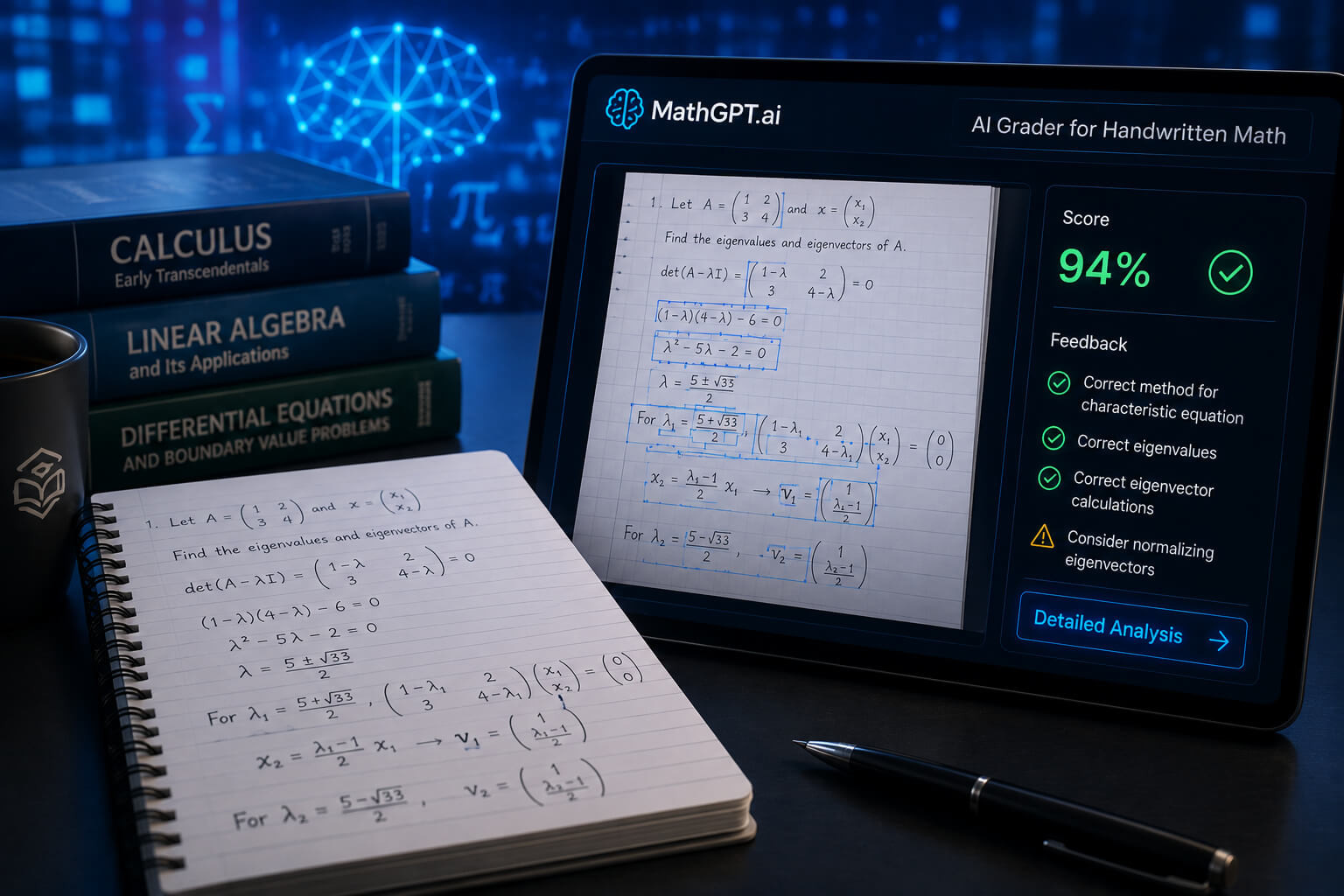
Artificial intelligence has already found its way into tutoring platforms, homework systems and course-management tools. MathGPT.ai is now taking on a messier problem: reading the actual steps students write on paper. With MathGPT.ai handwritten math grading, the technology aims to automate the process of evaluating students’ written mathematical work.
The education technology company has introduced a limited release of its AI Step-by-Step Grader, a tool built to evaluate handwritten mathematics assignments submitted by higher education students.
Rather than checking only whether the final answer is correct, the system analyzes the work that led to it. That means a student could still receive partial credit after making a calculation error near the end of an otherwise sound solution.
It sounds straightforward. Anyone who has graded several pages of handwritten algebra, calculus or mathematical proofs knows it is not.
The AI Looks at the Working, Not Just the Answer
Most automated homework systems work best when students type answers into structured fields. Multiple-choice questions are easy. A numerical answer is manageable. An unstructured proof written across a sheet of paper is another matter entirely.
MathGPT.ai says its new grader can process uploaded paper-based solutions and assess the individual steps within them. Faculty members can use the tool to evaluate how students approached a problem, even when the submitted answer turns out to be wrong.
The system applies a four-factor grading rubric. Instructors can adjust the weight assigned to each factor, giving them some control over how the platform calculates partial credit. The company has not publicly detailed every technical component behind the handwriting analysis or the four grading factors in its announcement.
That instructor control matters. Mathematics grading is rarely as clean as comparing one response with an answer key. Two students may use completely different methods and still reach a valid result. Another student may understand the main concept but lose points through a small arithmetic mistake.
The real test will be whether the AI can consistently recognize those differences.
Math Faculty Could Recover Hours Spent Grading
MathGPT.ai is pitching the Step-by-Step Grader as a workload tool as much as a student-learning product.
According to the company, educators can spend between 10 and 20 hours each week manually grading assignments. Its grader is designed to reduce that burden by analyzing handwritten submissions in minutes rather than requiring instructors to review every line themselves.
That claim will need to be measured in real classrooms, particularly across subjects with dense notation or complicated proofs. Handwriting quality alone could become an issue. So could unusual symbols, crossed-out work and solutions that jump between different parts of the page.
Still, the appeal is obvious. Automated grading does not need to replace instructors completely to be useful. Even a reliable first pass could flag likely errors, suggest partial-credit scores and leave faculty members to review uncertain cases.
That would be far more practical than asking educators to hand full control of grading to an algorithm.
Paper Assignments Are Making an Unexpected Comeback
There is a slightly ironic reason this product may find an audience.
As generative AI tools make online homework easier to complete without genuine understanding, some educators have returned to handwritten or in-class assignments. Paper creates friction. Students have to show their process, and instructors get a clearer view of how they reached an answer.
The problem is scale. Paper-based work takes much longer to grade.
MathGPT.ai is trying to sit between those two pressures. Students still complete and show their mathematical reasoning by hand, while AI handles part of the evaluation process afterward.
The company argues that this approach can support academic integrity because students receive credit for demonstrated reasoning rather than simply entering a final answer. It may also discourage direct answer copying, although no grading system can eliminate cheating on its own.
This is where the product becomes more interesting than another AI homework assistant. The software is not merely helping students solve problems. It is being placed inside the assessment process itself.
That brings greater responsibility. Accuracy, transparency and instructor oversight will matter considerably more when the output affects a student’s grade.
Students Receive Immediate Feedback on Their Mistakes
The Step-by-Step Grader also produces detailed feedback for students after reviewing their submissions.
MathGPT.ai says the system can identify calculation mistakes and help students understand where their solution went off course. In theory, that could reduce the familiar cycle of receiving a score, seeing a red mark and having little idea what needs to change.
Immediate feedback may also reduce routine emails and office-hour questions. A student who made a sign error halfway through an equation could see the problem quickly instead of waiting for an instructor to manually explain it.
There is a catch. Fast feedback is only valuable when it is accurate. A confidently incorrect explanation could confuse students or reinforce a flawed method. Institutions evaluating the grader will likely want evidence showing how often it interprets handwriting correctly and how reliably it handles alternative solution paths.
The company’s announcement does not provide an independent accuracy rate for the new grading feature. For now, its performance claims come from MathGPT.ai itself.
MathGPT.ai Is Building a Wider Instructor-Led Platform
The grader joins a broader MathGPT.ai platform that includes an assignment manager, textbook-based content and a conversational AI tutor.
The company describes the platform as instructor-led, with safeguards intended to prevent the tutor from simply revealing final answers. It uses Socratic-style questioning to guide students through problems and can integrate with learning management systems, according to its website.
MathGPT.ai says its technology has supported 1,200 courses across 150 higher education institutions and reached tens of thousands of students. Those adoption figures were supplied by the company and have not been independently verified in the announcement.
The Step-by-Step Grader is currently described as a limited release. MathGPT.ai has not disclosed a broad availability date or separate pricing for the feature.
AI Grading Will Need More Than Speed
Automating handwritten mathematics is a compelling use of multimodal AI. It also creates a long list of questions.
Can the system read poor handwriting? Will it understand unconventional but valid methods? How does an instructor challenge a questionable score? What happens when the model is uncertain? And will students know which parts of their grade came from AI analysis?
Those details will determine whether the grader becomes a trusted classroom assistant or another tool that creates extra checking work for faculty.
MathGPT.ai has identified a genuine pain point. College instructors want students to show their reasoning, but grading that reasoning takes time. An AI system capable of reviewing handwritten steps without flattening every problem into a single correct answer could be useful.
The difficult part begins after the product announcement: proving that the grader can be trusted when the handwriting is messy, the mathematics is complicated and the grade actually counts.
