


The AI race is no longer only about who builds the smartest model, the biggest data center, or the fastest chip cluster.
Now comes the harder question.
Who gets to set the rules?
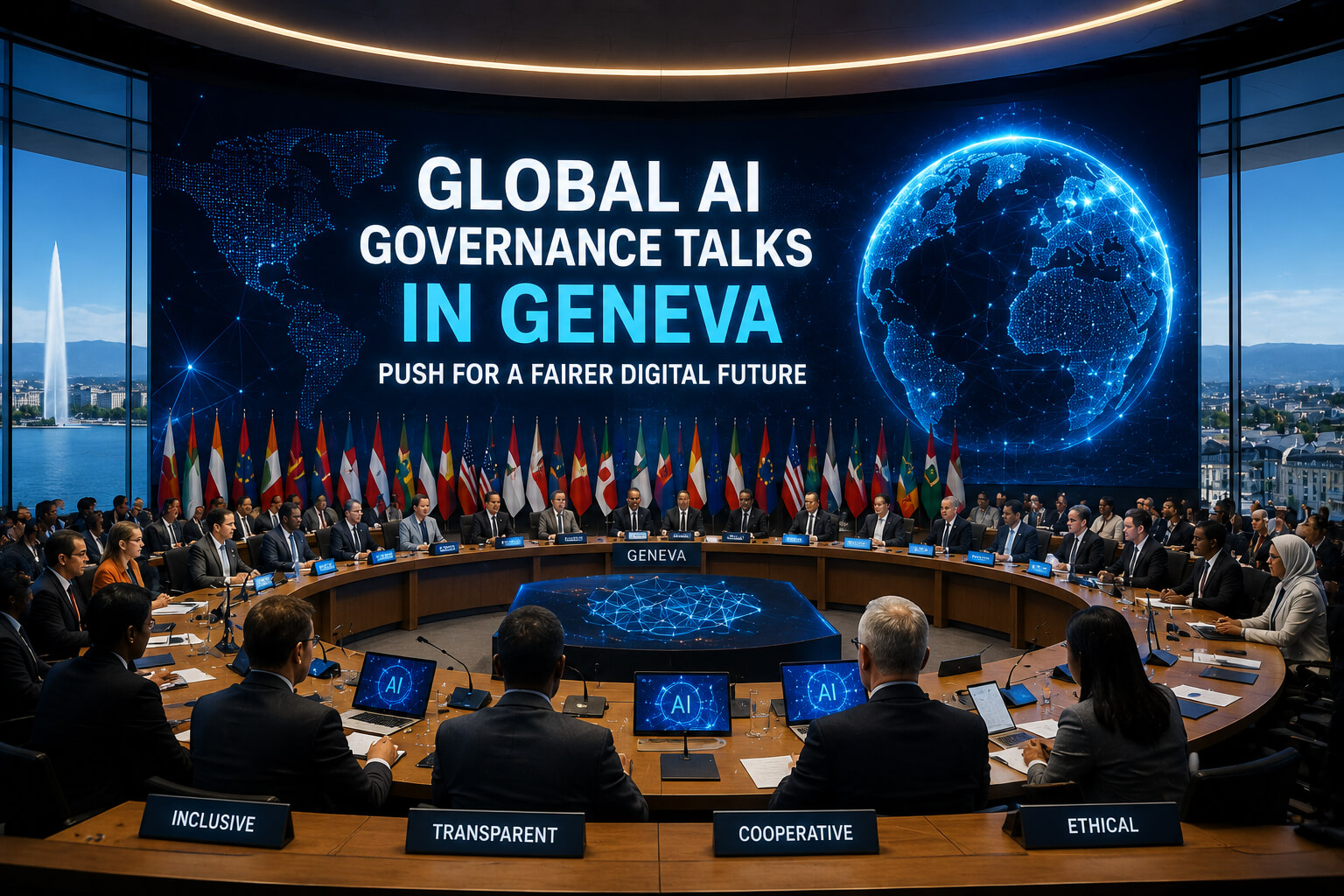
That is the issue sitting at the center of the Global Dialogue on AI Governance, taking place in Geneva on July 6 and 7, 2026. The talks bring together governments, member states, international organizations, private companies, academic experts, and technical communities as the world tries to shape a more coordinated approach to artificial intelligence governance.
Geneva Becomes the Center of the AI Governance Debate
The dialogue is jointly organized by UNESCO and the International Telecommunication Union, following a mandate from the United Nations General Assembly. It is also connected to the UN’s Global Digital Compact, which calls for stronger international cooperation on digital technology, including AI.
That sounds formal. Very UN. Very Geneva.
But the subject is not abstract anymore.
Generative AI is already changing cybersecurity, education, healthcare, public services, media, transportation, energy, and business operations. The technology has moved faster than many laws, institutions, and national strategies. That gap is exactly why global AI governance is becoming a serious international issue.
AI Benefits Are Not Guaranteed to Reach Everyone
One of the biggest themes of the Geneva talks is fairness.
AI has the potential to support economic and social development in areas such as health, education, agriculture, energy, and transportation. But that promise depends on whether countries can actually access the tools, infrastructure, skills, and policy voice needed to benefit from the technology.
Without that, AI could widen the digital divide instead of closing it.
Developing countries are expected to be a major part of the discussion, especially around capacity-building, knowledge-sharing, and access to AI applications. The concern is simple: if only a small group of powerful economies shapes AI standards, the rest of the world may end up following rules it had no real role in creating.
That would not be global governance. It would be digital hierarchy.
The Innovation vs Regulation Problem Is Getting Harder
The Geneva dialogue is also expected to focus on one of the most difficult balancing acts in AI policy: how to encourage innovation without letting risk run wild.
Too much regulation can slow useful development. Too little can leave societies exposed to cyberattacks, misinformation, privacy violations, automated discrimination, and unsafe AI deployment.
Participants are expected to explore shared principles around transparency, accountability, trust, and continuous risk assessment. These issues are becoming more urgent as AI systems evolve quickly and become harder for ordinary users, and even some institutions, to understand.
This is where the debate gets uncomfortable. AI governance cannot be a one-time document. It has to keep moving, because the technology does.
Cybersecurity Is Now One of the Biggest AI Governance Tests
Cybersecurity sits near the center of the discussion.
Technology and cybersecurity expert Dr. Mohammed Saeed Al Saqatri told Qatar News Agency that AI governance can help build an international rules-based order for responsible AI use, especially because digital threats do not respect national borders.
He warned that no country can manage these risks alone. AI is already being used by defenders to detect threats faster, analyze large datasets, and respond to incidents more accurately. At the same time, attackers are using AI for smarter phishing, adaptive malware, automated attacks, and deepfake-driven fraud.
That dual-use nature is the problem. The same technology can protect systems or break them.
AI Is Changing the Speed of Cyberattacks
Dr. Fath Al Aleem Ali Hija, Professor of Cyber Defense Studies at the Joaan Bin Jassim Academy for Defense Studies in Qatar, described AI as a force reshaping the cyber threat landscape itself. According to him, AI is changing the relationship between attackers and defenders, including how quickly attacks can be developed and how fast organizations must respond.
That matters because old cybersecurity models were not built for this pace.
AI can automate monitoring, detect anomalies, and improve situational awareness. But attackers can also use it to study targets, refine attacks, create convincing fake content, and adjust tactics based on defensive responses.
The result is a faster, messier, more automated cyber environment.
Sustainability Is Part of the AI Governance Conversation Too
The Geneva talks are not only about security and regulation. Sustainability is also part of the agenda.
AI’s growth depends on data centers, compute infrastructure, and energy-intensive systems. UN reports have pointed to concerns around data center energy consumption and the environmental impact of expanding AI technologies.
That adds another layer to the governance debate.
A fair digital order cannot ignore who gets access to AI infrastructure, who pays the environmental cost, and how digital resources are used responsibly.
Why These Talks Matter
The Geneva dialogue signals a shift in how the world talks about artificial intelligence.
AI is no longer being treated as only a technology issue. It is now tied to national security, digital trust, human rights, economic development, environmental sustainability, and international stability.
The expected outcome is not a single magic rulebook. That would be unrealistic.
The real goal is coordination: shared principles, stronger cooperation, better risk assessment, support for developing countries, and a governance structure that can keep up with a technology that refuses to slow down.
The stakes are high because AI is becoming part of the world’s basic digital infrastructure.
And infrastructure needs rules.
Not rules written by one country. Rules should not be shaped only by big tech. And they cannot arrive years too late.
Global AI governance is now moving from conference speeches into practical international policy work. Geneva is one step in that direction, and probably not the last.
