


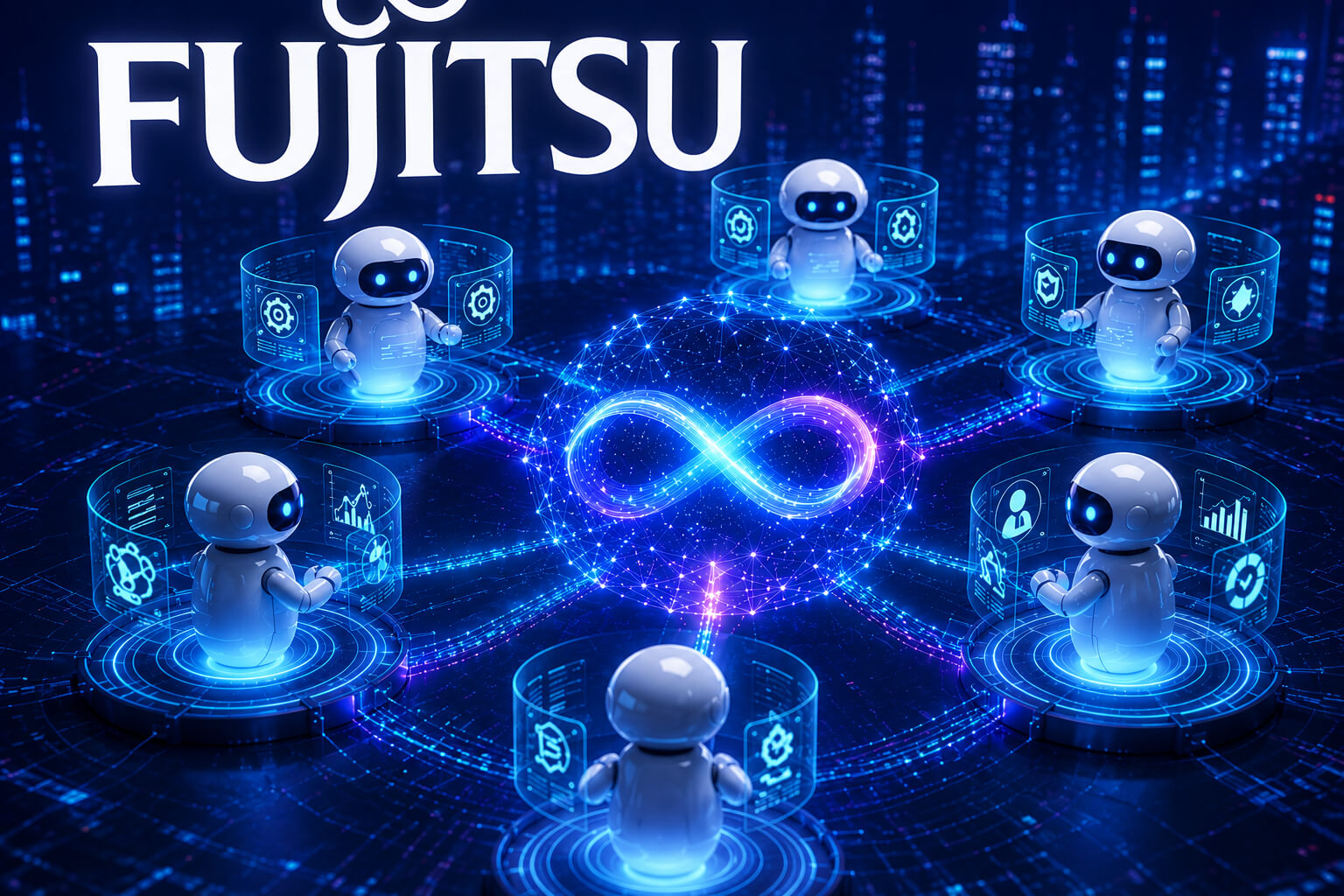
Fujitsu announced a major breakthrough in enterprise artificial intelligence with the launch of a new self-evolving multi-AI agent technology that continually learns, adapts, and improves based on actual business operations. The new system enables multiple AI agents to work as a team, collaborating to safely evolve through human feedback, operational results, and changing business environments.
The technology was announced on May 25, 2026, as part of Fujitsu’s wider push into advanced enterprise AI and autonomous business systems.
AI Agents That Learn and Improve Continuously
Fujitsu says traditional AI agents often fail to independently adapt when business requirements, regulations or operational processes change. Most enterprise AI systems still require experts to manually update prompts, search logic, and evaluation rules.
Fujitsu’s newly developed self-evolving multi-AI agent framework addresses this limitation by enabling AI systems to analyze successes and failures during task execution and convert those insights into operational improvements automatically.
The company says the technology allows AI agents to:
- Learn from human corrections and feedback
- Adapt to policy revisions and specification changes
- Improve prompts and evaluation methods autonomously
- Continuously optimize business workflows
Unlike conventional AI automation systems, Fujitsu’s approach focuses on “safe self-evolution,” ensuring AI changes are verified before being applied to future operations.
Fujitsu’s “Takane” AI Model Gets Major Performance Boost
One of the biggest applications of the technology is the enhancement of Fujitsu’s business-specific large language model (LLM) called “Takane.”
The company revealed that the self-evolving AI agents can automate the entire process of improving specialized LLMs, including:
- Data selection
- Learning condition adjustments
- Model evaluation
- Continuous optimization
Fujitsu tested the system across multiple industries including manufacturing, healthcare, finance, and public administration. The company reported an average accuracy improvement of 28 percentage points compared to the pre-specialized version of Takane.
In healthcare scenarios, the technology successfully extracted structured information such as diagnoses, disease progression stages, and treatment policies from unstructured medical records and clinical data.
AI for Large-Scale Enterprise Systems
Fujitsu also applied the self-evolving AI agents to document search systems for electronic health records and government platforms.
In the past, analyzing the impact of legal or policy changes in complex enterprise software required experienced specialists with deep knowledge of regulations and system architecture.
Fujitsu says the AI agents can now learn from previous searches, human corrections, and failed attempts. This allows them to improve search strategies automatically over time.
The AI agents also demonstrated advanced exploration techniques used by skilled professionals. These included reviewing related documents and uncovering hidden business relationships across systems.
Fujitsu Pushes Toward Sovereign AI
The company plans to integrate the new technology into its proprietary AI platform and expand its deployment across enterprise applications. Fujitsu also aims to combine the system with energy-efficient AI model technologies to support AI deployment in cloud, edge, and on-premises environments.
Fujitsu says its long-term goal is to create “sovereign AI” systems capable of continuously learning from real-world operations while remaining secure in highly confidential environments.
The company believes the technology could help solve major enterprise challenges, including:
- Shortages of skilled workers
- Regulatory adaptation
- Knowledge transfer
- Operational efficiency
By enabling AI systems to evolve alongside human workers, Fujitsu envisions a future where enterprise AI continuously improves business operations in real time.
Fujitsu is one of Japan’s largest digital services companies and continues to expand its investments in generative AI, autonomous agents, and AI-driven software development platforms.
For more Breaking AI news visit: https://breakingai.news
