


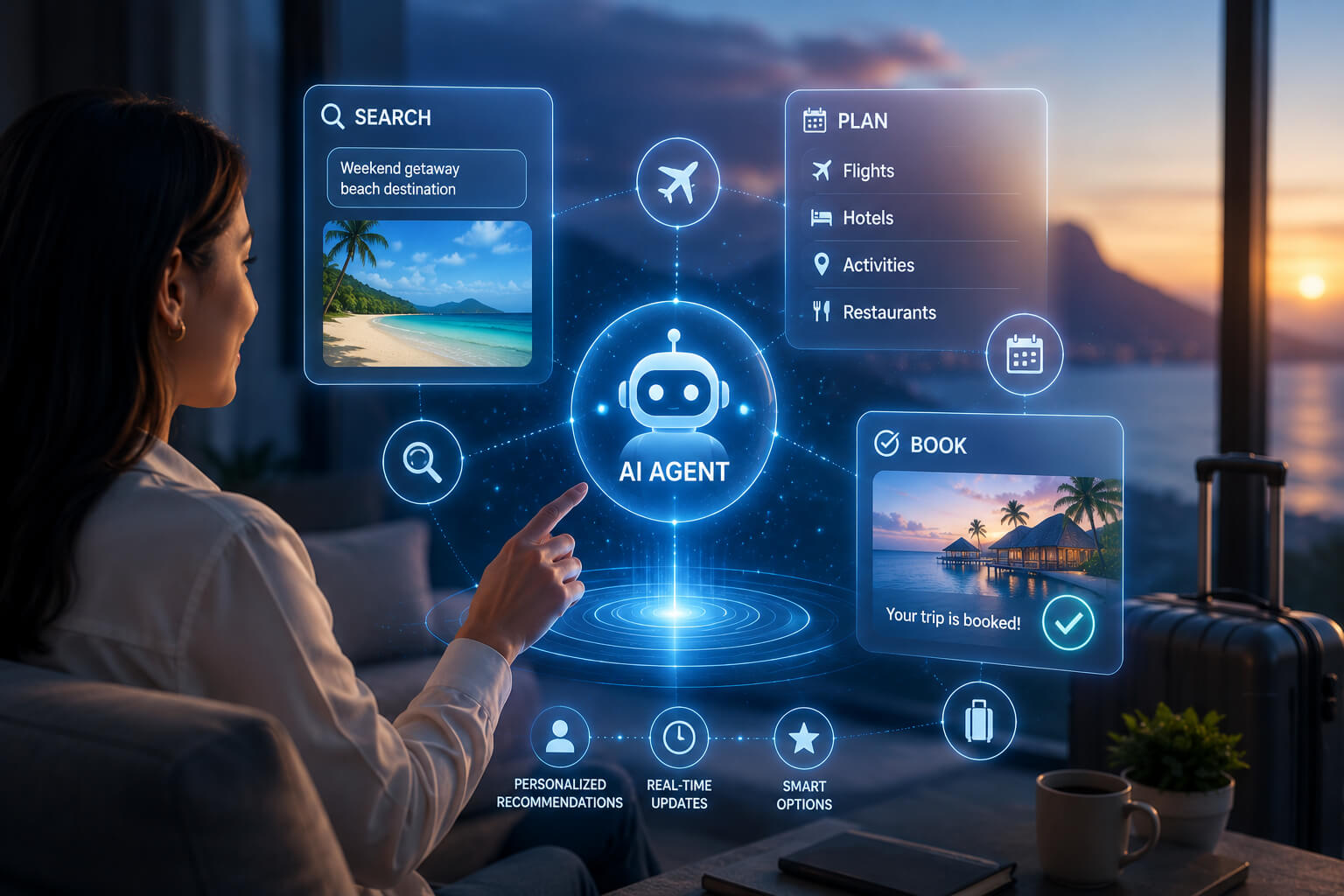
AI Agents Are Changing the Way Travelers Search, Plan, and Book Trips The traditional travel booking journey is evolving rapidly. For years, travelers followed a familiar path: search for inspiration, compare prices, read reviews, visit booking platforms, and finally book a flight, hotel, tour, or full itinerary.
Now, AI agents are disrupting that linear process.
Rather than spend hours scouring dozens of websites, travelers are starting to turn to intelligent AI systems that understand their intent, compare options, make recommendations, personalize itineraries and even take action on their behalf.
This change could revolutionize the way travel companies compete for attention online. In the age of AI agents, visibility may depend not only on search rankings, paid ads, or traditional booking channels. Rather, it might depend on a brand’s capacity to be understood, trusted, and selected by AI systems.
What Are Travel AI Agents
AI agents are autonomous systems that do tasks for users. While simple chatbots or generative AI tools generally respond with text, AI agents can carry out multi-step actions.
In travel that could be: Searching for destinations based on traveler’s budget and preferences Comparing flights, hotels, tours and experiences Creating personalized itineraries Answering booking queries Managing customer service requests Suggesting upgrades or add-ons Modifying plans based on real-time context The biggest difference is that travelers may no longer have discrete phases of discovery, planning, booking and personalization. AI agents could collapse those phases into one experience.
The Travel Funnel Is Becoming an AI-Powered Decision Layer
The old travel funnel was linear. A traveler searched, compared, booked, and then experienced the trip.
AI agents are making that process more fluid. A traveler might simply say, “Plan me a five-day beach trip in Asia under $1,500 with boutique hotels and good food,” and an AI system could instantly narrow the options, compare availability, recommend an itinerary, and guide the booking process.
This means the funnel is not just getting shorter. It is being replaced by an intelligent decision layer where AI understands user intent and acts upon it.
This poses a fresh challenge to travel brands – they need to ensure that their content, services, pricing, availability and customer experience are readable not just to humans, but also to machines.
Why Traditional SEO Might Not Be Enough
Search engine optimization has been a key traffic driver for travel brands for years. Hotels, airlines, tour operators, and travel platforms have leaned on keywords, backlinks, paid search, and content marketing to win customers.
But AI agents could disrupt the process of discovery.
If travelers start to rely more on AI systems to make decisions for them, brands may need to optimize for AI interpretation rather than search engine rankings, which means travel companies will need better structured data, clearer product information, accurate availability, helpful content and trustworthy digital signals.
In other words: the next chapter of travel SEO might be less about a ranking on page one and more about getting picked by an AI agent.
Travel Brands Need Machine-Readable Content
As AI agents become more involved in travel planning, travel brands need to make their information more accessible to AI systems.
This includes:
- Clear destination and property descriptions
- Accurate pricing and availability
- Structured data markup
- Detailed FAQs
- Transparent policies
- High-quality images and metadata
- Reviews and reputation signals
- Real-time updates
- Context-rich travel content
A hotel, airline or tour company might have a beautiful website, but if AI systems can’t properly understand what the brand is offering, that brand could become less visible in AI-powered travel recommendations.
AI Agents Might Change the Face of Travel Marketing
Travel AI agents may also change the nature of marketing. Instead of simply targeting human users with ads and content, brands may need to influence discovery systems powered by AI.
This does not mean brand storytelling disappears. In fact, strong brand identity may become even more important. But it has to be backed up with data, clarity, context.
For example, a boutique hotel can’t just say it offers a “unique luxury experience”. It might have to be specific about what makes it unique: location, amenities, room types, dining options, sustainability practices, guest ratings, nearby attractions, accessibility details, personalized services.
AI systems require some signals to match the right brand to the right traveler.
Human Travel Experts Still Matter
AI agents aren’t going to replace human travel advisors, hotel staff, or customer experience teams. But their roles might just change.
AI can take on repetitive tasks like answering common questions, comparing options, processing requests, and carrying out routine workflows. This frees up human subject matter experts to focus on higher-value work such as relationship building, complex problem solving, emotional intelligence, and personalized service.
Travel still requires human judgment. Many travelers still seek trust, assurance, taste and experience – especially for luxury trips, complex itineraries, group travel, destination weddings, corporate travel and high value bookings.
AI agents can eliminate friction, but humans can still deliver the emotional and strategic layer that tech can’t quite do away with.
Personalization to Become More Contextual
For years, personalization in travel was about past behavior, loyalty data, or customer profiles. AI agents could make personalization more dynamic.
AI systems could process real-time data about:
– Your current location
– Your travel reasons
– Weather
– Budget
– Time of day
– Number of people in your group
– Preferences
– Mobility needs
– Local events
– Past interactions
– Your current intentions
to make travel experiences more adaptive. For example, if a flight is delayed, the weather is bad or a better local experience presents itself, a traveler’s itinerary could change automatically.
Context could be a key competitive advantage for travel companies.
Smaller Travel Businesses Can Benefit Too
AI agents could also provide opportunities for smaller travel businesses. With the right tools, smaller operators can automate customer service, generate content, manage bookings, analyze data and personalize guests’ experiences more efficiently.
This could help independent hotels, local tour operators, boutique agencies and destination businesses compete with the big players.
But distribution remains a challenge. Creating an AI-ready travel product isn’t enough. Companies still need to ensure they are discoverable by the platforms, agents, and systems that travelers use.
The Future of Travel Discovery is Evolving
AI agents in travel herald a paradigm shift in the sector. Travelers may become increasingly reliant on intelligent systems that grasp their preferences and make choices on their behalf.
That means that the winners might not be the ones with the largest marketing budgets. They may be the ones with the clearest data, strongest context, best customer experience, and most AI-readable digital presence.
The travel funnel is not disappearing overnight, but it is evolving. Discovery, planning, booking and personalization are more connected than ever before.
For travel brands, the message is clear: the future of travel visibility will not only depend on being found by people. It will depend on being understood by AI.
Key Takeaway
AI agents are revolutionizing the travel experience from a manual search and booking activity to an intelligent, personalized and action-oriented one. As travelers turn to AI more and more for trip planning and booking, travel companies need to reimagine SEO, content, data and customer engagement in a world where machines are more and more making decisions.
