


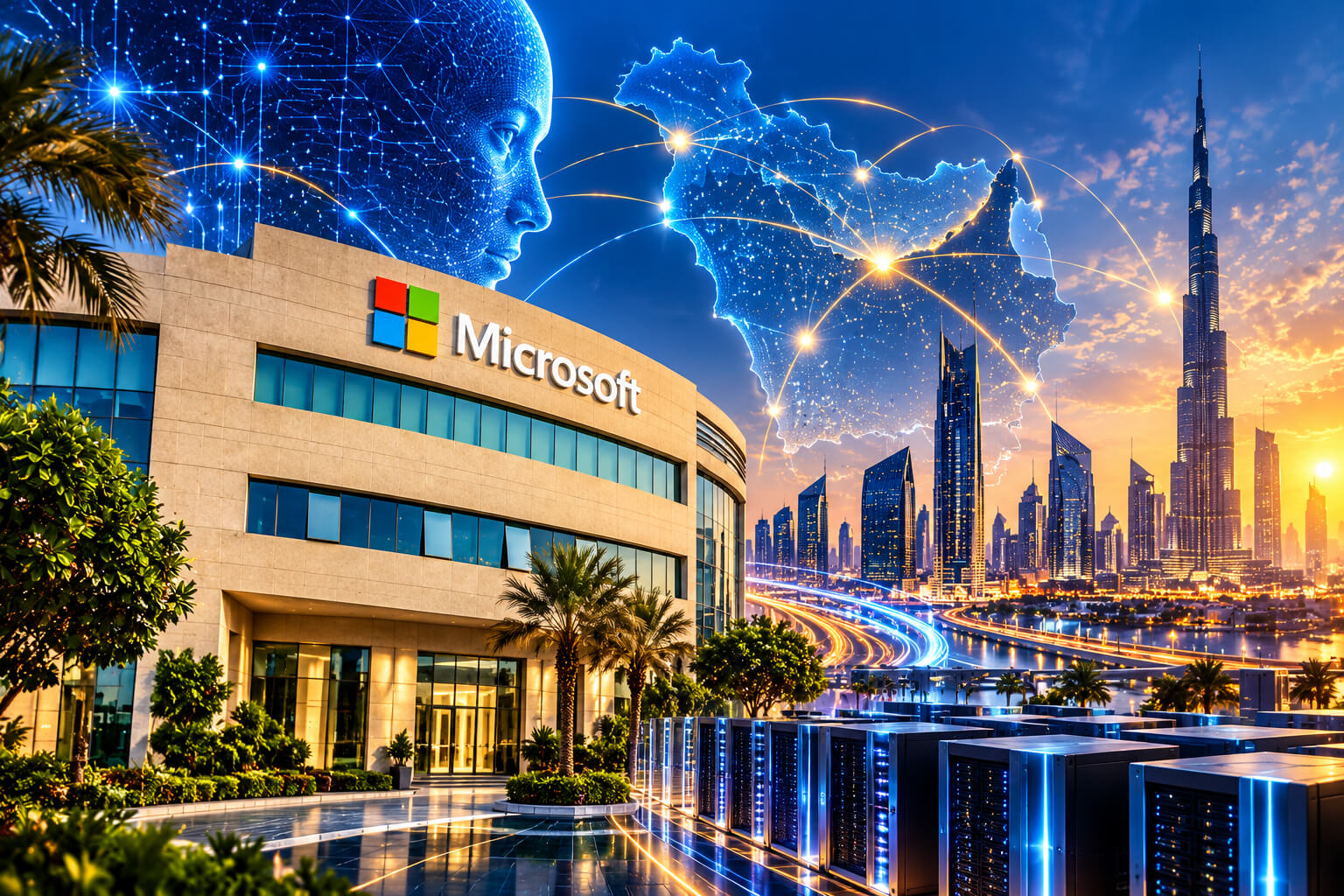
Microsoft is putting more money behind the Gulf’s fast-growing artificial intelligence ambitions.
The technology giant plans to invest more than $10 billion across the United Arab Emirates, Saudi Arabia, Qatar and Kuwait through 2030. The spending will cover AI infrastructure, cloud capacity, connectivity, cybersecurity, digital resilience and workforce development.
Around $2 billion of that total represents additional spending beyond previously announced commitments, including Microsoft’s major investment program in the UAE.
The announcement shows how quickly the Gulf’s AI race is moving beyond software. Data centers, subsea cables, cloud regions and national digital infrastructure are becoming just as important as the AI models running on top of them.
Microsoft’s Gulf Investment Will Exceed $10 Billion
Microsoft expects its capital and operating expenditure across the UAE, Saudi Arabia, Qatar and Kuwait to exceed $10 billion by 2030. The company said the investment will support its expanding cloud and AI infrastructure while strengthening its long-term presence across the four Gulf markets.
The total includes commitments Microsoft has already announced, particularly its large-scale spending plans in the UAE. The latest framework adds roughly $2 billion in additional regional investment, widening the company’s footprint beyond previously disclosed projects.
Microsoft has not broken down exactly how much each country will receive. Still, the wider direction is clear. The company is expanding its regional infrastructure while building closer relationships with governments, national AI companies and enterprise customers.
AI and Cloud Infrastructure Remain at the Center
A large portion of Microsoft’s investment will support cloud computing and AI infrastructure as Gulf countries accelerate national digital transformation programs.
The region has become one of the most aggressive markets for large-scale AI adoption, with governments investing heavily in computing capacity, national AI platforms and digital public services. Microsoft is positioning Azure and its wider AI ecosystem directly inside that expansion.
The strategy goes beyond simply adding servers. Large AI systems also require high-capacity networks, secure cloud environments, reliable data centers and strong connections between facilities. Microsoft’s investment reflects that broader infrastructure requirement.
More Than $400 Million Will Go Into Connectivity
Microsoft plans to invest more than $400 million in subsea and terrestrial connectivity across the Middle East by 2030.
That spending will build on existing regional infrastructure, including connections linked to the SeaMeWe-6 subsea cable system. The cable has landing points in several Gulf markets, including Qatar, Saudi Arabia and the UAE.
Connectivity rarely attracts the same attention as AI chips or data centers, but it is essential to the region’s technology buildout. More AI infrastructure means more data moving between cloud regions, companies, governments and end users.
Additional network routes can also strengthen resilience when a particular connection suffers an outage or disruption. That makes Microsoft’s connectivity investment both a capacity play and a reliability play.
Digital Resilience Becomes a Bigger Priority
Microsoft is also launching a dedicated Middle East Digital Resilience initiative as part of its broader Gulf strategy. The program will focus on helping governments and organizations identify vulnerabilities, improve business continuity planning and strengthen their ability to recover from digital disruption.
This marks a noticeable shift in the regional AI conversation. Building more infrastructure is one challenge. Keeping that infrastructure available during cyber incidents, network failures or wider regional disruption is another.
Microsoft is increasingly treating resilience as part of the AI infrastructure stack rather than a separate cybersecurity issue.
G42, HUMAIN and QAI Strengthen Microsoft’s Regional Position
Microsoft’s expansion will also rely heavily on partnerships with major regional AI organizations.
In the UAE, Microsoft already has a deep relationship with G42. The company invested $1.5 billion in the Abu Dhabi-based AI group in 2024, creating one of the most significant technology partnerships in the region.
In Saudi Arabia, Microsoft is working with HUMAIN, while in Qatar it is strengthening cooperation with QAI. Kuwait is also included in the broader regional investment framework through government and national technology initiatives.
These partnerships give Microsoft something that infrastructure alone cannot provide. They connect the company directly with government-backed AI strategies and national digital transformation programs.
Responsible AI Governance Expands Alongside Infrastructure
Microsoft is also increasing its involvement in responsible AI governance across the region. The company plans to expand work with the Responsible AI Future Foundation, which was developed with G42 and the Mohamed bin Zayed University of Artificial Intelligence.
The initiative focuses on areas such as AI governance, evaluation, responsible deployment and policy development. These issues are becoming more important as AI systems move beyond experimentation and into government services, enterprise operations and public-facing applications.
As adoption expands, questions around data sovereignty, privacy, accountability and model evaluation are becoming much harder to separate from infrastructure investment.
Cybersecurity Becomes Part of the Expansion
Cybersecurity is another major part of Microsoft’s Gulf strategy. The company plans to deepen cooperation with national cybersecurity authorities across the UAE, Saudi Arabia, Qatar and Kuwait. Dedicated cybersecurity specialists will work with local institutions to support national priorities and strengthen digital defenses.
The move reflects a wider change in how large AI projects are being designed. Governments and enterprises are no longer looking only at computing power. They are also examining how systems are protected, where data is stored, how services recover from disruption and how infrastructure is monitored.
That makes cybersecurity a core part of the region’s AI buildout rather than an additional layer added later.
Microsoft Targets AI Skills for More Than 4.2 Million People
Microsoft’s investment plan also includes a major workforce component. The company aims to provide AI and digital skills training to more than 4.2 million people across the UAE, Saudi Arabia, Qatar and Kuwait by 2030.
Its programs will target students, professionals, women, educators and workers entering technology-focused roles. That workforce push matters because infrastructure growth creates demand for people who can build, operate and secure increasingly complex AI systems.
Data centers can be constructed relatively quickly. Developing a large local talent base takes much longer. Microsoft appears to be investing in both at the same time.
Water and Energy Remain Important Infrastructure Questions
The expansion of AI infrastructure also brings environmental challenges. Microsoft says its regional strategy will support its sustainability goals, including water efficiency and the use of zero-water cooling technologies where feasible.
The company also plans to expand clean-energy procurement as its Middle East infrastructure footprint grows. That matters particularly in the Gulf, where high temperatures make cooling a major operational issue for large data centers.
AI infrastructure can consume significant amounts of power and water. As regional computing capacity expands, those engineering and sustainability challenges will become more difficult to ignore.
The Gulf AI Race Is Becoming an Infrastructure Race
Microsoft’s latest commitment points to a broader shift taking place across the Gulf. The first phase of regional AI growth focused heavily on models, partnerships and headline announcements. The next phase is becoming more physical.
Data centers, cloud regions, subsea cables, cybersecurity systems and sovereign infrastructure are now moving closer to the center of the discussion. Microsoft is positioning itself across nearly every layer of that ecosystem.
The additional $2 billion in spending is significant, but the structure of the wider investment may be even more important. The Gulf is not simply adopting AI products. It is building the infrastructure needed to operate AI at national and enterprise scale.
For Microsoft, that makes the region one of the most important emerging markets for long-term AI infrastructure growth.
Sources
Microsoft: “Microsoft Strengthens Its Commitment to the Middle East by Investing in Technology, Digital Resilience and People”
https://news.microsoft.com/source/emea/2026/09/microsoft-strengthens-its-commitment-to-the-middle-east-by-investing-in-technology-digital-resilience-and-people/
Middle East AI News: “Microsoft adds $2 billion to Gulf AI spending”
https://www.middleeastainews.com/p/microsoft-adds-2-billion-to-gulf
Reuters via Investing.com: “Microsoft plans $10 billion-plus Gulf investment with focus on resilience”
https://www.investing.com/news/stock-market-news/microsoft-plans-10-billionplus-gulf-investment-with-focus-on-resilience-4913619
