


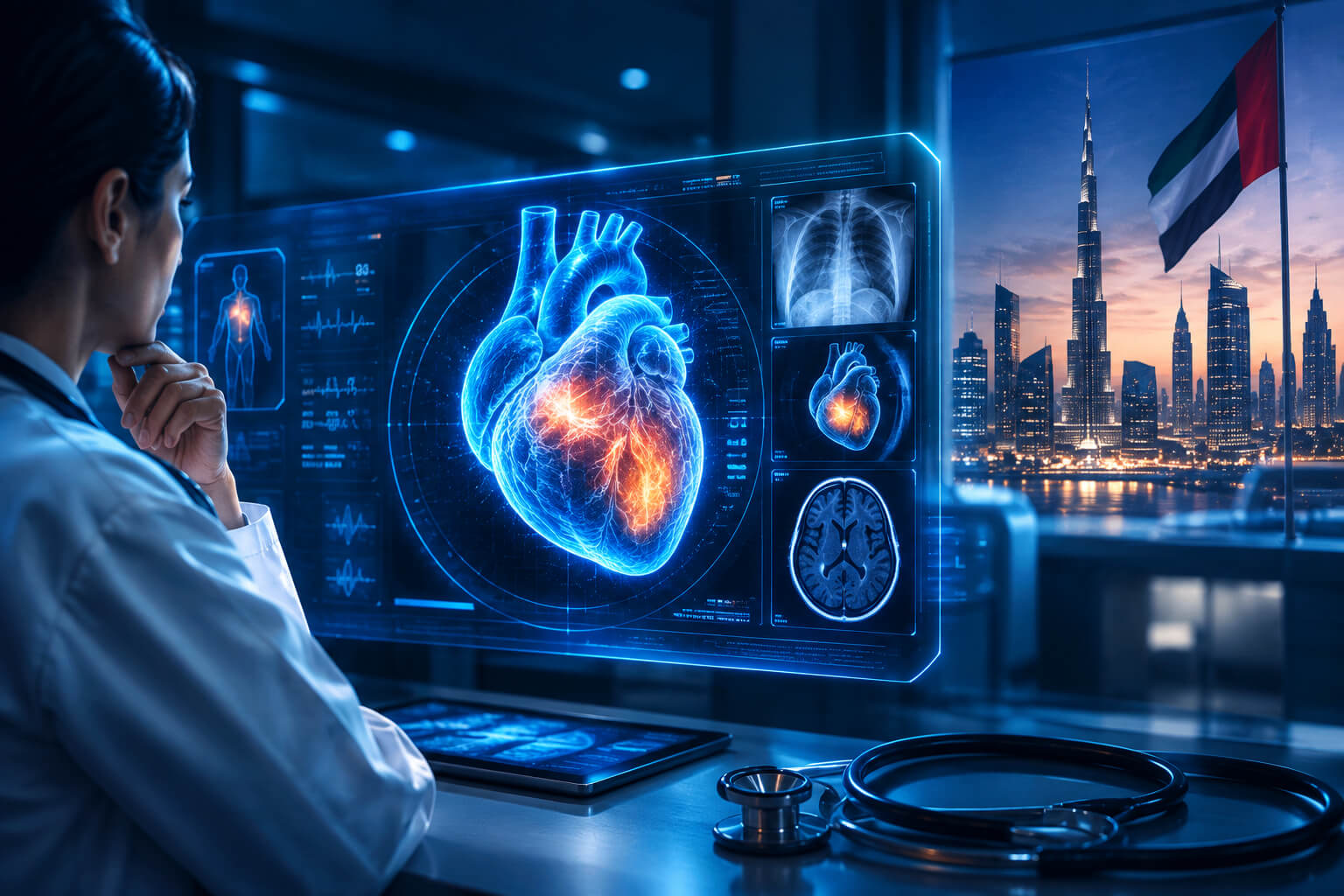
Artificial intelligence is moving deeper into the hospital — not as a chatbot sitting on a website, but inside the machines doctors already rely on to see what is happening inside a patient. AI-powered diagnostics in UAE hospitals are beginning to reshape the way medical professionals approach patient care and decision-making.
Aster DM Healthcare partnered with Fujifilm to introduce AI-enabled diagnostic, imaging and radiology systems across its healthcare network in the Gulf, with the UAE among the first markets targeted for deployment. The agreement was announced in October 2023 and was positioned as a significant expansion of AI-powered medical imaging in the region.
The interesting part isn’t simply that another healthcare company is “using AI.” Hospitals have been experimenting with algorithms for years.
This is about AI getting closer to everyday clinical equipment.
AI Is Moving Into the Radiology Room
Under the partnership, Aster and Fujifilm planned to introduce technology covering MRI, advanced CT scanning, 3D digital mammography, X-ray systems and C-arm imaging.
The systems were intended to give radiology teams more sophisticated tools for detecting and assessing medical conditions while improving the speed and efficiency of diagnostic workflows.
Medcare Royal Multi-Specialty Hospital was identified as an early location for the rollout, with the technology also planned for existing Aster and Medcare facilities in the UAE and Qatar. One Health, Fujifilm’s UAE distributor, was involved in implementing the project locally.
That distinction matters.
Healthcare AI often gets discussed as though a machine will suddenly replace the physician making the diagnosis. In practice, many of the systems appearing inside hospitals are far less theatrical. They analyse scans, flag suspicious areas, automate measurements or help clinicians work through enormous amounts of imaging data faster.
- The doctor remains in the room.
- The software gets another pair of eyes.
Why Medical Imaging Has Become a Natural Home for AI
Radiology produces exactly the sort of information modern AI systems are good at processing: huge collections of digital images containing patterns that can be compared across thousands or millions of previous examples.
An algorithm can potentially highlight something subtle on a scan before a radiologist reaches it. It can automate repetitive measurements. It can sort cases by urgency.
- None of that makes the technology infallible.
- It does make the economics rather obvious.
Hospitals constantly face pressure to handle more patients without sacrificing diagnostic quality. Radiologists, meanwhile, are expected to interpret growing volumes of increasingly complex medical imaging.
AI offers a way to attack that bottleneck.
The American Hospital Association has similarly identified diagnostics, operating-room optimisation, early detection of patient deterioration and other clinical workflows as some of the areas where hospitals see practical value from AI.
The UAE Has Become a Serious Test Bed for Healthcare AI
The Aster-Fujifilm project fits into a much larger technology push happening across UAE AI deployment.
The country’s health authorities and hospital groups have been steadily experimenting with AI for diagnostics, clinical decision support, patient monitoring and medical administration.
Abu Dhabi’s Department of Health, for example, has worked with Microsoft on AI and data-analytics initiatives aimed at personalised healthcare, clinical research and improved decision-making.
More recently, UAE providers have begun moving beyond conventional predictive algorithms toward generative and agentic AI systems capable of interacting with clinicians and patients.
Emirates Health Services has been exploring agentic AI that can engage patients before they see a clinician while operating within defined clinical boundaries.
Burjeel Hospital has also piloted evidence-grounded generative AI for clinical decision support, reflecting another emerging concern: hospitals want the speed of generative AI without clinicians quietly relying on unapproved consumer tools.
That may prove just as important as the algorithms themselves.
Faster Diagnosis Is Only Useful If Doctors Trust the System
Healthcare is an awkward place for the usual Silicon Valley mantra of moving fast and fixing mistakes later.
- A wrong restaurant recommendation is irritating.
- A wrong clinical recommendation is something else entirely.
So the next phase of AI adoption in hospitals will probably be less about who has the flashiest model and more about whether the system can show clinicians where an answer came from, protect patient data and fit naturally into existing medical workflows.
The technology also has to know when it doesn’t know.
That’s a much tougher problem than producing an impressive demo.
Research and policy discussions around healthcare AI increasingly emphasise maintaining clinician oversight, patient safety and human judgement even as automated systems take on more of the analytical workload.
AI in Hospitals Is Becoming Less Visible — and More Important
The biggest healthcare AI stories may eventually stop looking like AI stories.
- A radiologist notices a tumour earlier.
- A doctor spends less time searching through records.
- A deteriorating patient gets flagged sooner.
- A scan that once required several manual measurements gets analysed almost immediately.
- No robot doctor. No science-fiction operating theatre. Probably no dramatic moment at all.
- Just software quietly sitting inside the hospital workflow.
The Aster DM Healthcare and Fujifilm partnership was an early sign of that direction in the Gulf: AI shifting from experimental projects into the equipment and processes clinicians use every day. And that is where healthcare AI starts becoming considerably more interesting.
Sources
- Arabian Business — UAE hospitals to use AI to diagnose health issues
- Khaleej Times — Aster DM Healthcare and Fujifilm partner on AI-enabled diagnostics
- Medgate Today — Aster and Fujifilm introduce AI-enabled diagnostic solutions
- Department of Health – Abu Dhabi — AI-powered healthcare technologies
- Wolters Kluwer — Responsible AI adoption in UAE healthcare
