


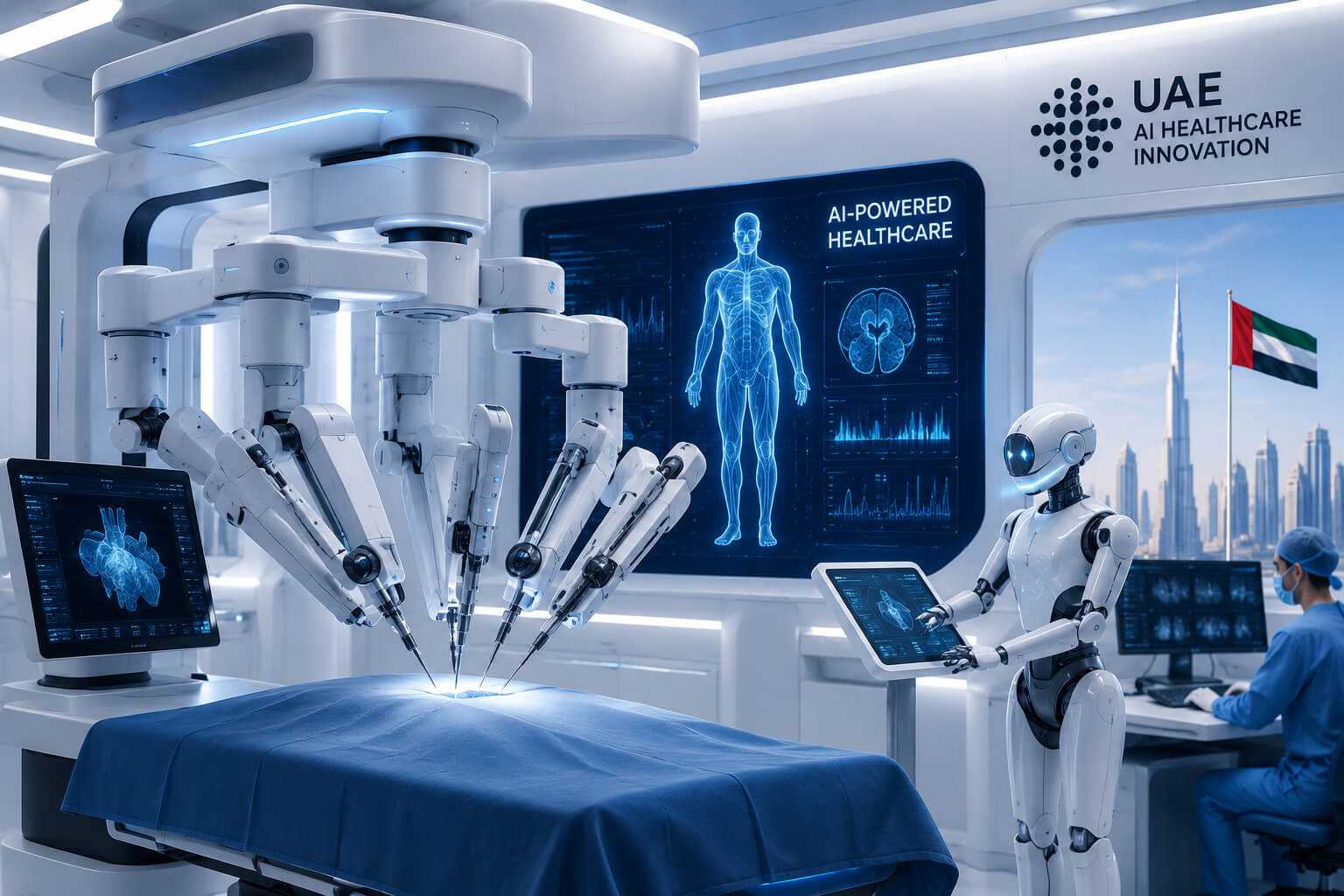
Medical robots are no longer sitting on the experimental edge of healthcare in the United Arab Emirates. They are drawing blood, assisting surgeons, dispensing medicine and helping patients walk again.
The UAE is expanding the use of robotics and artificial intelligence across hospitals as part of a wider push to build a smarter healthcare system. The rollout covers everything from minimally invasive surgery and joint replacement to remote ultrasound examinations and automated pharmacy services.
Some of the technology sounds futuristic. Much of it is already being used.
Robotic Surgery Is Giving Doctors More Control
Robotic-assisted surgery has become one of the most visible parts of the UAE medical robotics push.
At Cleveland Clinic Abu Dhabi, surgeons use advanced platforms including the da Vinci surgical system to carry out complex procedures through small incisions. The equipment provides a magnified three-dimensional view of the operating area while flexible robotic arms handle instruments inside spaces that can be difficult to reach using traditional techniques.
The robot does not operate independently. A surgeon controls every movement from a specialised console.
What changes is the level of precision. The platform filters natural hand tremors and converts the surgeon’s movements into smaller, steadier actions inside the patient’s body. For suitable procedures, this approach can reduce blood loss, post-operative pain and recovery time.
It is a practical example of where medical robotics makes sense: not replacing the doctor, but giving the doctor better tools.
AI-Powered Robots Are Also Drawing Blood
Even routine hospital procedures are beginning to look different.
Healthcare facilities under Emirates Health Services are using robotic blood collection systems supported by AI and infrared imaging. The technology creates a three-dimensional map of a patient’s veins, including those that may not be clearly visible to the human eye.
The system identifies a suitable vein and calculates the required needle depth before taking the sample. According to the Emirates News Agency, the process can reduce pain and bruising while cutting patient waiting times by as much as 50%.
Anyone who has experienced several failed needle attempts can understand the appeal.
This is not the most dramatic use of artificial intelligence in medicine. It may be one of the easiest for patients to notice.
Joint Replacement Gets Millimetre-Level Precision
Orthopaedic surgeons in the UAE are also using robotic systems for knee and hip replacement procedures.
These platforms create three-dimensional models from a patient’s CT scans. Surgeons can use those models to plan how much bone to remove and where to position the artificial joint.
During the operation, robotic navigation helps keep instruments within predetermined boundaries. The system can automatically stop an arm from moving outside the safe operating area, reducing the risk of damaging nearby tissue and ligaments.
The goal is not simply to make surgery look more advanced. It is to improve alignment, protect healthy tissue and make the procedure more consistent from one patient to the next.
Cardiac Robots Reduce Risk Inside the Operating Room
Medical robotics is also reaching cardiac care.
Al Qassimi Hospital uses robotic catheterisation technology to support procedures inside the arteries. Doctors operate through a digital control platform while robotic arms guide wires and stents with millimetre-level precision.
That added control may help reduce errors during delicate interventions. It can also limit the medical team’s exposure to radiation, since doctors do not need to stand as close to the imaging equipment throughout the procedure.
This matters because robotic healthcare is not only about improving patient outcomes. In some settings, it can also create a safer working environment for clinical staff.
Smart Pharmacies Are Handling Medicines in Seconds
Behind the scenes, automation is changing how hospitals manage prescriptions.
Robotic pharmacy systems operating in several UAE hospitals can store medicines, organise inventory, monitor expiration dates and prepare prescriptions. Electronic prescribing systems and barcode verification help ensure that the correct medicine reaches the correct patient.
Once a prescription enters the system, a robotic arm retrieves the medicine from a smart storage facility and delivers it within seconds.
There is nothing flashy about checking expiry dates or finding a box of tablets on a shelf. Those repetitive jobs, however, are exactly where automation can reduce avoidable mistakes and free pharmacists to spend more time on patient-facing work.
Remote Ultrasound Could Bring Specialists to Isolated Areas
The UAE’s medical robotics strategy stretches beyond major urban hospitals.
Remote ultrasound robots can allow a specialist to examine a patient from another location. A robotic arm at the patient’s side mirrors the doctor’s hand movements through a high-speed communication network while examination images are transmitted in real time.
The system could prove particularly useful in mountainous or remote communities where specialist services are harder to reach. Instead of travelling long distances for an initial examination, patients may receive diagnostic support closer to home.
This is where robotics begins to overlap with telemedicine. The doctor remains remote, but the technology provides a physical connection to the examination room.
Robotic Exoskeletons Are Supporting Rehabilitation
Rehabilitation is another area where the technology is becoming more physical and personal.
Robotic exoskeletons are being used to help some patients recovering from strokes, paralysis and serious mobility problems practise standing and walking. Sensors inside the wearable system track muscle signals and body movement, while electric motors provide additional support around the joints.
The equipment does not instantly restore movement. Rehabilitation rarely works that way.
Instead, the robotic suit helps patients repeat controlled movements while maintaining balance and reducing the risk of falling. Over time, those repeated exercises may support strength, coordination and confidence.
The UAE Is Building a Wider AI Healthcare System
Taken individually, these projects can look like separate technology upgrades. Together, they show something larger.
The UAE is moving medical robotics into several parts of the patient journey: diagnosis, surgery, treatment, medication and recovery. AI helps interpret information, identify patterns and guide equipment, while robotic systems carry out highly controlled physical tasks.
Doctors, surgeons, nurses and pharmacists still make the important clinical decisions. That distinction matters. The current model keeps medical professionals in charge while using machines to improve accuracy, consistency and speed.
The harder work comes next. Hospitals will need to maintain expensive systems, train clinical teams and make sure patients understand when and why robotic technology is being used.
Still, the direction is clear. In the UAE, medical robots are becoming part of ordinary healthcare rather than an occasional demonstration of what might be possible one day.
